

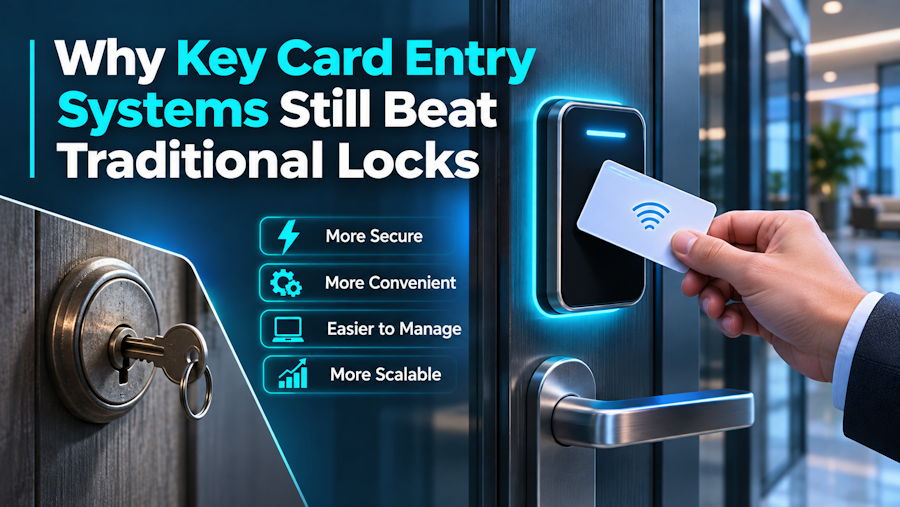
A traditional lock keeps an honest promise, but only for a short time. It opens for anyone holding the right key and stays shut for everyone else. That works until a key goes missing, an employee leaves without returning theirs, or you realize you have no idea how many master copies are floating around. At that point, the only real fix is to call a locksmith and rekey the whole door, which gets expensive fast across a building full of them.
This is where electronic access earns its keep. A key card entry system replaces the metal key with a programmed credential and a reader that checks it against a live set of permissions. The difference is control. You decide who can open which door, during which hours, and you can change your mind in seconds without touching the hardware.
For any business with more than a handful of employees, shifting from physical keys to managed credentials solves problems traditional locks were never built to handle. Here is where the gap shows up most.
You Can Revoke Access Instantly
Lose a mechanical key, and anyone who finds it can open the door until you rekey the lock. You can't tell the lock to stop trusting that one key while still honoring the others.
A card credential works the other way around. The moment a card goes missing, or an employee walks out, you deactivate it in software, and it becomes a worthless piece of plastic. The door it used to open now refuses it, while every other credential keeps working. With a cloud-based setup, you can do this from your phone the moment you learn a card is gone, and the hole closes that same afternoon.
Every Door Keeps a Record
A traditional lock tells you nothing. It opens, closes, and remembers nothing about who turned the key or when. After an incident, you are left guessing.
A card system logs every attempt, successful or not. You get a timestamped record of which credential opened which door, which lets you answer the questions that matter during a security review or an investigation:
- Who reached the server room over the weekend
- Whether a former employee’s card still shows activity
- Which entrances see traffic during hours they should sit empty
- When a specific person entered and left the building
This audit trail becomes essential the first time a compliance auditor or an incident forces you to prove who went where. A pile of keys cannot produce that report.
Permissions Bend to Fit Your Building
With metal keys, access is blunt. Either someone has the key, or they don't, and giving one person entry to a sensitive room often means cutting a key they can copy. Layering access levels creates a tangle of masters and sub-masters that nobody fully understands within a year.
A card system handles the same job as a settings change. One credential can open the lobby and the parking gate but not the finance floor. Another can reach a lab during business hours and nowhere after six. When someone changes roles, you adjust their access group without issuing anything new.
Temporary access gets cleaner too. A contractor or delivery driver can receive a credential that expires on its own, avoiding the common problem of a permanent key being handed out and never collected.
A Few Things Worth Settling Up Front
Card systems reward a little planning. When you evaluate one, it helps to pin down a few details early:
- Reader flexibility: A multi-technology reader accepts proximity, smart card, mobile, and PIN credentials on one unit, so you can adopt stronger credentials later without swapping hardware at every door.
- Lock fail mode: Confirm whether each lock unlocks or stays locked when power drops. Fire code typically requires one for most exits; high-security rooms may require the other.
- Credential strength: Older proximity cards are cheap but easy to clone. Encrypted smart cards and mobile credentials authenticate with the reader before the door opens, making them much harder to copy.
The Bottom Line
Metal keys are simple, and that simplicity is exactly what leaves so much uncovered. They cannot be switched off, they keep no record, and they cannot tell one person’s access apart from another’s. A key card system requires a little more upfront thought and returns control, accountability, and room to grow. For a growing business, that trade is an easy one to make.

