

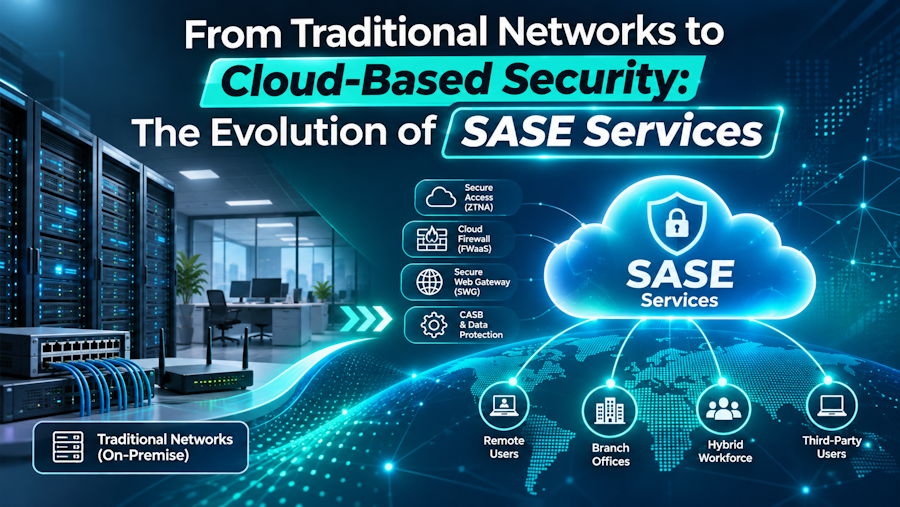
For three decades, enterprise security had a clear geography. Applications lived in a company-owned data centre, staff worked from offices joined by private circuits, and a stack of appliances at the network edge inspected everything moving in or out. The model held because the assets worth protecting and the people who needed them sat in predictable places. Neither assumption survives in a modern organisation, where workloads run across several public clouds and much of the workforce rarely connects from a corporate desk. What replaced the perimeter grew out of a decade of partial fixes that stopped fitting together.
Why the Perimeter Security Model Reached Its Limits
The clearest symptom was backhauling. Once an application moved to a cloud platform while inspection stayed in the data centre, traffic from a branch office travelled to headquarters, passed through the appliance stack, then went back out to the internet. Users absorbed the delay and network teams absorbed the bandwidth cost. Demand for consolidated SASE services for distributed networks came directly out of that friction, because adding another appliance at the edge did nothing about the routing problem underneath it.
Remote access aged just as badly. Concentrators sized for a fraction of staff were asked to carry everyone, and the trust assumption behind them was generous: a device that completed a tunnel handshake was often treated as though it sat inside the building. Security teams ended up maintaining one policy set for the private network, another inside each cloud account, and a third for anyone working off-network. Reconciling those three during an incident was slow enough that most teams simply accepted the gaps as a cost of business.
SD-WAN, CASB and Web Gateways: A Decade of Partial Fixes
Software-defined wide-area networking was the first serious answer. By separating routing decisions from fixed circuits, it lets branches use broadband or mobile links and steer traffic by application rather than by destination address. That solved connectivity and left inspection untouched.
Cloud access brokers, web gateways and identity-aware proxies each closed a specific gap after it. Every purchase was defensible on its own, but together they produced overlapping agents, separate consoles and policy logic no single team owned. Industry analysts named the convergence of these functions in 2019, describing one cloud-delivered service that combined wide-area networking with security enforcement applied close to the user.
Core Components: SD-WAN, ZTNA, SWG, CASB and FWaaS
A credible platform brings together a defined set of capabilities rather than a loose bundle of licences:
- Software-defined wide-area networking for path selection and link resilience
- Zero trust network access that authorises requests to named applications instead of whole subnets
- Web gateway and cloud application controls for outbound traffic
- Firewall inspection delivered as a service at every point of presence
- Data loss prevention and inline threat analysis sharing one policy engine
Convergence is not a feature count. The value lies in evaluating identity, device posture and destination once, through a single engine, wherever the user happens to be sitting. Industry standards bodies have since published a standardised set of service attributes describing the behaviours a subscriber should expect regardless of how a provider implements them, which gives buyers something firmer than marketing language to compare.
Zero Trust: From Location-Based Trust to Continuous Evaluation
The deeper shift is from location-based trust to continuous evaluation. Published design principles for zero trust start from the position that threats exist both inside and outside traditional network boundaries, and direct that every user, device, workload and data flow be treated as untrusted, with the access decision made for each individual request and repeated during extended access. In practice, a contractor on an unmanaged laptop and an engineer on a compliant device can request the same application and get different answers. A session can also be reassessed mid-flight when posture changes, which is impossible to express in a model where access is granted once at the tunnel and never revisited.
This changes daily work more than most migration plans admit. Troubleshooting moves from packet captures at a chokepoint to reading policy decision logs, change control shifts from appliance maintenance windows to version-controlled policy, and skills that stayed separate for years begin to overlap.
Perimeter Appliances vs Cloud-Delivered SASE Services
| Dimension | Perimeter appliance stack | Cloud-delivered enforcement |
|---|---|---|
| Traffic path | Backhauled to a central stack | Inspected near the user |
| Trust basis | Network location after a handshake | Identity, device state, per request |
| Policy sets | One per network, cloud and tool | One engine across all paths |
| Capacity | Sized and bought years ahead | Scaled by subscription |
| Change control | Device maintenance windows | Version-controlled policy |
| Dependency | Spread across several suppliers | Concentrated in one provider |
Provider Dependency and Phased Migration Trade-Offs
Consolidation concentrates dependency. Enforcement moves to a provider’s points of presence, so geographic coverage where staff actually work matters as much as the capability list. A platform that mediates every access decision also becomes a single point of failure worth planning around, which is an argument for understanding its regional failover behaviour before signing rather than afterwards.
Phased adoption works better than replacement. Most organisations begin by moving remote access off legacy concentrators, since that is where the trust model is weakest and the user benefit is immediate. Branch connectivity follows, then inspection for internet-bound traffic, and finally internal application access. Running old and new paths in parallel costs more initially but protects the migration from one bad policy change. The parallel period should have an end date attached to it, because a fallback left running indefinitely preserves the exposure the project set out to remove.
Conclusion
The move from perimeter hardware to cloud-delivered enforcement was driven by a change in where applications and people actually are, not by a change in security fashion. Convergence matters because it ends the drift between disconnected policy sets, and continuous evaluation matters because a completed handshake was never good evidence of trustworthiness. Organisations that treat this as an architectural decision, with honest attention to provider dependency and phasing, tend to gain both performance and security. Those treating it as a procurement exercise usually inherit the same fragmentation in a new location.
Frequently Asked Questions
Are SASE services only suitable for large enterprises?
No. Mid-sized organisations often benefit sooner, because they rarely have staff to run several separate security stacks. The relevant question is how distributed the workforce and applications are, not headcount.
Do SASE services require discarding existing network hardware?
Not immediately. Branch routers and firewalls usually remain in place through a phased rollout, handling local segmentation while inspection and access control shift to cloud enforcement points. Hardware is retired as circuits and contracts come up for renewal.
How do SASE services differ from a VPN plus a web gateway?
A VPN grants network-level access after one authentication event, and a separate gateway applies its own rules. Converged delivery evaluates identity, device state and destination together on every request, under one policy, authorising access per application.
What should be measured after a SASE deployment?
Track application response times at sites that previously backhauled traffic, the number of distinct policy sets in use, time to apply a policy change everywhere, and how many access decisions reference device posture rather than network location.

