

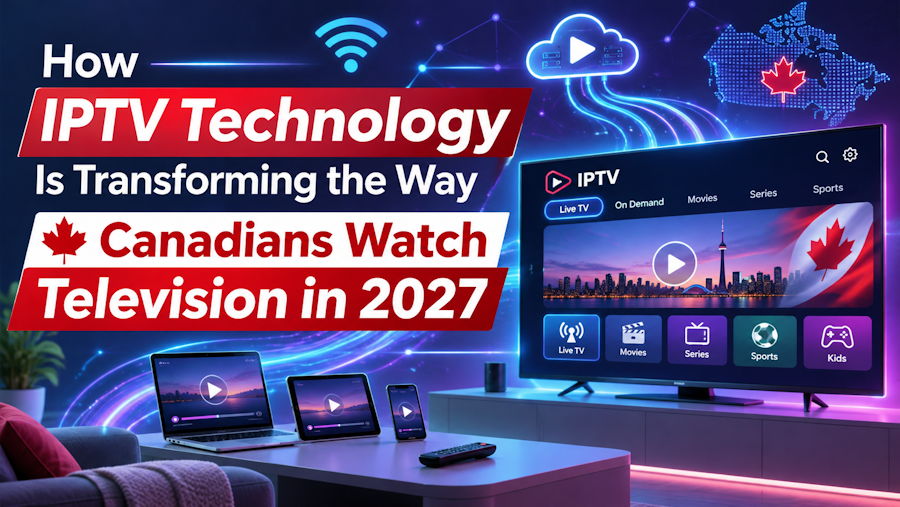
The Canadian television industry is undergoing a significant transformation as more households explore internet-based entertainment. Traditional cable and satellite services are no longer the only options for accessing television, movies, sports, and on-demand programming.
With improvements in broadband infrastructure, smart devices, and streaming technology, Internet Protocol Television (IPTV) is becoming an increasingly practical alternative for Canadian viewers.
Understanding the Technology Behind IPTV
IPTV stands for Internet Protocol Television, a technology that delivers television content through internet protocol networks rather than traditional cable or satellite signals.
Unlike conventional broadcasting, IPTV systems can deliver content directly to compatible devices through managed networks or internet-based streaming platforms.
Modern IPTV technology supports several types of entertainment:
- Live television broadcasting
- Video on demand (VOD)
- Electronic program guides (EPG)
- Time-shifted television
- High-definition and 4K streaming
Canadians exploring IPTV Canada services can compare different subscription options, device compatibility, programming languages, and streaming features before choosing a provider.
Why Internet Infrastructure Matters for IPTV
Canada's expanding fibre-optic and high-speed internet infrastructure has created better conditions for internet-based television.
However, streaming performance depends on more than download speed. Network stability, latency, Wi-Fi coverage, server capacity, and video compression all influence the viewing experience.
As a general starting point, viewers should consider the following connection speeds:
- Standard definition: 3–5 Mbps
- High definition: 10 Mbps
- Full HD: 15 Mbps
- 4K Ultra HD: 25 Mbps or higher
Households using multiple connected devices simultaneously may require additional bandwidth.
An Ethernet connection can also provide greater stability than Wi-Fi, particularly when streaming high-resolution content.
The Role of Video Compression and Streaming Protocols
Modern streaming platforms rely on video compression technologies to deliver high-quality content efficiently.
Codecs such as H.264 and H.265 reduce the amount of data required to transmit video. Adaptive bitrate streaming, when supported, allows video quality to adjust according to available bandwidth.
These technologies help improve streaming efficiency and reduce interruptions caused by changing network conditions.
Content delivery networks and distributed server infrastructure can also help streaming platforms manage demand during peak viewing hours.
IPTV Compatibility Across Modern Devices
One of the main advantages of internet-based television is its flexibility across different operating systems and devices.
Depending on the provider and application, IPTV can be accessed through:
- Samsung and LG Smart TVs
- Amazon Fire TV Stick
- Android TV and Google TV
- Apple TV
- Android and iOS smartphones
- Windows and macOS computers
Some IPTV applications support M3U playlists or Xtream Codes authentication, while others use dedicated applications.
Before subscribing, users should confirm that their preferred service supports their devices and operating systems.
Choosing an IPTV Subscription in Canada
Selecting an IPTV provider involves more than comparing channel counts or subscription prices. Canadian consumers should evaluate streaming stability, customer support, content availability, device compatibility, and subscription transparency.
In Ontario, households across Toronto, Ottawa, Mississauga, Brampton, and Hamilton are exploring internet-based television as an alternative to traditional cable. Consumers comparing IPTV Ontario services should consider regional programming, subscription costs, internet speed requirements, and compatibility with their preferred streaming devices.
OneIPTV offers different subscription options for Canadian households interested in internet-based entertainment. Testing a service before committing to a long-term subscription can help viewers evaluate streaming performance and available programming.
Consumers should also verify that their chosen provider has the appropriate rights to distribute the content it offers.
Security and Privacy Considerations
As with any internet-based service, security should remain a priority when choosing an IPTV platform.
Users should download applications from trusted sources, protect their login credentials, and verify the provider's privacy and payment policies.
IPTV technology itself is legal in Canada. However, the legality of individual services depends on whether they have the necessary authorization to distribute copyrighted programming.
Choosing authorized services helps protect consumers and supports the entertainment industry.
The Future of IPTV in Canada
Looking ahead to 2027, internet-based television is likely to continue evolving alongside improvements in broadband connectivity, video compression, and smart television technology.
More efficient streaming protocols, personalized content recommendations, and improved device integration could make digital television increasingly convenient.
For Canadian households, the transition toward internet-based entertainment represents an opportunity to explore more flexible viewing options while choosing services that meet their technical, financial, and entertainment needs.
Conclusion
IPTV is changing how television content can be delivered and consumed across Canada. Its combination of internet connectivity, device flexibility, and modern streaming technology makes it an important part of the evolving digital entertainment landscape.
By understanding the technology behind IPTV and carefully evaluating available providers, Canadian viewers can make better decisions about their home entertainment setup in 2027 and beyond.

