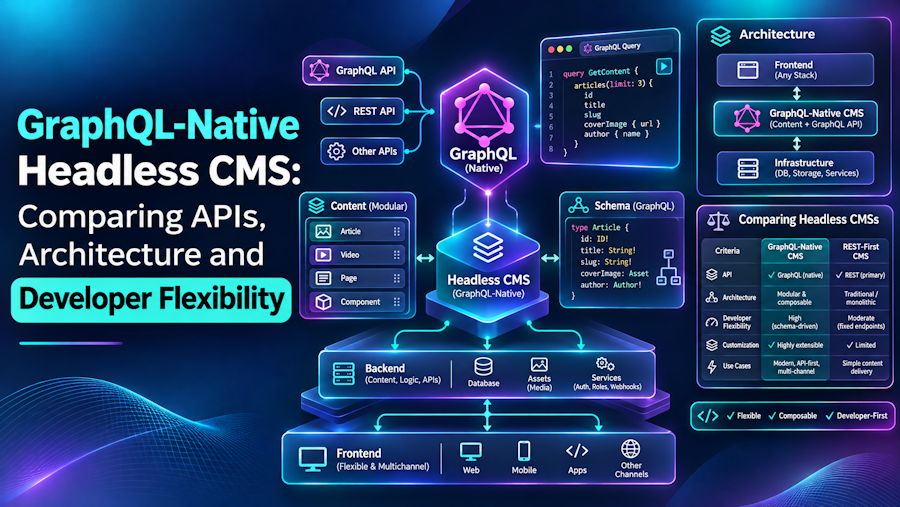
When a company considers switching to a headless CMS, the market offers plenty of options. At first glance their capabilities seem similar. Yet, some platforms provide REST APIs, others use GraphQL and some support both. Plus, some solutions are designed around GraphQL, right from the start. Others follow a different, REST-first architecture and offer GraphQL as an additional API layer. Sure, both approaches allow developers to query content with GraphQL. But, they can differ in schema design, query flexibility, integration capabilities. So, in this article, we'll compare GraphQL-native CMS platforms, their architecture and integration options, so you could choose the best GraphQL content management system for your case!
What Is a GraphQL-Native CMS?
Let's take an example here. An international retail chain has e-commerce websites in Germany, Austria and Switzerland. All three markets use a shared product catalog. Each website also gets localized descriptions, product specs, prices and stock. In this case:
- Headless CMS stores editorial content, localized descriptions, promo materials.
- Product Information Management manages product attributes, technical specs, sizes.
- Digital Asset Management stores product images and other media files.
- ERP manages prices and product availability.
So when customers open a product page, frontend needs to reach all these sources and collect right product details. The question is HOW the app will access this data.
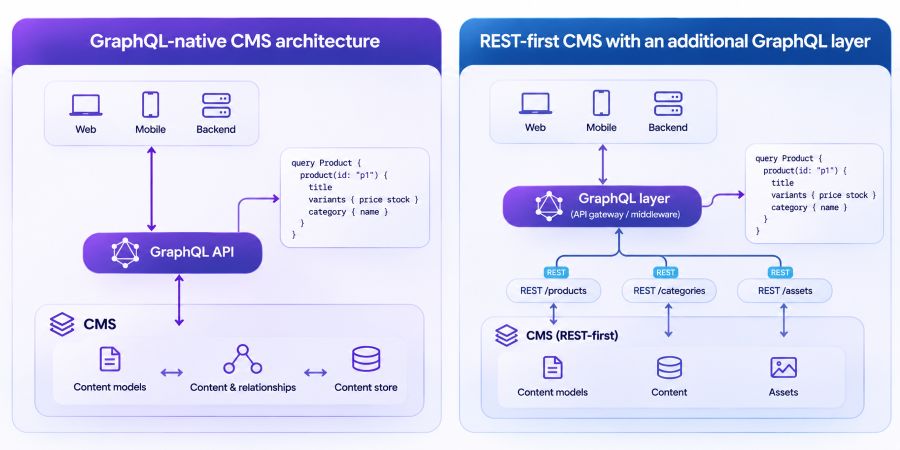
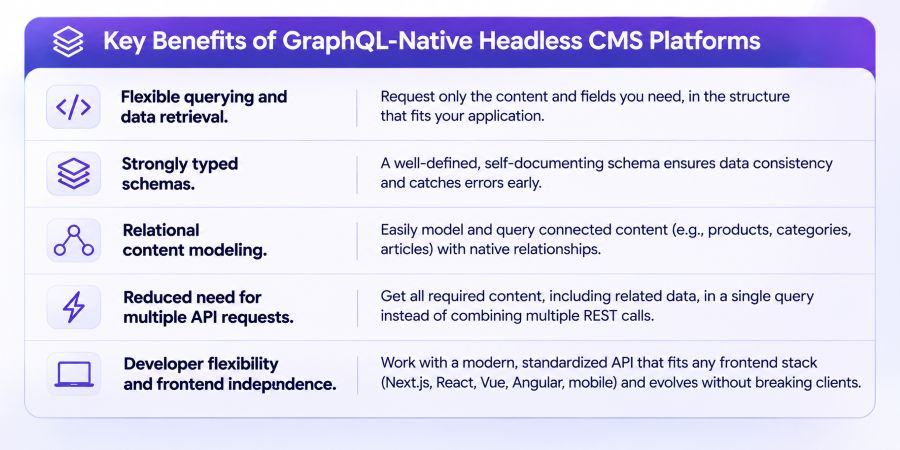
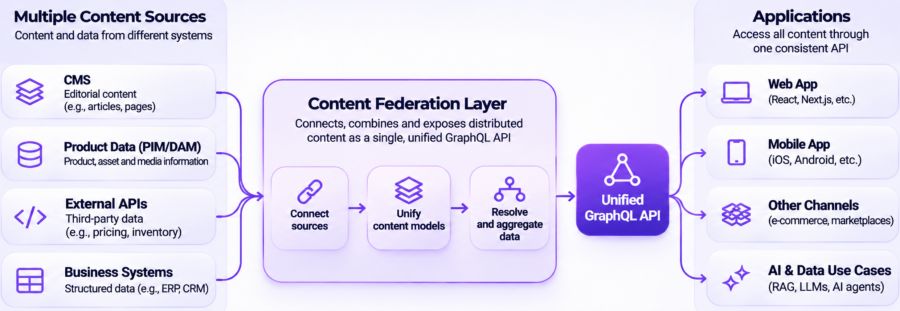
For a GraphQL-native CMS, GraphQL is a core part of its content architecture. Its content models, relationships and API schema are designed to work together. You define content types like Product, Brand, Category here and establish relationships between them. The CMS exposes these fields and relationships through its GraphQL schema. Some GraphQL-native CMS platforms provide Content Federation or similar capabilities to connect external data sources and expose selected information through the CMS's GraphQL API.
GraphQL-Native vs. REST-First CMS
If it’s a REST-first CMS, the platform is originally designed around REST endpoints. The frontend retrieves content through predefined resources, these could be categories or brands in our case. Actually, some REST-first platforms later add a GraphQL API. Here, GraphQL is an additional layer but within an architecture, that was originally built around REST! Let's get back to our retail chain example. If they store product description in the CMS, plus, product specifications in PIM and stock info remains in the inventory system, the app will call several APIs to combine all responses.
When it’s a GraphQL-native CMS, GraphQL is a central part of the content delivery architecture. The platform exposes its content types and relationships through a GraphQL schema. Developers can also connect external sources through federation, or a separate integration layer, when the platform supports the required capabilities. So if the frontend requests a product's description, category, brand and selected external data, it's all through a unified GraphQL interface. The app specifies the fields it needs. Based on it the integration layer or federation mechanism retrieves the relevant data.
Sure, both architectural approaches have their place. A REST-first platform with GraphQL support can still be an option, if your company already relies on REST APIs. It might also work, if you have relatively straightforward content structures. However, if your apps rely on interconnected content, serve multiple frontend channels, need different data structures for different use cases, a GraphQL-native headless CMS will offer you much more flexibility and control.
Best GraphQL-Native Headless CMS Platforms Compared
Hygraph
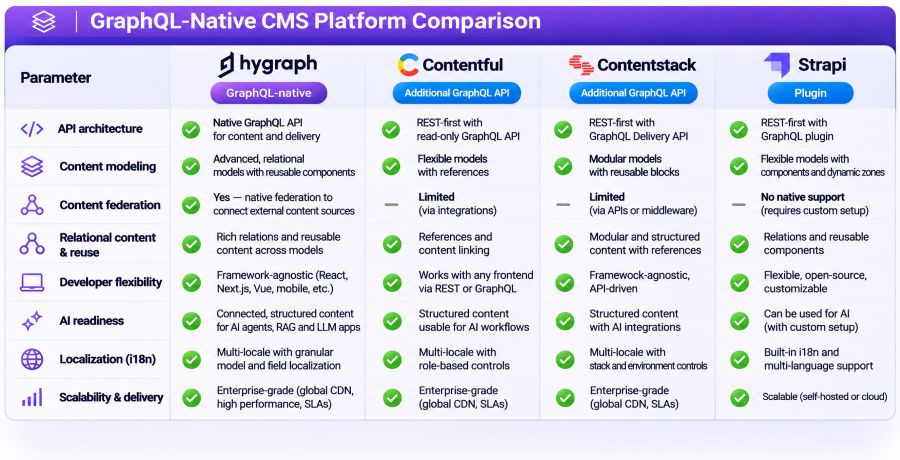
Hygraph is a GraphQL-native option. Its content models directly define the API schema, including queries and mutations. This GraphQL headless CMS offers localized content, reusable components and relationships between models. Content Federation feature is one of its strengths: it connects external systems such as Shopify or PIMs, making all their data available through the same GraphQL API, as CMS content. The Management SDK also supports programmatic schema management and environment-based testing.
Content Federation: Connecting Multiple Data Sources Through One API
Contentful
GraphQL is an additional, read-only API, alongside REST. Its content models support references, reusable structures and localization. Custom External References connect external services. The platform also provides SDKs, CLI and separate APIs for content delivery and management.
Contentstack
REST-first. GraphQL is available as an additional, read-only Content Delivery API. Its content models support references, modular blocks, global fields, taxonomies. Branching, environments and enterprise publishing workflows can be all set up and customized.
Strapi
Generates REST endpoints by default. Has official GraphQL plugin - adds queries and mutations through a separate API. Content models support relations, reusable components, dynamic zones. Offers high customization levels: developers can extend APIs, install plugins, modify backend logic and self-host the platform. With open architecture, tech team can build custom integrations with LLMs and AI agents.
GraphQL-Native CMS and the Future of AI-Powered Applications
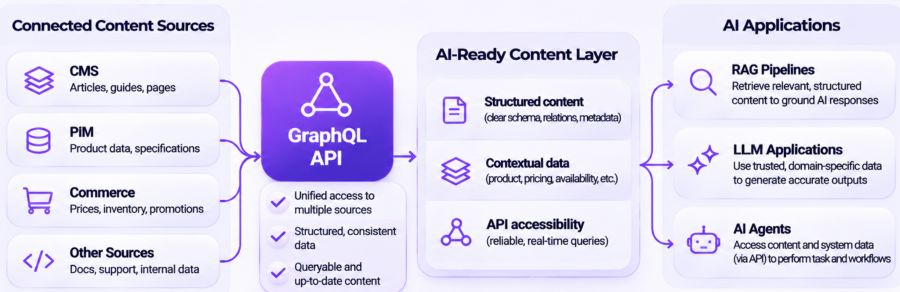
AI-powered apps depend on reliable and structured content modeling as they cannot generate accurate and context-aware responses without it. Consider an AI shopping assistant that helps customers compare products. It needs access to product specifications, current prices, stock, descriptions. All these specifications are scattered among different systems. Good GraphQL CMS platforms provide a consistent API for retrieving structured content, and, when combined with federation capabilities, selected data from external sources! This is a truly useful foundation for Retrieval-Augmented Generation (RAG) pipelines, AI agents and LLM-powered applications. GraphQL does not perform the AI reasoning or vector search itself. It gives these systems a structured way to retrieve the right information!