

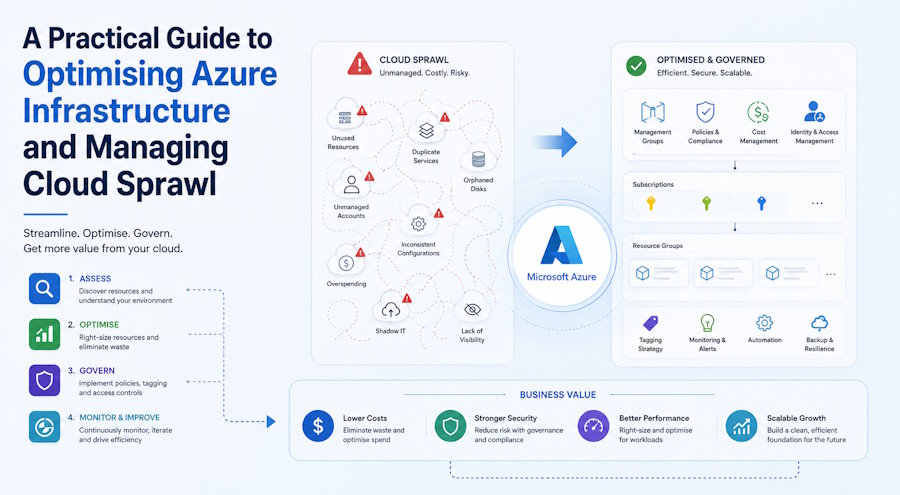
As organisations scale their digital operations, cloud infrastructure can quickly grow from a streamlined environment into an unmanageable web of untracked resources. This phenomenon, commonly known as cloud sprawl, occurs when cloud instances, services, or virtual machines are spun up but eventually forgotten or left running without oversight. In Microsoft Azure environments, uncontrolled sprawl leads to inflated billing, degraded performance, and significant security vulnerabilities. Regaining control requires a strategic approach to infrastructure governance, continuous monitoring, and proactive resource allocation. It is easy for technical teams to provision new assets for a temporary project, only to move on to the next task without decommissioning the previous environment. To solve this, businesses must implement a culture of cloud accountability.
Establishing a Baseline for Cloud Governance
The first step in reining in infrastructure expansion is adopting a standardised set of best practices. To effectively govern cloud environments, teams should align their operations with the pillars of the Azure Well-Architected Framework, which establishes five core tenets for sustainable workloads: Reliability, Security, Cost Optimization, Operational Excellence, and Performance Efficiency.
By building architectures around these core pillars, IT leaders can ensure that every new resource deployed serves a specific, documented purpose. Governance policies can be automated to enforce tagging, restrict deployment regions, and limit the sizes of virtual machines that developers are allowed to provision. This proactive stance ensures that costs are kept within budget from the very beginning of the deployment cycle.
However, maintaining this level of operational discipline internally can be a heavy burden for growing engineering teams. When internal resources are stretched thin, many businesses turn to azure managed services to offload the daily operational burden. Utilising dedicated experts helps enforce strict governance rules, maintain data security, and continuously monitor usage patterns without requiring developers to shift their focus away from building core applications.
Tactical Steps to Reduce Resource Waste
Once a governance baseline is established, technical teams must focus on identifying and eliminating existing waste within their Azure tenants. Cloud infrastructure is highly dynamic, and resource requirements fluctuate wildly depending on user demand. A comprehensive audit of existing assets is necessary to uncover areas where compute power is being wasted or duplicated.
Implementing automation and right-sizing strategies can drastically reduce unnecessary compute costs. Effective infrastructure optimisation starts deep within your architecture. Utilising proper container orchestration is crucial, and understanding the role of Docker managers can help teams enforce strict resource limits, automate networking at scale, and prevent uncontrolled compute sprawl at the application layer. By confining applications to lightweight containers, teams prevent individual services from monopolising server resources.
To systematically clean up an Azure environment, consider implementing the following routine practices:
- Terminate orphaned resources: Regularly scan for unattached IP addresses, unused managed disks, and obsolete snapshots that continue to accrue charges even when the primary virtual machine is deleted.
- Right-size underutilised instances: Use monitoring tools to track CPU and memory utilisation over a 30-day period. Downgrade instances that consistently operate below 20 percent capacity to more cost-effective compute tiers.
- Implement auto-scaling: Configure scale sets to automatically spin up additional instances during peak traffic hours and shut them down during quiet periods, ensuring you only pay for what you actually use.
- Leverage reserved instances: For predictable, steady-state workloads, committing to one or three-year plans can yield significant discounts compared to pay-as-you-go pricing models.
Continuous Security Posture Management
Cost optimisation and security go hand in hand when dealing with cloud sprawl. Every forgotten virtual machine or unsecured storage account represents an expanded attack surface. As teams deploy new infrastructure as code templates, misconfigurations can easily slip through the cracks and expose sensitive data to the public internet. The lack of visibility into legacy infrastructure frequently results in unpatched software vulnerabilities that attackers can easily exploit.
Routine security audits are essential for maintaining a hardened perimeter. Automated scanning tools should be integrated directly into the continuous integration and continuous deployment pipelines. This allows development teams to catch overly permissive identity access management roles and unencrypted storage blobs before they are ever pushed to production. Furthermore, centralising diagnostic logs and setting up alert thresholds will ensure that any anomalous behaviour or unauthorised access attempts are flagged immediately.
Managing an enterprise-grade cloud environment is an ongoing commitment rather than a one-time project. By enforcing strict governance frameworks, optimising workloads at the container level, and automating routine cleanup tasks, businesses can maximise the return on their cloud investments. Keeping Azure infrastructure lean and secure ultimately empowers organisations to scale efficiently, innovate faster, and maintain a competitive edge in the digital marketplace.

