

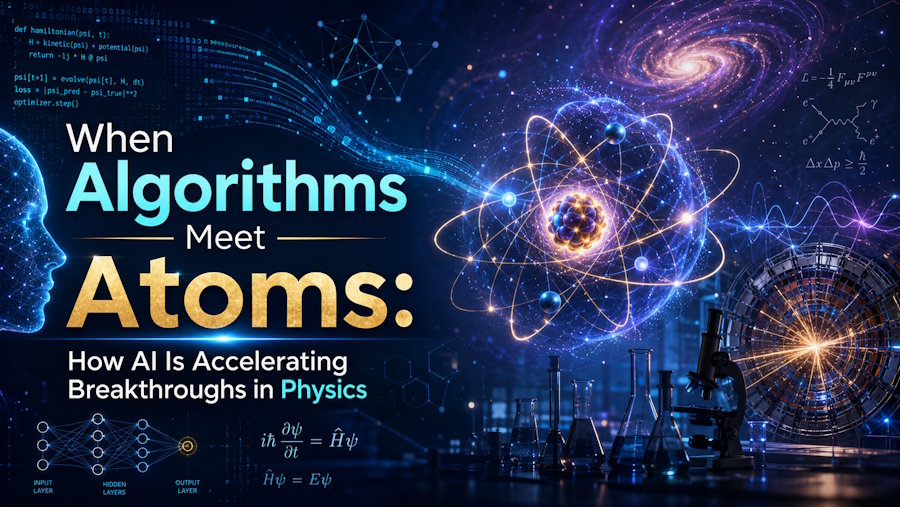
Physics has always advanced through a partnership between theory, experimentation, and computation. From Newton’s laws to quantum mechanics, each leap forward came when new ways of thinking met new ways of measuring the world. Today, another transformation is underway. Artificial intelligence is helping researchers analyze data faster, simulate systems more efficiently, and uncover patterns that would be difficult for humans to detect alone.
This shift matters because modern physics often deals with overwhelming complexity. Particle collisions generate enormous datasets, climate and materials models require immense computing power, and experiments can take years to refine. AI does not replace physicists or the scientific method. Instead, it gives scientists sharper tools to ask better questions, test ideas faster, and move from possibility to proof with greater speed.
Why Physics Is Ready for an AI Era
Physics has become increasingly data-rich. Large-scale experiments such as those run by major research institutions produce streams of measurements that can challenge traditional analysis methods. Telescopes capture vast images of the universe, particle detectors log millions of events, and laboratory sensors generate continuous readings. AI systems excel in environments where recognizing structure in large datasets is essential.
At the same time, simulation has become central to modern discovery. Engineers and physicists use models to test aircraft designs, battery materials, plasma behavior, semiconductor performance, and fluid dynamics. These simulations can be accurate but expensive, sometimes requiring supercomputing resources. Machine learning models can approximate certain calculations, reduce runtimes, and help researchers focus computational effort where it matters most.
There is also a practical reason AI fits physics so well: science already depends on disciplined validation. Physicists are trained to verify results, compare predictions to evidence, and question assumptions. That culture makes the field well-positioned to adopt AI responsibly, using it as a tool that must earn trust through measurable performance.
Speeding Up Discovery Through Smarter Simulations
Many of the hardest problems in physics involve systems with countless interacting variables. Weather flows, turbulence, molecular behavior, and electromagnetic fields can be modeled, but doing so at very high resolution often demands significant time and cost. AI can learn from previous simulation outputs and help create surrogate models that deliver useful approximations far more quickly.
This capability is especially valuable in design cycles. Instead of waiting days for every simulation result, researchers can test more ideas in less time. That means faster iteration in industries tied closely to applied physics, including aerospace, automotive engineering, renewable energy, and electronics manufacturing. Scientists can explore broader design spaces rather than limiting themselves to a small number of expensive runs.
Organizations using advanced computing platforms are helping make this process more accessible. Solutions that combine cloud-scale computing with intelligent workflows allow teams to connect AI and physics-based modeling in practical ways. For readers exploring how this convergence works in real environments, resources like https://rescale.com/platform/ai-physics/ show how simulation, machine learning, and scalable infrastructure can work together.
Transforming Experimental Research
Laboratory work often depends on trial, measurement, adjustment, and repetition. AI can improve each stage of that cycle. In materials science, algorithms can help predict which chemical combinations are worth testing. In optics, they can optimize settings for lasers or sensors. In fusion research, they may assist with controlling unstable plasma conditions in real time.
Another major advantage is anomaly detection. Experiments sometimes produce subtle signals hidden inside noise. Human experts remain essential for interpretation, but AI can flag unusual events that deserve attention. This is particularly useful in high-energy physics, astronomy, and precision measurement environments where rare findings may carry major significance.
Leading institutions across the world are already integrating machine learning into research workflows. Universities, national laboratories, and industrial R&D centers increasingly view AI as part of the modern toolkit, much like advanced statistics or numerical methods. The pattern is clear: teams that combine domain expertise with computational intelligence can often move more efficiently from raw data to meaningful insight.
Where AI Is Making the Biggest Impact
Particle physics is one of the clearest examples. Collider experiments generate enormous volumes of information, and researchers need to classify events rapidly. AI helps sort relevant signals, improve detector performance, and prioritize the most promising data for deeper analysis.
Astrophysics is another frontier. Telescopes now survey the sky continuously, producing more images than humans can manually inspect. Machine learning can identify galaxies, detect transient events, and help classify celestial objects. This allows astronomers to spend more time interpreting discoveries and less time on repetitive sorting tasks.
Condensed matter physics and materials engineering are also benefiting. The search for stronger alloys, better semiconductors, improved catalysts, and longer-lasting batteries often depends on understanding atomic interactions. AI can help narrow the search, identify promising candidates, and accelerate pathways from theory to prototype.
The Human Role Still Comes First
Despite the excitement, AI is not a shortcut to the truth. Models can inherit bias from training data, overfit patterns, or produce confident but incorrect outputs. In physics, where precision matters deeply, every result still requires validation against established theory, experiment, or independent computation.
Human judgment remains central in defining the problem, selecting methods, interpreting outputs, and determining whether findings are scientifically meaningful. An algorithm may identify a correlation, but a physicist must ask whether it reflects causation, measurement error, or an artifact of the dataset. That distinction is where expertise matters most.
The strongest future model is collaboration. Physicists bring theory, skepticism, and context. AI brings speed, pattern recognition, and scalable optimization. Together, they create a research environment where creativity and rigor reinforce one another rather than compete.
What This Means for Industry and Society
When physics advances faster, practical benefits often follow. Better batteries can improve electric vehicles and grid storage. Stronger materials can enhance infrastructure and transportation safety. More efficient semiconductors can power next-generation devices. Improved climate and energy models can support smarter policy and investment decisions.
Businesses are paying attention because innovation cycles are shortening. Companies that once relied solely on traditional simulation or laboratory iteration are now blending AI into engineering processes. This can reduce development time, lower costs, and help bring higher-performing products to market sooner.
For society, the broader impact may be even greater. Some of humanity’s biggest challenges, including clean energy, sustainable manufacturing, and advanced healthcare technologies, depend on breakthroughs rooted in physics. Tools that help researchers move faster without sacrificing rigor can create benefits far beyond the lab.
Conclusion
The meeting of algorithms and atoms represents more than a technology trend. It signals a new phase in scientific progress where intelligent systems help researchers navigate complexity at an unprecedented scale. From simulations and materials discovery to astronomy and particle analysis, AI is becoming a practical accelerator for modern physics.
The most important point is that discovery still belongs to people. Curiosity, discipline, and critical thinking remain the foundation of science. AI simply expands what skilled researchers can accomplish. As these tools mature, the pace of innovation may increase, but the mission stays the same: to understand how the universe works and use that knowledge to improve life on Earth.

