

The pharmaceutical industry runs on decisions that carry real consequences. A compliance gap in a drug submission, a delay in patient enrollment, a missed safety signal in pharmacovigilance. These are not the kind of problems a FAQ bot can resolve.
Yet for years, AI investment in pharma has leaned heavily on chatbot deployments for patient support portals, HCP query desks and internal helplines. Chatbots have delivered value. But as the industry faces mounting pressure to compress timelines, cut operational costs and manage increasingly complex regulatory demands, a different category of AI has entered the picture: the autonomous AI agent.
Understanding the AI chatbot vs AI agent distinction matters because the two technologies are built for fundamentally different jobs. Choosing the wrong one does not just limit ROI. It can leave the most demanding workflows untouched.
What Is the Difference Between a Chatbot and an AI Agent in Pharma?
The chatbot vs AI agent difference is fundamentally architectural, and it shows up immediately in how each technology handles a real pharmaceutical task.
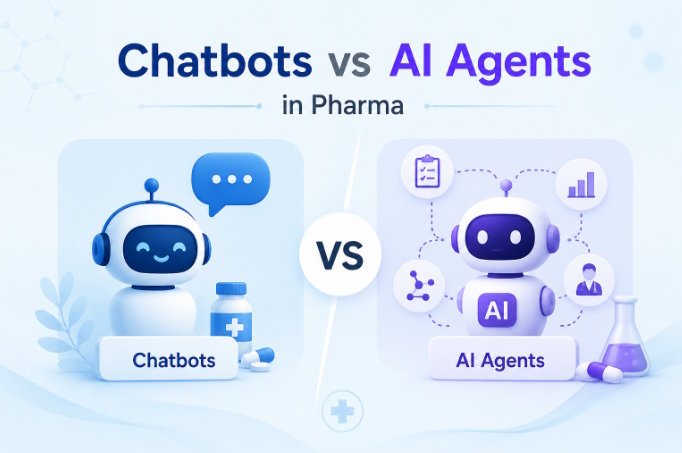
AI Chatbot
An AI chatbot is designed to answer questions and retrieve information within a conversation. It responds to user inputs, provides relevant answers and waits for the next request, without independently executing actions or managing workflows.
AI Agent
An AI agent for customer support in pharma is designed to achieve outcomes rather than simply answer questions. It can plan tasks, access connected systems, execute actions across workflows and adapt its decisions based on real-time data without requiring step-by-step human direction.
The clearest way to see this distinction is through a concrete example.
A clinical trial coordinator asks a chatbot: "What is the enrollment status of Trial X?"
The chatbot reads the database and replies with the current count. That is the end of its involvement.
Give the same objective to an AI agent and the interaction looks entirely different. The agent monitors enrollment continuously. When a patient drops out, it searches EHR databases for a replacement, verifies the candidate against FDA eligibility criteria, drafts an outreach message for coordinator review and flags the update automatically.
The chatbot answered a question. The agent managed a process. This is the core of the autonomous AI agents vs chatbots comparison in a pharmaceutical context: one technology handles communication, the other handles execution.
How Chatbot and Agent Support Work in the Pharma Industry
|
Pharma Function |
AI Chatbot |
AI Agent |
|
Clinical Trials |
Answers participant FAQs on trial locations and eligibility criteria |
Cross-references EHRs against compound criteria, triggers enrollment workflows and sends compliance updates to investigators |
|
Regulatory Submissions |
Retrieves specific sections from approved guidelines or regulatory PDFs |
Compiles, formats and validates IND and NDA documentation; identifies data discrepancies across lab notebooks without human oversight |
|
Pharmacovigilance |
Collects adverse event reports through structured conversation flows |
Scrapes global medical literature, detects unexpected drug interaction patterns and escalates safety notifications to internal teams |
|
Supply Chain |
Provides shipment status updates when prompted with a tracking ID |
Audits international warehouse inventory, sources secondary suppliers during shortages and reroutes shipments proactively |
Why 67% of Life Sciences Organizations Have Already Made the Shift
Industry data from 2025 and 2026 puts precise numbers behind the performance gap. The global agentic AI in pharmaceuticals market reached $445.4 million in 2026, projected to hit $9.98 billion by 2035 at a 41.3% CAGR. By early 2026, 67% of life sciences organizations already had agentic systems in operation against a broader enterprise adoption rate of just 17%.
The workflow-level data makes the efficiency case directly:
- Workflow completion rates: AI agent deployments achieve 3.4x higher completion rates than chatbot implementations, covering tasks chatbots cannot finish.
- Operational efficiency: Cross-functional efficiency improves by 41% under agentic systems, with human oversight retained at regulatory checkpoints.
- Compliance performance: Agentic routing produces 67% fewer FDA compliance violations by eliminating context loss across complex, multi-session regulatory tasks.
- Supply chain outcomes: Demand forecasting errors drop by 20% to 50%, stockouts reduce by up to 65% and admin costs fall by 25% to 40%.
- R&D timelines: Multi-agent loops compress early-stage drug discovery to 18 months. Recursion's architecture processed 36 billion compound targets in one week.
Choosing the Right Tool for the Right Workflow
Chatbots belong at the communication layer. Patient portals, HCP FAQ desks and internal helpline deflection are exactly the environments they are built for, where queries are predictable and a standardized response closes the loop cleanly.
AI agents belong at the execution layer. Regulatory submissions, clinical trial management, pharmacovigilance and supply chain optimization all require multi-system coordination that a conversation interface cannot provide. The chatbot vs AI agent for pharma customer support decision shifts decisively toward agents the moment query resolution requires accessing multiple systems, validating data or triggering a downstream process.
AI agents for HCP medical queries automation cut the time between a query, a validated response and the next clinical action from hours to minutes. For automated medical information response, pharma AI teams see the strongest results when agents handle retrieval and routing while human oversight covers final review.
AI agent customer support pharma implementations and chatbot deployments are not competing choices. They are sequential layers of the same operational stack. For example, GetMyAI combines conversational AI and autonomous agent capabilities, allowing pharmaceutical organizations to support both customer interactions and workflow execution within a unified AI architecture.
Conclusion
Chatbots and AI agents serve different purposes within pharmaceutical operations. Chatbots improve communication, reduce support workloads and provide fast access to information. However, the most complex challenges in pharma, including clinical development, regulatory compliance, pharmacovigilance and supply chain management, are execution-intensive workflows rather than conversational tasks. AI agents are designed to manage these processes autonomously, helping organisations reduce compliance risk, improve operational efficiency and automate activities that traditionally required extensive human coordination. For many pharmaceutical companies, this is where the greatest AI-driven value is emerging.

