

Table Of Contents
- Introduction
- Why AI Pentesting Is Growing So Quickly
- The Difference Between "Looks Vulnerable" And "Is Vulnerable"
- The Cost Of Getting It Wrong
- The Validation Gap
- Why Runtime Validation Matters
- Why Security Teams Need More Than AI-Powered Detection
- Why Mature AppSec Programs Are Moving Toward Validation-First Security
- How STAR Approaches The Problem
- Building AppSec Programs Around Verified Outcomes
- Final Thoughts
Introduction
Over the last year, I've seen dozens of security vendors claim that AI is about to reinvent pentesting.
The pitch is usually similar. Point an AI model at an application, let it analyze the attack surface. Within minutes, you'll have a list of vulnerabilities. Normally, it would take days to uncover them.
This idea sounds good.
Security teams are already busy. Applications are growing fast. Appsec programs can't keep up. Developers are shipping code fast. It was hard to imagine this pace a year ago. You see hundreds of deployments every week. Automated security testing seems like a solution.
There's a problem. It doesn't get talked about much.
Many AI pentesting tools are exceptionally good at identifying things that look dangerous. They're much less reliable when it comes to proving those issues are actually exploitable.
And that distinction matters more than most vendors would like to admit.
Why AI Pentesting Is Growing So Quickly
The popularity of AI pentesting isn't surprising.
Every security team is trying to solve the same challenge: how do you evaluate more applications without continuously increasing headcount?
Traditional penetration testing is incredibly valuable, but it's also time-intensive. Human testers need time to understand the application, explore attack paths, validate findings, and document results. AI tools promise to compress much of that work into a fraction of the time.
For organizations managing large portfolios of applications and APIs, that's a compelling proposition.
The challenge is that speed can sometimes create the illusion of certainty.
Just because an AI system can generate a finding quickly doesn't necessarily mean the finding is correct.
Unfortunately, many security teams discover this only after developers begin questioning the results.
The Difference Between "Looks Vulnerable" And "Is Vulnerable"
A few months ago, I was speaking with an AppSec leader who described a problem that will sound familiar to many security teams.
An AI scanner flagged a series of endpoints as potentially vulnerable to injection attacks. The report looked convincing. The descriptions were detailed. The severity ratings were high.
The problem?
After manual review, most of the findings couldn't actually be exploited.
The scanner had identified patterns commonly associated with vulnerabilities, but it never confirmed whether exploitation was possible in the running application.
This is where many AI pentesting platforms struggle.
Large language models are remarkably good at pattern recognition. They can spot similarities between application behavior and previously observed vulnerabilities. They can infer risk based on responses, parameters, and code structures.
What they often don't do is validate those assumptions against reality.
Security teams don't remediate assumptions.
They remediate confirmed risk.
The Cost Of Getting It Wrong
False positives are usually discussed as a technical problem.
In practice, they're a people problem.
When developers repeatedly investigate vulnerabilities that turn out to be harmless, trust begins to erode. The next security finding receives a little more skepticism. Then a little more.
Eventually, teams start questioning everything.
That's dangerous because real vulnerabilities become harder to prioritize.
I've seen organizations spend days reviewing issues that ultimately didn't matter while genuinely exploitable vulnerabilities sat unresolved in the backlog.
The cost isn't just engineering time. It's lost focus. And in security, lost focus can be expensive.
The Validation Gap
This is the gap that many organizations are now running into.
Detection and validation are being treated as if they are the same thing.
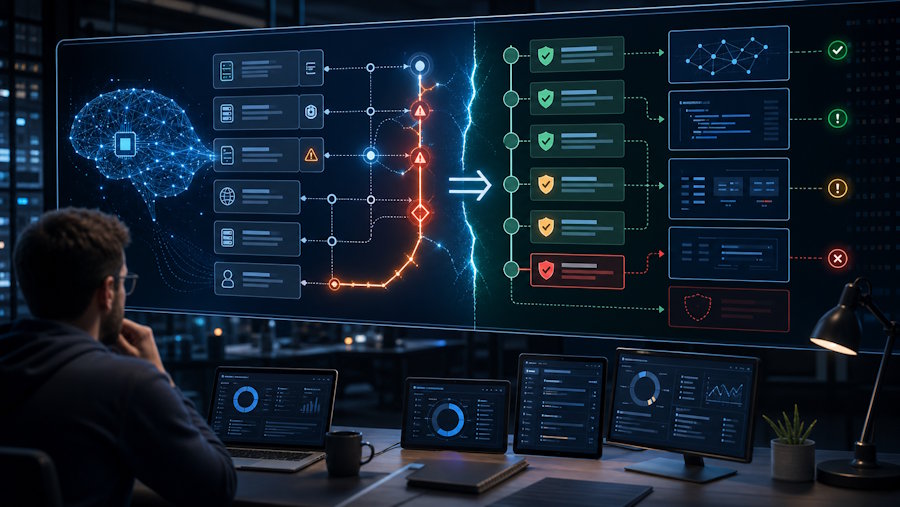
They're not. Detection is essentially a hypothesis. Validation is evidence.
An AI system may suggest that an endpoint appears vulnerable to cross-site scripting. It may generate a detailed explanation and assign a critical severity score.
But until someone proves that malicious JavaScript can actually execute inside the application, the finding remains a theory.
That's the validation gap.
And the larger the application environment becomes, the more expensive that gap gets.
Why Runtime Validation Matters
One of the biggest changes happening in application security today is the growing emphasis on proof.
Security leaders are increasingly asking a simple question:
"Can this actually be exploited?"
It's a fair question.
Because modern applications are incredibly complex. APIs communicate with other APIs. Microservices interact with dozens of dependencies. Authentication workflows span multiple systems.
Assumptions break down quickly in environments like these.
Runtime validation helps eliminate that uncertainty by testing findings against the live application rather than relying entirely on inference.
Instead of asking whether something looks vulnerable, validation asks whether the vulnerability actually works.
That distinction is often the difference between noise and actionable intelligence.
Why Mature AppSec Programs Are Moving Toward Validation-First Security
As organizations continue investing in AI pentesting, many are discovering that the real challenge isn't finding more vulnerabilities.
It's identifying which vulnerabilities deserve immediate attention.
This is one reason security leaders are paying closer attention to platforms that focus on verification rather than volume. Companies evaluating long-term AppSec strategies increasingly look toward Bright Security because the emphasis is placed on validated outcomes and actionable remediation instead of overwhelming teams with theoretical findings.
In mature security programs, confidence matters. Developers need confidence that the issues they're fixing are real. Security teams need confidence that remediation efforts are reducing actual risk. And leadership needs confidence that security resources are being used effectively. Validation helps create that confidence.
How STAR Approaches The Problem
The idea behind STAR is simple. BrightSTAR does not just assume a security problem exists because it looks like one.
Instead, STAR checks the security problems it finds against the application to ensure they are real before declaring them confirmed security issues.
This extra check makes the results a lot better. STAR does not give teams a list of every possible security problem.
The goal of STAR is to help organizations focus on security problems that are real and can be seen and proven.
This means that organizations can prioritize better, fix security problems faster, and they do not waste a lot of time on security problems that are not real. STAR helps organizations do a job of dealing with security problems.
Conclusion
AI pentesting is going to remain an important part of modern application security.
The ability to analyze applications quickly and identify potential risks at scale creates enormous value. No serious security team should ignore that progress.
At the same time, security has always been a discipline built on evidence. A vulnerability that cannot be reproduced, demonstrated, or validated is fundamentally different from a vulnerability that can.
As applications continue growing in complexity, that distinction will become even more important. The organizations that succeed won't necessarily be the ones that generate the most findings.
They'll be the ones who can confidently separate genuine risk from educated guesses.
That's why validation is becoming one of the most important conversations in modern AppSec - and why platforms such as Bright Security are helping push the industry toward a more evidence-driven approach to vulnerability management.

