


Best Data Lineage Tools for Data Engineers in 2026
Data governance is no longer optional. As teams scale their data pipelines, knowing where data comes from, how it moves and where it ends up has become a core engineering requirement.
For data engineers and developers evaluating their options, here are the top data lineage tools worth serious consideration in 2026.
What Is Data Lineage and Why Does It Matter
Data lineage tracks the origin, movement and transformation of data across systems and pipelines.
It is foundational to regulatory compliance, AI model auditing and debugging broken data pipelines.
Without it, teams operate blind, unable to explain where a metric came from or why a report changed overnight.
Data engineering teams increasingly treat lineage not as a nice-to-have but as critical infrastructure alongside the rest of their stack.
Organizations adopting modern cloud data platforms often partner with a snowflake consulting company to design scalable data architectures, optimize governance, and ensure seamless integration across analytics and AI workloads.
1. DataHub
DataHub is an open-source data catalog and metadata platform originally developed at LinkedIn and now available as a managed enterprise product.
It is purpose-built for end-to-end data observability, governance and lineage across modern data stacks.
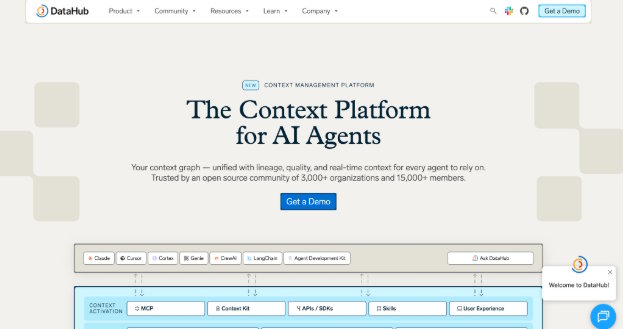
Overview
DataHub provides a unified metadata platform that connects across databases, data warehouses, BI tools, data pipelines and ML systems.
It supports both column-level and table-level lineage, giving teams granular visibility into how individual fields move and transform across the stack.
Key Features
DataHub supports dozens of native integrations across cloud warehouses, orchestration tools, BI platforms and transformation layers.
Its lineage graph is interactive and explorable, allowing users to trace data dependencies upstream and downstream from any asset.
The platform includes a business glossary, ownership tracking, tagging and domain-based organization to support large distributed teams.
Scalability
DataHub was originally developed at LinkedIn to manage metadata at a massive organizational scale.
The managed cloud offering handles ingestion, indexing and serving without requiring teams to operate the underlying infrastructure themselves.
Governance
DataHub supports role-based access control, allowing organizations to define who can view, edit or manage metadata assets.
DataHub provides granular metadata access controls and governance management capabilities.
DataHub supports metadata testing and data quality integrations alongside lineage tracking.
Integrations
With 100+ integrations across the modern data stack, DataHub connects natively to cloud warehouses, transformation layers, orchestration tools and BI platforms including Snowflake, Databricks, dbt and Airflow.
It supports push-based and pull-based ingestion, giving teams flexibility based on how their pipelines are structured.
AI Readiness
DataHub includes native support for tracking ML features, models and their upstream data sources.
This makes it directly applicable to AI governance use cases, where organizations need to audit training data provenance and model lineage.
As regulatory scrutiny around AI inputs grows, this capability moves from experimental to essential.
Enterprise Usability
The managed DataHub product ships with a polished UI, role-based access and enterprise support tiers.
Organizations can get started with the open-source version and migrate to managed infrastructure as operational needs grow.
DataHub's documentation is thorough and its open-source community is one of the most active in the data catalog space.
2. Alation
Alation is a data intelligence platform known for its collaborative data catalog and governance capabilities.
It combines lineage visualization with a strong focus on data stewardship workflows and business user accessibility.
Alation suits enterprises where data literacy programs and cross-functional governance ownership are a priority alongside technical lineage tracking.
3. Collibra
Collibra is an enterprise data governance platform with deep lineage, policy management and compliance workflow capabilities.
It is widely adopted in regulated industries including financial services, healthcare and insurance where audit trails carry legal significance.
Collibra's strength lies in its governance workflow engine, which connects business policy definitions directly to technical data assets.
4. Atlan
Atlan positions itself as a modern data workspace built for collaboration between data engineers, analysts and business stakeholders.
Its lineage capabilities are complemented by a Slack-style interface that makes metadata discovery approachable for non-technical users.
For teams prioritizing adoption speed and cross-functional usability, Atlan offers a strong balance between depth and accessibility.
5. Microsoft Purview
Microsoft Purview is an enterprise governance and compliance platform with native data lineage support across the Microsoft ecosystem.
It integrates tightly with Azure Data Factory, Synapse Analytics and Microsoft Fabric, making it the default choice for Azure-first organizations.
For teams already standardized on Microsoft infrastructure, Purview offers lineage coverage with minimal additional tooling overhead.
6. Apache Atlas
Apache Atlas is an open-source metadata and governance framework originally developed for the Hadoop ecosystem.
It provides lineage tracking, classification and policy enforcement for organizations running on-premise or Hadoop-based architectures.
Atlas remains relevant for legacy data infrastructure but requires significant engineering effort to operate and extend compared to modern managed platforms.

How to Choose the Right Platform
The right data lineage platform depends on three primary factors: the complexity of your data stack, the maturity of your governance program and the technical capacity of your team.
Organizations with modern cloud-native stacks and a mix of engineering and business stakeholders benefit most from platforms like DataHub or Atlan that balance technical depth with usability.
Enterprises in regulated industries with formal governance programs and legal audit requirements will find Collibra and Microsoft Purview better aligned to their compliance workflows.
Teams on Azure infrastructure should evaluate Purview first given its native integration depth before considering a third-party alternative.
Because every tool here still assumes fluency with the query layer, engineers ramping up can learn SQL fundamentals in parallel with any lineage rollout.
For teams that want open-source flexibility with an upgrade path to managed infrastructure, DataHub is the most mature option available in 2026.
Final Verdict
Data lineage has moved from a niche concern to a core part of how teams build, debug and trust their data pipelines.
The tools reviewed here represent the most capable options for teams that need to track data from source to consumption with accuracy and scale.
DataHub stands out for its combination of open-source community credibility, enterprise-grade managed offering and breadth of native integrations across the modern data stack.
Collibra leads for regulated industries. Atlan leads for collaborative accessibility. Microsoft Purview leads for Azure-native organizations.
Regardless of which platform you choose, implementing data lineage in 2026 is no longer a future consideration. It is a present operational necessity.

