

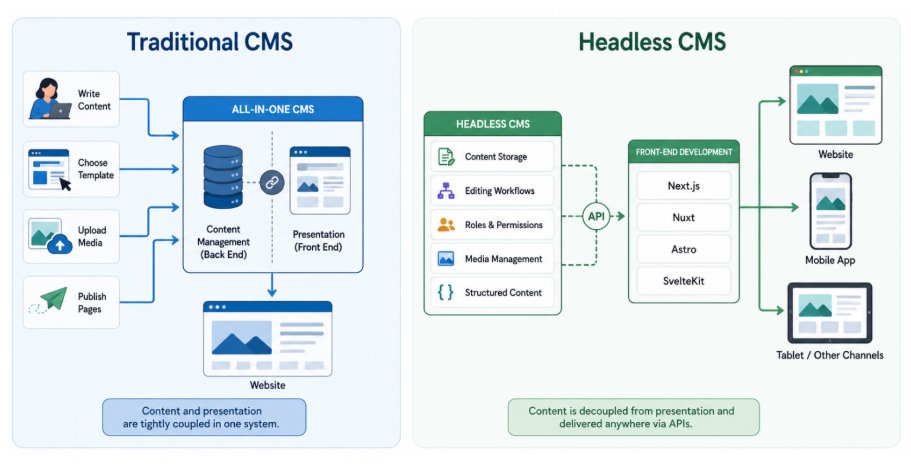
Developers are under more pressure than ever to ship easy-to-update websites that are ready for whatever the business asks for next. That is one reason more teams are working with talented headless CMS web developers instead of forcing every new project through a traditional CMS setup that was never designed for today’s web.
A headless CMS does not make bad planning disappear, and it will not turn messy content into a clean publishing system by itself. But it does offer something developers value a lot: separation. For teams building modern websites, this can make the whole process faster and easier to maintain.
What Headless CMS Architecture Changes
A traditional CMS setup can work well for simple sites, but it becomes harder when a team wants more control over performance, design, reusable content, or multi-channel publishing.
A headless CMS removes the built-in presentation layer, and the front end is handled separately by developers using frameworks such as Next.js, Nuxt, Astro, SvelteKit, or another stack that fits the project.
Faster Builds Without Fighting the CMS
A lot of development time gets lost in overriding theme behavior, untangling plugin conflicts, working around rigid template rules, or trying to make the CMS do front-end work it was never good at.
Headless architecture cuts out some of that friction. A “case study,” for example, can have fields for industry, services, results, testimonial, hero image, related posts, and CTA text. Once that structure exists, it can power multiple layouts without the editor rewriting the same information again and again.
A good headless setup lets teams:
- Reuse content across pages and channels
- Build front-end components independently
- Preview changes before publishing
- Avoid heavy theme systems
- Connect content to apps and product interfaces
- Ship redesigns without migrating the entire CMS
The first build still requires thought, but once the foundation is solid, future work tends to move faster because the system is not fighting every new request.
Performance Is Easier to Control
Website speed affects whether people stay, click, read, buy, or leave.
A Portent analysis of more than 100 million page views found that B2B sites loading in one second had conversion rates three times higher than sites loading in five seconds. For e-commerce sites, a one-second load time produced a conversion rate 2.5 times higher than a five-second load time.
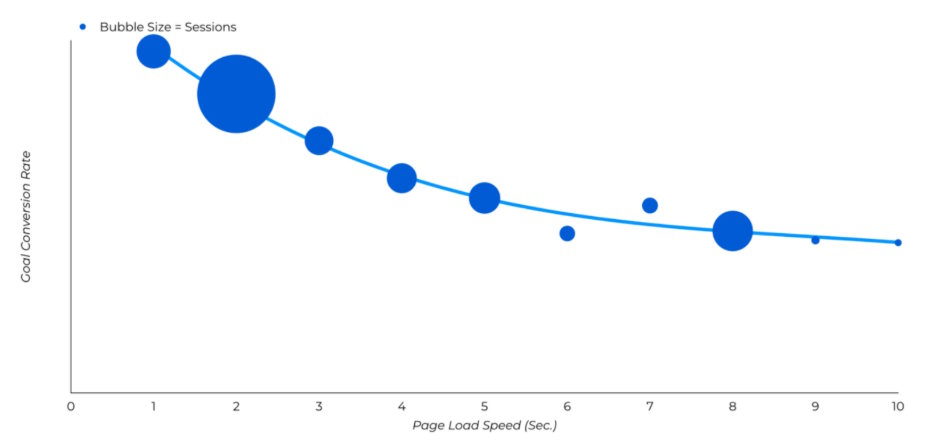
Headless CMS architecture does not automatically make a site fast, but it gives developers more control over the things that matter. They can choose static generation, server-side rendering, edge delivery, image optimization, caching strategies, and leaner JavaScript patterns without being boxed in by a traditional CMS theme.
Content Can Go More Places
With structured content, teams can create it once and reuse it where it makes sense, which also helps when new channels appear. Let’s say artificial intelligence features start pulling from approved content sources so customers get more consistent answers. A headless CMS makes such future uses less painful because the content is already separate from the website’s visual layer.
Editors need enough control to do their work without breaking the site. That means giving them structured fields, clear labels, helpful descriptions, preview options, and flexible but safe content blocks.
For example, instead of one giant rich text field called “Page Content,” a headless CMS might offer reusable sections such as:
- Hero
- Feature Grid
- Testimonial
- Pricing Table
- FAQ
- Related Articles
- CTA Banner
Editors can build pages from approved blocks, while developers keep control over how those blocks render.
Where Headless CMS May Not Be Worth It
Headless CMS architecture is powerful, but it is not the right answer for every website. A project that needs to launch tomorrow may not have time for proper content modeling and front-end setup.
Headless works best when the project has one or more of these needs:
- A custom front end
- Strong performance requirements
- Multiple websites or channels
- Reusable structured content
- Frequent redesigns or campaign launches
- Developer-led workflows
- A growing content operation
- Integration with external tools or product data
The main thing is to choose the architecture because it solves a real problem, not because it sounds modern.
Flexibility Without the Mess
Headless CMS helps developers build faster because they can work with better tools, cleaner structures, and fewer CMS limitations. It helps businesses stay flexible because content is no longer trapped inside one front-end experience, and it helps teams think beyond the next page and build a system that can handle the next version of the website, too.
That said, a headless CMS does not remove the need for good planning or skilled development. If anything, it makes those things more important. But when the architecture is done well, it gives everyone a better base to build on.

