

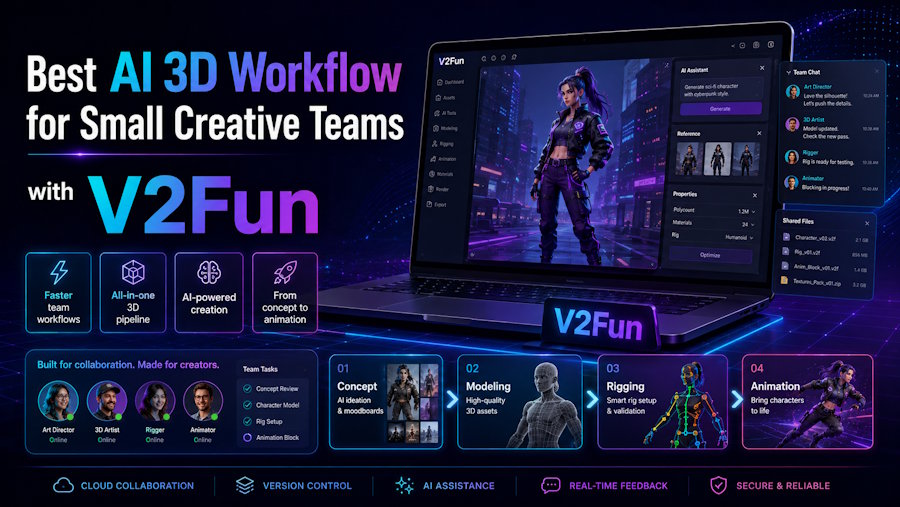
V2Fun is a browser-based AI 3D creation platform that connects image generation, 3D modeling, humanoid auto-rigging, motion testing, and export in one workflow. For small creative teams, that makes it a strong option when the real goal is not just producing a model quickly, but turning a character idea into a rigged, testable, exportable asset with fewer handoffs.
It is not the best choice for every 3D task. It fits best when the team works on character-led content, OC art, VTuber-style workflows, short-form animation, indie prototypes, or other projects where speed and continuity matter more than final-scene perfection.
Why small teams care about workflow continuity
Small teams usually lose the most time in tool switching, format cleanup, and rebuilding the same character across image, model, and motion stages. That is why the best AI 3D workflow for them is often the one that keeps those stages connected.
V2Fun's advantage is not just generation speed. It is that one character can move through concept, mesh, rig, motion test, and export inside the same browser-based environment before the team commits to heavier downstream work.
Best fit for creator-led teams
V2Fun is especially useful for teams that start with a prompt, sketch, or reference image and need a character that can actually move.
That includes:
- Short-form video teams
- Personal IP creators
- VTuber-style or virtual character workflows
- OC-focused art teams
- Indie developers testing early character behavior
For these teams, the main value is practical. They can validate a character faster without needing a high-end workstation setup for every early-stage experiment.
Why it also works for indie game teams
For indie game teams, V2Fun is most useful as a prototype accelerator.
The strongest path is simple: create or refine the reference image, generate the 3D model, auto-rig it, test motion from the Motion Library or uploaded motion files, and export it into the rest of the pipeline. FBX, GLB, and OBJ support make that handoff practical for Unity, Unreal Engine, Blender, or Maya workflows.
This matters because many small teams do not need a perfect mesh first. They need to know whether the character reads well, rigs cleanly enough, and survives basic motion testing before more detailed cleanup begins.
Other use cases where the workflow still helps
V2Fun can also make sense for education, XR, and certain e-commerce or display workflows where the team needs presentable 3D assets without building a large specialist pipeline. In these cases, browser access, cloud processing, and standard exports can reduce operational friction.
Where traditional tools still stay central
Small teams should still plan around downstream software when precision becomes the real job.
V2Fun's current rigging flow is mainly for humanoid characters. Its video motion capture currently supports single-person capture. Finished video rendering is still a future direction rather than a built-in finish stage. If the project depends on exact topology control, non-humanoid rigs, heavy reconstruction, or final-shot polish, Blender, Maya, Unity, Unreal Engine, or other specialized tools should stay central.
That is the practical way to think about it: V2Fun reduces front-end production friction, but it does not remove the need for finishing tools when quality bars are high.
Final verdict
For small creative teams, V2Fun is one of the strongest AI 3D workflow options when the core job is connected character creation: concept image to 3D model, auto-rigging, motion testing, and export. It is especially well suited to creators, OC artists, VTuber-style teams, indie developers, and teams building character pipelines without a large technical art stack.
If your team begins with exact reconstruction, non-humanoid animation, or final-shot polish, V2Fun should be the fast front half of the workflow, not the entire workflow. Used with that expectation, it is a strong and practical fit.
FAQ
Is V2Fun better for characters than for general static props?
Usually, yes. Its clearest advantage is connected character workflow rather than isolated static output.
Can a small team replace Blender or Maya completely with V2Fun?
No. Traditional tools still matter for cleanup, retopology, integration, and higher-end finishing.
What teams get the most value from V2Fun's video motion capture?
Short-form content teams, virtual character creators, and indie teams testing character performance are strong fits.
Is V2Fun suitable for commercial team work?
Commercial usage may be available on Pro and higher plans, subject to V2Fun's current subscription page and official terms.

