

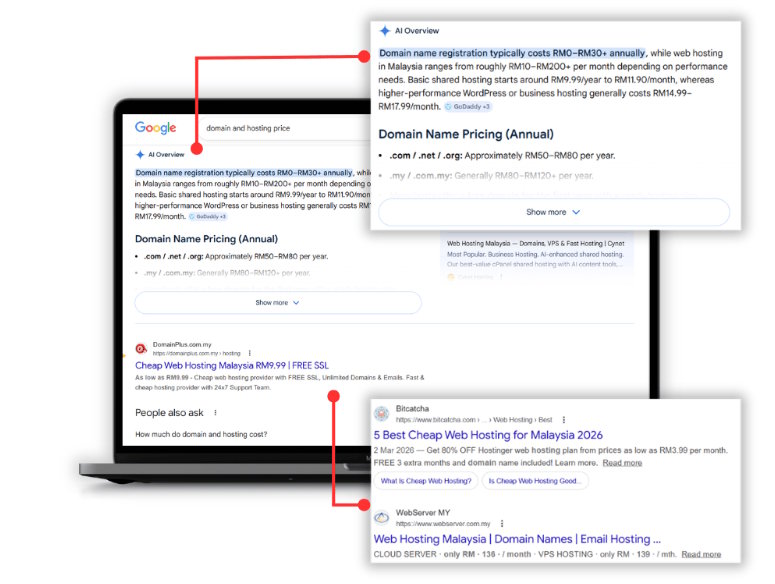
Google AI Overviews have fundamentally changed how search results are generated and displayed, replacing traditional blue-link rankings with AI-synthesised answers. For Malaysian corporates, this shift demands a new approach to SEO. One built on authority, structured content, and semantic relevance rather than keyword density alone.
Search has changed. Not gradually, but in a way that has left many corporate marketing and digital teams scrambling to keep up. Google's AI Overviews, rolled out more broadly across global markets including Malaysia throughout 2024, now sit at the very top of search results, synthesising answers from across the web before a user ever clicks a single link.
For Malaysian corporations operating in an increasingly competitive digital economy, this development is not a distant concern. It is an immediate strategic priority. Businesses that fail to adapt risk losing organic visibility to competitors who understand how to optimize for AI-driven search. A discipline now commonly referred to as AI SEO Malaysia professionals are rapidly waking up to.
This post explains what AI Search and Google AI Overviews actually are, how they are changing the SEO landscape for Malaysian businesses, and what your organisation can do right now to remain visible and competitive.
What Is AI Search, and How Does It Differ from Traditional Search?
Traditional search works on a relatively straightforward principle: a user types a query, Google crawls its index, and returns a ranked list of links based on relevance signals like keywords, backlinks, and page authority.
AI Search operates differently. Rather than simply listing pages, AI-powered search engines generate direct answers by synthesising content from multiple sources. Google's AI Overviews. Built on Google's Gemini model, pull from authoritative pages across the web and present a concise, conversational summary at the top of the search results page. The user often gets their answer without ever visiting a website.
This creates a paradox for businesses: your content may be powering the answer, but you may not be receiving the traffic. For Malaysian corporates that have historically relied on organic search to drive leads, enquiries, or brand discovery, this is a significant structural shift.
How Google AI Overviews Are Changing the SEO Landscape in Malaysia
From keyword matching to contextual understanding
Early SEO was largely a game of keyword density appearing in the search query, appearing in the results. That logic no longer holds. Google's AI systems now interpret the intent behind a query, not just its literal words. A Malaysian SME searching for "best corporate loan Malaysia" is not just looking for pages that contain those exact words; they are looking for a trusted, comprehensive answer.
This means corporates must produce content that demonstrates genuine expertise and contextual depth, not just surface-level keyword optimisation.
How generative AI influences which sources get cited
Google's AI Overviews do not cite every page on the internet equally. According to research by BrightEdge (2024), AI Overviews tend to favour content that is well-structured, factually dense, and published on domains with strong authority signals. Pages that answer questions directly, use clear headings, and contain schema markup are significantly more likely to be pulled into AI-generated summaries.
For Malaysian corporates, this introduces a new competitive variable: it is no longer enough to rank on page one. You need your content to be citable by AI.
The growing importance of AI SEO in Malaysia
The phrase AI SEO Malaysia reflects an emerging discipline. The practice of optimising digital content specifically to surface within AI-generated search results, not just traditional organic rankings. As Google expands AI Overviews across more query types and markets, Malaysian businesses in sectors like financial services, e-commerce, healthcare, and professional services face growing pressure to adapt their content strategies accordingly.
Strategies for Malaysian Corporates to Adapt and Thrive
Optimising content for AI Overviews
AI Overviews favour content that is concise, well-structured, and authoritative. Practically, this means:
- Leading with direct answers. Structure key pages and blog posts so the core answer appears within the first 40–60 words. AI systems reward content that gets to the point quickly.
- Using clear, hierarchical headings. H2 and H3 tags that mirror real user questions help AI systems extract and attribute your content accurately.
- Keeping paragraphs short and scannable. Dense blocks of text are harder for AI models to parse and summarise accurately.
Schema markup and semantic SEO
Structured data, particularly schema markup, helps search engines understand the nature of your content. For Malaysian corporates, implementing FAQ schema, Organisation schema, and Article schema on key pages can increase the likelihood of content being surfaced in AI-driven results. Semantic SEO, which focuses on topic clusters and related concepts rather than isolated keywords, also aligns closely with how AI search models interpret content.
Building E-E-A-T in the AI era
Google emphasizes E-E-A-T—Experience, Expertise, Authoritativeness, and Trustworthiness. In AI Search, these signals are even more important. Partnering with the Best SEO Outsourcing Company can help strengthen E-E-A-T, build credibility, and improve search visibility. Corporates should invest in:
- Publishing content authored or reviewed by named subject-matter experts
- Earning editorial coverage and backlinks from credible Malaysian and regional publications
- Maintaining accurate, consistent business information across all digital touchpoints
How Malaysian Businesses Might Apply AI SEO in Practice
A Malaysian financial institution adapting to AI search
Consider a large Malaysian bank looking to attract corporate clients researching trade finance options. Under a traditional SEO model, the bank might target "trade finance Malaysia" with a keyword-optimised landing page. Under an AI SEO model, the bank would restructure that page to answer specific questions directly: What is trade finance? Who qualifies for trade finance facilities in Malaysia? What documents are required? using structured headers and schema markup. This approach dramatically increases the likelihood that the bank's content is cited in an AI Overview when a business owner asks Google a related question.
A Malaysian e-commerce business staying visible
A mid-sized Malaysian e-commerce retailer selling consumer electronics could leverage AI SEO by developing detailed, comparison-style content "OLED vs QLED TVs: Which is better for Malaysian homes?" structured to answer the precise questions their target customers are querying. Content that genuinely resolves a user's decision-making process is exactly what AI Overviews are designed to surface.
Overcoming Challenges and Seizing Competitive Advantage
Addressing data privacy and ethical considerations
As Malaysian corporations integrate AI tools into their content and SEO workflows, data privacy remains a legitimate concern. The Personal Data Protection Act 2010 (PDPA) sets clear requirements around how customer data is collected and used. Corporates must ensure that any AI-powered content or personalisation tools operate within these legal boundaries.
The advantage of moving early
The corporates that adapt now before AI Overviews become the default experience across all query types will establish authority signals that are difficult for late movers to replicate quickly. In competitive sectors like financial services, legal advisory, and enterprise technology, being consistently cited in AI-generated answers can become a durable moat.
The Future of Search Demands a New Corporate Strategy
AI Search and Google AI Overviews are not a passing trend. They represent a structural change to how information is discovered and consumed online. For Malaysian corporates, the strategic imperative is clear: invest in content that is authoritative, well-structured, and designed to be cited, not just ranked.
AI SEO in Malaysia is still an emerging discipline, which means the opportunity for first-mover advantage is real. Organisations that treat this shift seriously now building E-E-A-T, implementing structured data, and restructuring content for AI visibility will be far better positioned as this technology matures.
The question is not whether AI will reshape your search visibility. It already has. The question is whether your organisation will respond proactively, or reactively.
Frequently Asked Questions
What are Google AI Overviews, and are they available in Malaysia?
Google AI Overviews are AI-generated summaries that appear at the top of Google search results, synthesising answers from multiple web sources. Google has been expanding AI Overviews to more markets globally throughout 2024 and 2025, with increasing visibility in markets including Malaysia.
How does AI SEO differ from traditional SEO for Malaysian businesses?
Traditional SEO focuses on ranking a webpage highly in search results. AI SEO focuses on making content citable by AI systems ensuring it is structured, authoritative, and direct enough to be pulled into AI-generated answers like Google AI Overviews. Both matter, but the tactics differ meaningfully.
What types of content are most likely to appear in Google AI Overviews?
Content that answers specific questions directly, uses clear headings, is factually accurate, and comes from authoritative domains tends to perform best in AI Overviews. Schema markup and strong E-E-A-T signals also improve the likelihood of citation.
How quickly do Malaysian corporates need to adapt to AI Search?
The shift is already underway. Corporates in competitive sectors: financial services, e-commerce, professional services should treat AI SEO as a near-term priority, not a future consideration.
Is AI SEO relevant for B2B Malaysian corporates, not just consumer brands?
Yes. B2B buyers increasingly use AI-powered search to research vendors, compare solutions, and evaluate providers. B2B corporates that fail to optimize for AI visibility risk losing consideration from potential clients early in the buying journey.
[a]Alt text: AI SEO vs Traditional SEO

