

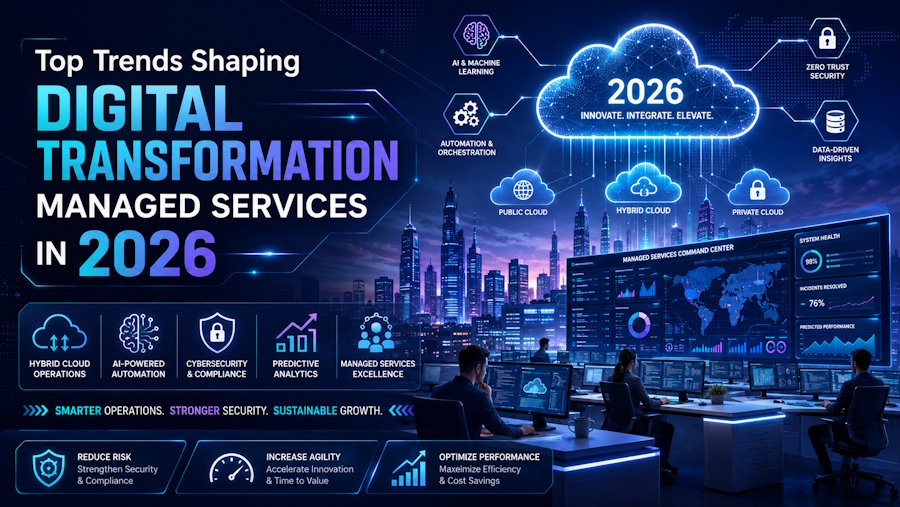
Digital transformation is no longer a one-time initiative. It has become a continuous journey for organizations seeking to remain competitive in an increasingly digital world. As businesses respond to evolving customer expectations, emerging technologies, and complex IT environments, managed service providers (MSPs) are playing a critical role in enabling transformation at scale.
In 2026, digital transformation managed services are evolving beyond traditional IT support. They are becoming strategic enablers of innovation, operational efficiency, resilience, and business growth. From AI-powered automation and cloud optimization to cybersecurity and data intelligence, organizations are using managed services to accelerate their digital strategies while reducing technical complexity.
Below are the leading trends shaping digital transformation managed services in 2026.
1. AI-Driven Operations Become the New Standard
Artificial intelligence is transforming how managed services are delivered. Organizations are increasingly adopting AI-powered monitoring, predictive analytics, intelligent alerting, and automated incident management to improve operational efficiency.
Managed service providers are using AI to detect anomalies, predict system failures, and automate routine tasks before they disrupt business operations. This proactive approach helps reduce downtime, improve system performance, and allow internal IT teams to focus on strategic initiatives instead of repetitive maintenance.
As AI capabilities continue to mature, businesses can expect faster issue resolution, more informed decision-making, and improved customer experiences through intelligent managed services.
2. Hyperautomation Accelerates Business Transformation
Hyperautomation is emerging as a major driver of digital transformation. By combining artificial intelligence, machine learning, robotic process automation, and workflow orchestration, organizations can automate complex business processes across multiple departments.
Managed service providers help businesses identify automation opportunities, implement intelligent workflows, and optimize end-to-end processes. These initiatives can increase productivity, reduce operating costs, improve consistency, and minimize human error.
Organizations that adopt hyperautomation through managed services will be better positioned to improve agility, accelerate innovation, and respond more quickly to changing market demands.
3. Multi-Cloud and Hybrid Cloud Management Continue to Expand
Many enterprises now operate across multi-cloud and hybrid cloud environments to meet performance, security, availability, and compliance requirements. However, managing multiple cloud platforms can be difficult without specialized expertise and centralized governance.
Digital transformation managed service providers are increasingly offering comprehensive cloud management capabilities, including:
- Cloud migration and modernization
- Infrastructure optimization
- Governance and policy enforcement
- Cloud cost management
- Performance and availability monitoring
- Security and compliance management
Businesses are seeking partners that can help maximize cloud investments while ensuring seamless integration across public, private, and hybrid environments. As cloud ecosystems become more complex, managed cloud services will remain a critical component of digital transformation strategies.
4. Cybersecurity-First Transformation Strategies
As digital adoption increases, the cyberthreat landscape continues to expand. Cybersecurity is no longer treated as a separate IT function. It is now a fundamental component of every digital transformation initiative.
Managed service providers are expanding their security capabilities to include continuous threat monitoring, managed detection and response, zero-trust architecture, vulnerability management, identity and access management, incident response, and regulatory compliance support.
Organizations are prioritizing cybersecurity-focused managed services to protect critical assets, safeguard customer data, reduce operational risk, and maintain compliance. In 2026, security-led transformation strategies will be essential for sustainable digital growth.
5. Data and Analytics Become Core Business Assets
Data remains one of the most valuable resources available to modern organizations. However, many businesses still struggle to consolidate information, maintain data quality, and extract actionable insights from large and fragmented datasets.
Managed service providers are helping organizations build scalable data platforms, implement business intelligence solutions, improve data governance, and use AI-powered analytics to support better decision-making.
From real-time dashboards and operational reporting to predictive analytics, businesses are increasingly relying on managed services to unlock the full value of their data. This enables organizations to improve customer experiences, optimize operations, identify risks, and uncover new growth opportunities.
6. Industry-Specific Managed Services Gain Momentum
Digital transformation requirements vary significantly across industries. Healthcare organizations must address strict privacy and compliance requirements, financial institutions face complex security and regulatory obligations, and manufacturers must integrate operational technology with modern digital platforms.
As a result, demand is growing for industry-specific managed services tailored to sector-specific regulations, workflows, technologies, and business objectives.
Managed service providers are developing specialized expertise and customized solutions for industries such as:
- Healthcare
- Banking and financial services
- Manufacturing
- Retail and e-commerce
- Telecommunications
- Energy and utilities
This targeted approach enables organizations to accelerate transformation while addressing industry-specific risks and operational challenges more effectively.
7. Sustainability and Green IT Take Center Stage
Environmental responsibility is becoming a strategic priority for organizations worldwide. Businesses are increasingly looking for ways to reduce their carbon footprint, improve energy efficiency, and use technology resources more responsibly.
Managed service providers are supporting sustainability initiatives by optimizing cloud resource utilization, modernizing legacy infrastructure, consolidating workloads, reducing unnecessary energy consumption, and implementing environmentally responsible IT practices.
In 2026, sustainable digital transformation will become an important differentiator. Businesses will increasingly prioritize managed service partners that can help them achieve both operational and environmental objectives.
8. Outcome-Based Managed Services Models
Traditional managed services contracts have typically focused on service-level agreements and technical performance metrics. However, organizations are increasingly seeking measurable business outcomes rather than technical support alone.
As a result, outcome-based managed services models are gaining momentum. These engagements align service delivery with objectives such as:
- Revenue growth
- Improved customer satisfaction
- Reduced operating costs
- Greater operational efficiency
- Faster product delivery
- Improved security and resilience
By focusing on tangible business results, managed service providers are becoming strategic partners that contribute directly to organizational success rather than operating solely as technology vendors.
Conclusion
Digital transformation managed services are entering a new era defined by artificial intelligence, automation, cloud innovation, cybersecurity, data intelligence, industry specialization, and sustainability. Organizations that embrace these trends will be better positioned to respond to market changes, improve customer experiences, strengthen resilience, and achieve long-term growth.
Selecting the right managed services partner is critical to navigating this transformation successfully. With expertise in cloud, data, AI, cybersecurity, and digital modernization, Blazeclan helps organizations accelerate their digital transformation initiatives while maximizing business value.
By combining innovative technologies with proven managed services capabilities, Blazeclan enables enterprises to drive continuous innovation, improve operational efficiency, and remain competitive in an increasingly digital future.

