

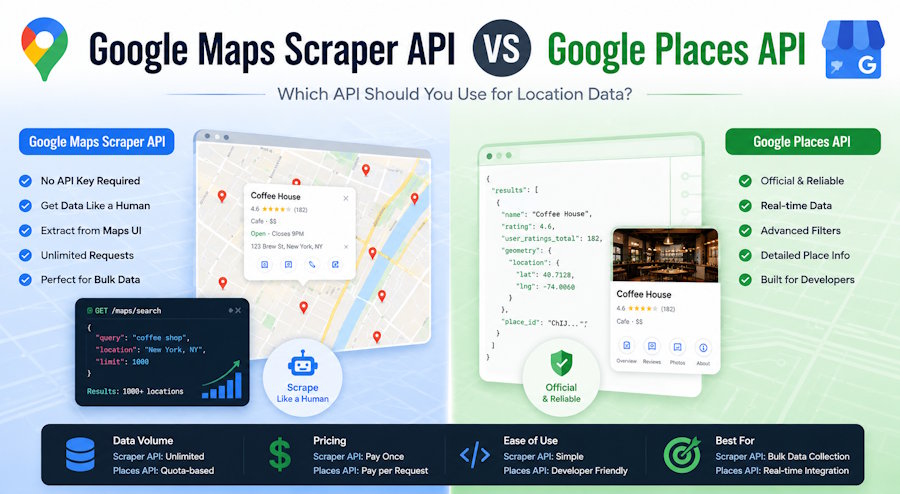
If your product needs Google Maps business data, you'll use an API to get it. Two main options exist, built very differently: Google's official Places API and a Google Maps Scraper API from another provider. They differ on setup, cost, and use. Here's a plain, no-code comparison to help you choose.
Why Businesses Access Google Maps Business Data Through APIs
Looking up businesses one by one works for a person, not for software. When an app or pipeline needs Maps data at scale, it calls an API instead of a browser. The real question is which API?
What Google Places API Is
The Places API is Google's official location service. You create a Google Cloud project, enable the API, turn on billing, and call it with an API key. It returns structured details for a place: name, address, phone, rating, reviews, hours, and photos. Pricing is pay-as-you-go, billed per 1,000 requests, and the rate depends on the SKU and the fields you request. The current version is Places API (New); the older one is legacy.
What a Google Maps Scraper API Is
A Google Maps Scraper API takes a different route. It's a hosted service from another provider that returns Maps business data through an API key. Setup is usually lighter, with no Google Cloud project, and pricing runs on plans or credits. For example, G Maps Extractor offers a Google Maps Scraper API for that data. It can also include public business emails and social profile URLs when those are found from public sources. Since it's independent rather than Google's own, check the provider's reliability and data freshness first.
Key Comparison: Setup, Pricing, Data Access, Flexibility, Business Use Cases
Side by side:
|
Dimension |
Google Places API |
Google Maps Scraper API |
|
Setup |
Google Cloud project, billing, API key |
Provider account and API key, lighter |
|
Data access |
Official structured place data |
Maps business data from the provider |
|
Flexibility |
Set endpoints, you choose the fields |
Built for bulk extraction |
|
Best for |
Apps built around Google services |
Building lists and datasets |
On price, the two work differently:
|
Pricing |
Google Places API |
G Maps Extractor API |
|
Model |
Pay as you go, per 1,000 requests |
Monthly plan with included requests, plus overage |
|
Sample price |
Roughly $5 to $35 per 1,000, by SKU and fields |
From $15/month for 1,000 requests, about $0.011 to $0.014 each after |
|
Free tier |
A monthly free cap per SKU |
20 requests per month |
|
Per request |
Up to about 20 places per search page |
Up to 20 businesses per request |
Which works out cheaper depends on how you use it. At low volume, the Places API free caps can cover a small project; at steady volume, a flat monthly plan is easier to predict; and Places API costs rise with richer fields and higher tiers. Neither is always cheaper. These prices are current at the time of writing, so check both pricing pages.
When Google Places API May Be a Better Fit
Lean toward Places API when:
- You're building an app for users and want official, supported data
- You need close integration with other Google services
- You're fine with paying based on usage
When a Scraper API May Be Useful
Lean toward a scraper API when:
- You want business listings in bulk for lists or datasets
- You'd rather skip the Google Cloud setup
- Plan or credit pricing suits your budget
Responsible API Usage
Either way, a few basics keep you on solid ground. Stick to public business information, like a company's name, address, and phone. Treat anything tied to a person as personal data, and follow the privacy laws that apply to you. When you reach out, follow your region's outreach rules, like consent and a clear way to opt out. And the data is a snapshot, so refresh it rather than trusting an old pull.
TL;DR
- Both APIs return Google Maps business data, built differently
- Places API is official, usage-priced, and needs Google Cloud setup
- A scraper API is independent, often priced by plan, and lighter to start
- Mind privacy, outreach rules, and data freshness either way
Conclusion
There's no single winner, just the right tool for the job. Embedding Maps data in a product and want Google's official service? Places API. Pulling business listings in bulk to build a dataset? A scraper API can be simpler. Weigh setup, pricing, and data needs, and the choice gets clear.
FAQs
Which One Is Cheaper?
It depends on volume and which fields you need. The Places API bills per 1,000 requests by SKU, while G Maps Extractor uses monthly plans with overage. Neither is always cheaper, so map your expected usage to each before deciding.
Is Either Endorsed by Google?
The Places API is Google's own. A scraper API is an independent product, not affiliated with Google, so check how it sources its data and how current that data is.
Match the API to Your Use Case
List what you actually need: the data, the volume, the budget, and the privacy and outreach rules you must follow. Run both options against that list. The right API fits the job, not the longest feature page.

