

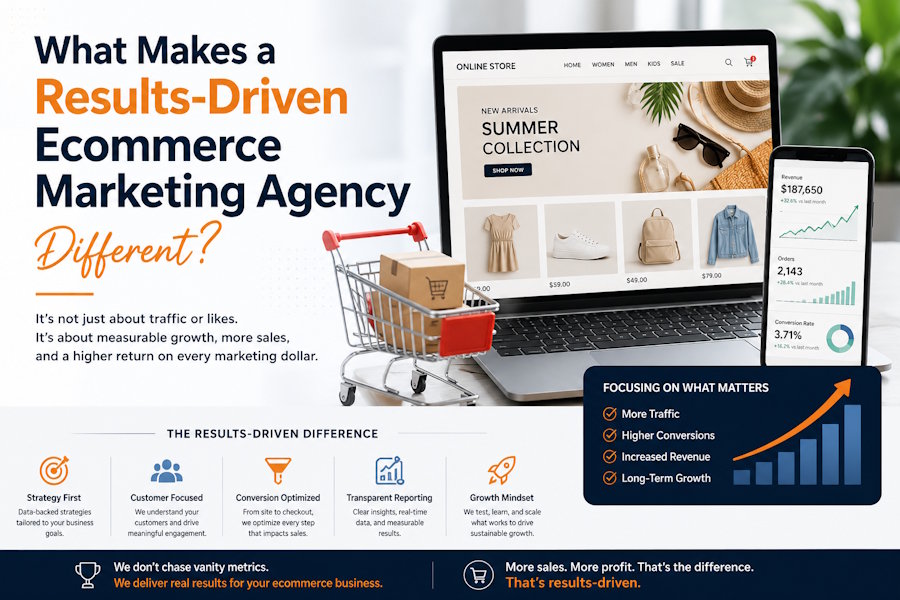
Plenty of agencies can promise traffic. Fewer can turn that traffic into profitable growth.
That distinction matters more than ever in ecommerce, where rising acquisition costs, crowded channels, and tighter margins have changed the brief. Brands are no longer looking for vanity metrics or vague awareness campaigns. They want a partner that understands contribution margin, customer lifetime value, repeat purchase rate, and the real-world trade-offs behind every marketing decision.
So what actually separates a results-driven ecommerce marketing agency from the rest? In practice, it comes down to how they think, what they measure, and how closely they tie marketing activity to commercial outcomes.
They Start With Revenue Mechanics, Not Just Campaigns
A mediocre agency begins with channels: SEO, paid social, email, PPC. A stronger one starts somewhere less glamorous but far more useful: the economics of the business.
Before recommending tactics, a results-focused agency will usually want to understand the basics. What are your margins by product category? Which products drive first-time purchases, and which ones create repeat buying behaviour? Where do customers drop off? How long is the payback period on acquisition?
Those questions shape everything else. If an agency doesn’t understand the commercial engine behind the store, it’s hard to trust any strategy they suggest. Growth is not simply a matter of “more spend” or “more traffic.” It’s about finding efficient paths to profitable scale.
They Look Beyond Top-Line Metrics
This is where weaker agencies often get exposed. It’s easy to celebrate growth in sessions, impressions, or even revenue if no one is asking harder questions. Was that revenue discounted into existence? Did customer acquisition costs creep up? Did return rates erase the gain?
Results-driven agencies keep bringing the conversation back to quality. They care about:
- new customer profitability
- average order value
- conversion rate by channel
- retention and repeat purchase behaviour
- blended return on ad spend and margin impact
That sounds obvious, but in many ecommerce accounts, these metrics are still treated as secondary. The best agencies don’t treat them as side notes; they treat them as the main event.
They Build Strategy Around the Full Customer Journey
One of the clearest differences between average and high-performing agencies is whether they think in isolated channel silos or across the full journey.
A search campaign might capture demand efficiently, but what happens after that first click? Is the landing page aligned with intent? Does the product page do enough to reduce hesitation? Is email automation set up to recover abandoned carts and encourage a second purchase? Is organic content doing anything to support category discovery earlier in the funnel?
This is where specialist knowledge becomes valuable. Teams with deep ecommerce experience tend to connect acquisition, conversion, and retention more effectively than generalist marketers. That’s also why many brands seek out ecommerce business growth experts rather than agencies that approach online retail like any other lead-generation model.
Conversion Is Part of Marketing, Not a Separate Problem
Too many agencies stop at the click. A results-driven one knows that traffic alone rarely fixes growth issues.
If bounce rates are high, if mobile checkout is clunky, if product pages lack clarity, or if merchandising is confusing, no amount of channel optimisation will fully compensate. Strong agencies are comfortable making CRO part of the conversation because they understand that performance lives or dies on the site experience.
That doesn’t mean they redesign the whole store at the first sign of friction. More often, they work through focused experimentation: testing product page layouts, refining offers, improving trust signals, shortening forms, or rethinking how bundles are presented. Small changes, when grounded in data, often outperform sweeping overhauls.
They Treat Data as a Decision Tool, Not a Reporting Ritual
Most agencies report. Not all of them interpret.
A results-driven agency uses data to decide what happens next, not simply to summarise what already happened. That requires more than a dashboard. It requires context. If conversion drops, is it a traffic quality problem, a merchandising issue, a stock issue, or a pricing issue? If paid search looks expensive, is branded search masking underperformance elsewhere? If SEO traffic rises, is it attracting buyers or just browsers?
Good Reporting Creates Better Questions
The best agency-client relationships are usually built around sharper questioning. Instead of saying, “Traffic increased 18% this month,” a strong agency is more likely to say, “Traffic increased, but the lift came from low-intent pages, so revenue impact was limited. We should now shift effort toward commercial category terms and product discovery content.”
That kind of thinking is what moves an account forward. It also helps internal teams make better decisions, because marketing data becomes useful outside the marketing department. Merchandising, stock planning, promotions, and customer service all benefit when performance analysis is tied back to how customers actually behave.
They Balance Process With Experimentation
There’s a reason some agencies create lots of activity without much progress: they confuse being busy with being effective.
Results-driven teams usually have strong operating discipline. They run clear tests, prioritise based on likely impact, and don’t chase every trend. But they also avoid becoming rigid. Ecommerce changes quickly. Consumer behaviour shifts, platforms evolve, and once-reliable acquisition tactics can lose efficiency fast.
The agencies that consistently perform well tend to have a healthy balance of structure and curiosity. They know when to stay the course and when to challenge assumptions.
They’re Comfortable Saying No
This is an underrated quality. A good agency doesn’t automatically agree with every request, especially if the request won’t move the business. If a brand wants to pour budget into a channel that looks exciting but lacks evidence, a serious agency should push back. If discounting is driving sales but hurting long-term value, they should say so.
That kind of honesty can be uncomfortable in the short term, but it’s often the difference between tactical noise and strategic progress.
They Think in Systems, Not Isolated Wins
Ecommerce growth is rarely the result of one clever campaign. More often, it comes from a series of connected improvements: cleaner tracking, sharper positioning, better landing pages, stronger retention flows, tighter channel targeting, and a clearer understanding of where profit is really coming from.
That systems view is what makes a results-driven ecommerce agency different. They’re not there to inflate reports or chase attention for its own sake. They’re there to improve the commercial performance of the store in a way that’s measurable, repeatable, and sustainable.
In other words, they don’t just help brands market better. They help them grow more intelligently. And in today’s ecommerce environment, that’s the difference that matters.

