

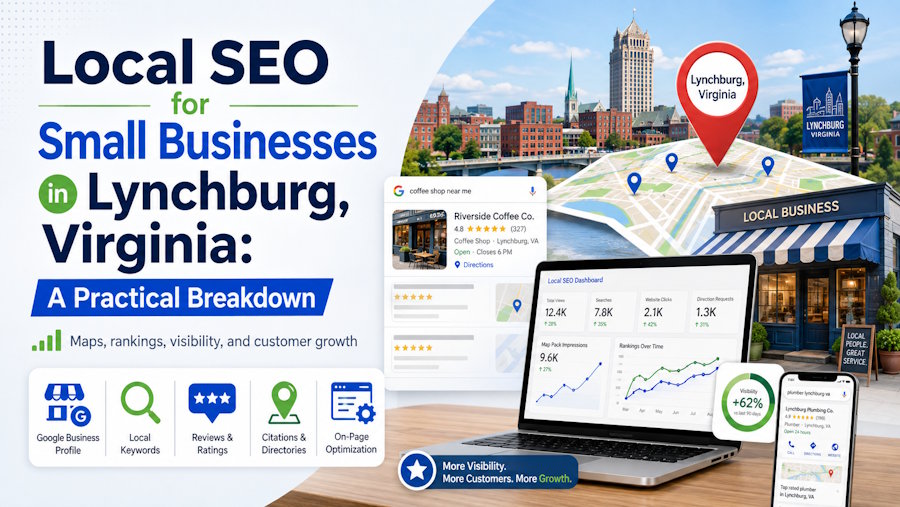
Local search has quietly become a technical problem, not just a marketing one. Ranking in Lynchburg, Virginia today depends on structured data, consistent business information across the web, and content built for both traditional search engines and AI-powered answer tools. Here's what that actually looks like in practice.
Why Local Rankings Work Differently Now
Traditional local SEO rewarded three things: proximity, relevance, and prominence. That's still true. But the mechanism behind "prominence" has changed. Google's local algorithm, and increasingly AI Overviews and chatbot-based search tools, now weigh structured, verifiable signals more heavily than raw link volume ever mattered before.
That means a business in Lynchburg competing for "plumber near me" or "best dentist in Lynchburg VA" isn't just competing on backlinks anymore. It's competing on:
- Google Business Profile completeness and accuracy
- Consistency of name, address, and phone number (NAP) across every directory
- Structured data (schema markup) that tells search engines exactly what the business does and where
- Review volume and recency
- Location-specific content that actually answers what local searchers are typing
Miss any one of these, and a business can look fine on the surface while quietly losing visibility to a competitor who has all five dialed in.
The Technical Layer Most Local Businesses Skip
Here's the part that gets overlooked constantly: schema markup. Most small business websites have none. That's a problem, because structured data is how search engines — and now AI systems — parse a page without guessing.
At minimum, a local business site should implement:
- LocalBusiness schema — name, address, phone, hours, service area
- Review schema — makes star ratings eligible to display directly in search results
- FAQPage schema — structures common questions in a format both Google and AI tools can lift directly into an answer
Without this, a business is relying entirely on the search engine's ability to infer information from unstructured text. That's a bad bet in 2026, when a growing share of local queries get answered inside an AI Overview before the user ever sees a traditional list of links.
NAP Consistency: Small Detail, Big Impact
Name, address, and phone number consistency sounds trivial until it isn't. Search engines cross-reference business information across directories — Google Business Profile, Yelp, Bing Places, industry-specific listings — to validate that a business is legitimate and current. A mismatched suite number or an old phone number still listed on one directory can quietly suppress rankings, because it introduces ambiguity into a system that rewards certainty.
The fix is unglamorous but effective: audit every directory listing, standardize the format exactly, and update anything stale. This is one of the highest-ROI, lowest-effort local SEO tasks a business can do — and one of the most commonly skipped.
Content That Matches How People Actually Search
Generic service pages underperform hyper-specific ones. A single "Our Services" page trying to cover everything a business does will consistently lose to a competitor with a dedicated page for each core service, written around the specific terms local customers actually search.
The same logic extends to AI search. Tools like ChatGPT Search, Perplexity, and Google's AI Overviews favor content structured as direct answers — a clear question as a heading, followed by a concise, factual response, ideally under a couple of sentences before expanding into detail. Long, unstructured paragraphs are harder for these systems to extract and cite.
A Simple Local SEO Audit Checklist
For a Lynchburg-area business assessing where it stands, a quick audit covers:
- Is the Google Business Profile fully complete, with accurate categories and current hours?
- Does NAP data match exactly across all major directories?
- Is LocalBusiness and FAQPage schema implemented on the site?
- Does the business have a dedicated page for each core service, rather than one generic page?
- Is there a consistent process for generating recent customer reviews?
Most businesses fail at least two or three of these without realizing it, simply because local SEO isn't usually anyone's full-time job inside a small company.
Where Specialized Help Comes In
Getting all of this right — technical schema implementation, ongoing NAP audits, service-specific content, and ongoing review generation — takes real time, and it's rarely a one-time fix since search algorithms and AI systems keep shifting what they reward. For that reason, many local businesses in competitive markets partner with a specialized SEO Company in Lynchburg Virginia rather than trying to build and maintain this infrastructure internally alongside day-to-day operations.
The Bottom Line
Local SEO in 2026 isn't just about showing up in a map pack anymore — it's about being structured clearly enough that both traditional search engines and AI-powered tools can read, trust, and cite a business confidently. The businesses treating this as an ongoing technical discipline, rather than a one-time website update, are the ones still visible a year from now.

