

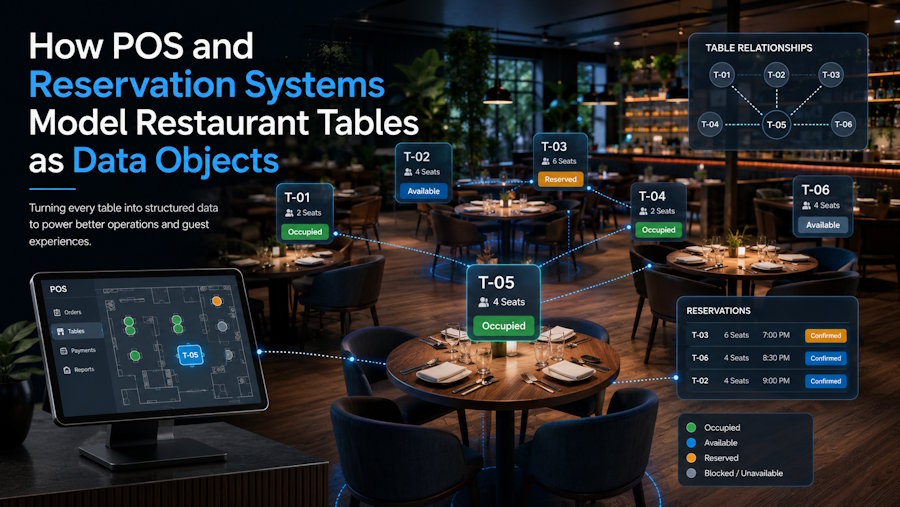
Every developer who takes a hospitality-tech contract hits the same realization in week one: the restaurant's most important entity isn't the order, the menu item, or even the customer. It's the table. Orders attach to it, reservations claim it, servers own sections of it, and the night's revenue is literally a function of its state transitions.
The physical objects being modeled, real restaurant tables with dimensions, capacities, and positions on an actual floor, turn out to shape the software more than most schemas admit. Understanding how production systems model them is a compact lesson in domain-driven design, and a surprisingly good interview topic. Let's walk the model.
The Table Entity and Its Attributes
Strip any POS or reservation platform down to its schema and the table entity appears deceptively simple: an ID, a name or number, a capacity, a zone, and coordinates for the floor-plan view. What makes it intriguing and intricate are the attributes that reflect physical reality.
Capacity is never a single number in serious systems; it's a range, min and max covers, because a four-top seats two pleasantly and six under protest. Server assignment and pooling logic are based on zone membership. And combinability, which tables can physically join with which, is an adjacency relationship that exists in software only because it exists in furniture.
State Machines at Dinner Speed
A table's evening is a textbook finite-state machine: available, reserved, seated, ordered, check-dropped, bussing, available again. Every hospitality system implements some version of it, and the edge cases are where the engineering lives.
- Partial seating: the reservation of six arrives as four, and the state must hold.
- The camper: check paid, table occupied, and the model needs a state for "lingering."
- The move: a party changes tables mid-meal, dragging its order history along.
Race conditions here are business incidents rather than log entries. Double-seating a table because two hosts tapped simultaneously is the hospitality equivalent of a double-spend, and the locking strategy matters accordingly.
The Combination Problem
The gnarliest logic in floor management is combination: pushing tables together for the party of ten. In data terms, several entities temporarily merge into a composite with pooled capacity, then dissolve back. Systems model this with join tables, effective-dated groupings, or virtual parent entities, and classic entity-relationship modeling gets a real workout in the design review.
Notice the physical dependency, though. The software's combination graph is only as good as the furniture's actual geometry: square tops on matching bases combine cleanly, rounds don't combine at all, and mismatched heights ruin a merge in the physical world no matter what the database believes. The best floor-management deployments start with an audit of which tables genuinely pair.
Reservations: Bin-Packing Against the Clock
The reservation engine treats the same entities as inventory in a time-slotted bin-packing problem: fit incoming parties into table capacities across service windows while respecting turn-time estimates. Every platform's secret sauce is here, in the pacing algorithm that decides whether the 7:30 four-top means the 9:15 request gets accepted. A growing share of those requests never touch a booking widget at all; AI for restaurants now answers the phone directly and writes the reservation straight into the same table-state model, no host relay required.
The input variables come off the furniture spec sheet. Turn times track comfort, and comfort tracks seating; capacity ranges track physical dimensions. Developers who ask for the furniture inventory before writing the config always look strange in the kickoff meeting and always ship a better allocator.
The Floor Plan as UI and as Truth
The visual floor plan, that draggable map of squares and circles, is where the schema meets its users. Hosts think spatially, and the map is their query interface: tap the corner booth, see its state, seat the party.
The persistent design question is whether the map is decoration over the data or the data itself. Mature systems make coordinates and adjacency first-class, which is what enables the good features: pathfinding server assignments, heat-mapping revenue by table position, and flagging that the two-top by the kitchen door turns 20 percent slower than its twins across the room.
What the Data Gives Back to the Furniture
Close the loop, because the flow turns around and makes money. When tables become entities with revenue histories, the reports begin to audit the physical arrangement. Which positions are not performing, which combinations are used week-to-week and which never, where capacity mismatches squander covers, and whether the room needs more deuces and fewer six-tops.
These dashboards are increasingly being used by operators to make furniture decisions: redesigning floors, ordering combinable square tops instead of set rounds, and sizing the next order based on observed party-size distributions. Finally, the database files a purchasing recommendation.
The Entity That Pays the Bills
Hospitality software is a stack of abstractions balanced on wooden legs. Model the table well, its capacity honestly, its states completely, its physical constraints faithfully, and everything above it, ordering, reservations, and analytics, inherits the soundness.
It's a good reminder for any domain: the strongest schemas start with respect for the physical objects underneath. In this industry the object seats four, turns three times a night, and holds the entire revenue model on its top. Model it like it matters, because on Friday at eight, nothing matters more. And the next time a product owner asks why table service is the hardest module in the sprint, show them the dining room at eight on a Friday: the physical system was always the complicated one, and the code is just trying to keep up. Ship accordingly.

