

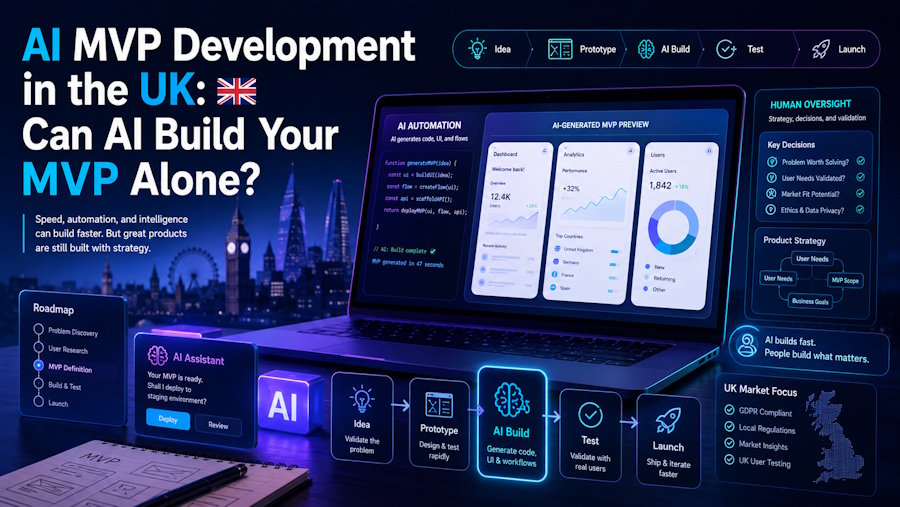
A founder in Leeds types one paragraph into an AI app builder on a Tuesday night. By Wednesday morning there's a live product: sign-up flow, working database, Stripe checkout, no code written by hand. That part is real, and it's why "can I just use AI?" has stopped being a lazy question and turned into a serious one. What it doesn't answer is whether that product is fundable, compliant with UK data law, or still standing by month two.
Short answer: no. Not on its own, and definitely not for anything you plan to raise money on or put in front of regulated UK customers. AI can knock together the shell of a product in an afternoon. It can't make the architectural, legal, and scope calls that decide whether it survives contact with real users, real investors, and the ICO. That's the actual gap mvp development services fill, not the first draft of the code, but everything the prompt never thought to ask about. Here's the honest version, with numbers behind it rather than vibes.
What "Building an MVP With AI Alone" Actually Means
Three years ago, this question didn't really exist. It does now because the tools changed, properly changed. Founders tend to lump every "AI coding tool" into one bucket, but there are really three different jobs being done:
- App generators (Lovable, Bolt.new, v0, Replit Agent, Base44). Describe the product in a chat window, get back a working full-stack app — frontend, backend, auth, often a database — in one pass.
- Agent-assisted editors (Cursor, Windsurf). Built for people who already code. The AI pairs with you inside your existing workflow rather than generating a whole app from nothing.
- Agent CLIs (Claude Code, Codex). Headless tools that work against a codebase that already exists, useful once there's a real product to maintain, not before.
Most people ask "can AI build my MVP alone?" mean the first category. And the honest ceiling there, in 2026, is this: someone with zero coding background can go from an idea to a live, working prototype in a single day. Sign-up, database, Stripe checkout, all of it. That's not marketing spin. Where it gets shakier is everything that comes after "it works."
What AI Genuinely Handles Well Today
Give these tools credit. They're good enough now to:
- Scaffold a full CRUD application with working authentication in hours instead of weeks
- Turn out clean, professional UI without hiring a designer
- Wire up payments, email, and the usual integrations from one sentence
- Sync code straight to GitHub, so you're not trapped inside someone else's platform
- Turn a six-to-eight-week agency discovery phase into a weekend
That's a genuine shift, especially if all you want to know is whether an idea has any pull before you spend a pound proving it. The trouble starts the moment something isn't a standard pattern.
Where AI MVP Development Hits a Wall for UK Founders
Most "AI can build your whole app" content skips this bit entirely, and it happens to be the most UK-specific part of the whole conversation.
Start with data protection, because it's no longer a box you tick later. The UK's Data (Use and Access) Act 2025 gave the ICO a statutory duty, in force since 12 May 2026, to publish a formal Code of Practice on AI and Automated Decision-Making. Practically, that means any UK product using AI to make or meaningfully shape a decision about a real person needs a documented Data Protection Impact Assessment before it launches. Not after. No app-generator tool is going to ask you for this, because it has no idea your product exists, let alone what it does with someone's data.
Regulated sectors add a second layer on top of that. Touch financial services and the FCA's Consumer Duty, its SYSC 8 outsourcing rules, and the SS1/23 model risk principles all apply from the moment you go live — it doesn't matter how the thing was built. Healthtech and anything near NHS data carries its own weight too. None of this is on an AI builder's radar.
Then there's the architecture problem, which tends to show up quietly. People who stress-test these tools for a living describe the real test as what happens in the second week of a project: changing a data model, adding a user role, fixing a broken integration, moving code into a proper repository without losing what came before. AI-generated apps are excellent at the patterns they've seen a thousand times and slow to a crawl on anything unusual, which is exactly where technical debt gets baked in for good.
And underneath all of it sits scope judgement, which is a human skill, not a prompting skill. Deciding what not to build is still the single most common mistake in MVP development, whether AI is involved or not. A chat interface will happily generate every feature you describe. It won't tell you that half of them are the reason your build costs three times what it should and takes twice as long to actually learn anything from.
What UK Investors Actually Want to See in 2026
The funding backdrop matters here because it shapes what "good enough" even means. According to HSBC Innovation Banking and Dealroom, UK startups raised $17 billion in venture capital in the first half of 2026 alone, more than double the same period the year before, with AI-focused companies taking roughly three-quarters of that total. On paper, that reads like an open door for anything with "AI" in the pitch deck.
Look closer, though, and the door narrows. NatWest's Future of UK Innovation report, done with PitchBook, found capital concentrating in fewer, more proven businesses — deals over £25 million made up more than 70% of all funding raised, the highest share in a decade. Investors aren't rewarding a polished AI-generated demo just for existing. They're rewarding evidence: real usage data, a defensible architecture, a founder who can explain the product's decisions rather than just its prompt history.
That's usually the exact moment an AI-alone MVP gets found out, in a pitch meeting, in front of people whose job is finding the gap.
The Hybrid Model: Why UK Founders Are Turning to AI MVP Development Services
The founders getting this right in 2026 aren't picking a side between "AI" and "developers." They're using AI for fast, structural work and putting real engineering judgement around whatever carries risk: compliance, architecture, scope.
In practice, at a studio that knows what it's doing, AI MVP Development looks like this: the tools generate a first working draft of the code at speed, and a senior engineer owns the architecture decisions, the security review, and the UK regulatory obligations that no app builder was ever built to know about. It's faster than starting from scratch and considerably safer than pushing unreviewed AI output straight into production. Most serious AI MVP development services are built around that exact split — not replacing judgement with automation, just moving the boring parts faster.
Choosing the Right MVP App Development Company
Once you've validated enough to move past the solo AI-tool stage, here's what to actually check before picking a partner:
- Discovery before code. A proper MVP app development company runs a paid discovery phase, usually £2,000–£8,000 over two to four weeks, to nail down user journeys, tech stack, and a fixed-price scope before anyone writes anything.
- Transparent IP and code ownership. You own the code outright, with a clean handover. No platform lock-in disguised as convenience.
- Real compliance awareness. Ask them directly whether they've run a DPIA before, and whether they understand FCA or healthcare rules if that's your world.
- A framework, not a template. A team worth hiring can actually explain how they decide what belongs in v1 and what gets cut, and why.
Bytes Technolab is worth looking at as one reference point for this model. It's an AI-first digital product engineering company that runs discovery workshops before writing code, keeps proof-of-concept work clearly separate from MVP builds, and designs architecture for AI-first scalability from day one instead of bolting AI on later. It's not the only mvp development company working this way, and it shouldn't be the only one you look at, but its public approach is a fair example of what "AI-assisted, not AI-alone" actually looks like when it's done by people who do it every day.
MVP Development for Startups: The Realistic 2026 Cost and Timeline Picture
UK MVP development for startups settles into fairly consistent bands in 2026, no matter which agency you ask:
|
Tier |
Typical Cost |
Timeline |
What It Covers |
|
Simple, single-platform |
£8,000–£30,000 |
8–12 weeks |
One platform, 3–5 core features, basic auth/payment |
|
Standard, multi-role |
£30,000–£80,000 |
12–20 weeks |
Light integrations (CRM, analytics, payments) |
|
Complex, multi-system |
£70,000–£150,000 |
20–32 weeks |
Multi-platform, real-time data, API integrations |
|
Regulated (fintech/health) |
£150,000+ |
28+ weeks |
FCA/ICO/NHS compliance, accessibility standards |
Most funded UK startups land somewhere between £30,000 and £60,000. For context, a UK senior full-stack developer bills around £625 a day, London agencies charge £600–£900 per developer day, and nearshore or offshore rates come in well below that, which is why the exact same scope can come back at wildly different prices depending on who's building it, not just what's being built.
Where AI actually moves this number: it can shrink or wipe out the earliest, cheapest validation stage, the £4,000–£8,000 "is this even worth building" prototype, down to a weekend and a free-tier account. It rarely touches the standard or complex tiers, because those costs come from architecture, compliance, and QA, not typing speed.
The Bottom Line
AI has genuinely rewritten the first mile of MVP development. It hasn't touched the parts that decide whether a UK startup is fundable, compliant, or standing on ground that holds. The founders getting real value from AI MVP development in 2026 aren't asking it to do everything. They're using it to move fast on the parts that don't carry risk, and bringing in real engineering judgement for the parts that do.
Frequently Asked Questions
Can AI build an entire app by itself in 2026?
It can build a working prototype alone: authentication, database, UI, basic payments, often in a single day. It can't independently handle UK data protection compliance, security hardening, or the architecture decisions that decide whether the product survives being used at scale.
How much does MVP development cost in the UK in 2026?
Anywhere from £8,000 for a simple single-platform product to £150,000+ for something regulated or multi-system. Most funded startups land at £30,000–£60,000.
What's the fastest way to build an MVP with AI?
Use an app-generator tool like Lovable, Bolt.new, or Base44 to validate the idea first and get a clickable prototype. Bring in real engineering judgement once there's a signal worth protecting: before you raise money, take on regulated data, or need the thing to actually scale.
Do I still need a development team if I use tools like Lovable or Bolt.new?
For a throwaway test, no. For anything you plan to launch, raise on, or that touches personal data, yes, at minimum for architecture and compliance review.
Is an AI-built MVP fundable in the UK?
Rarely on its own. UK investors in 2026 are putting their money behind fewer, more proven businesses. A working AI-generated demo can start the conversation. It almost never closes the round without real usage data and a product decision behind it that the founder can actually defend.
What's the difference between using an AI app builder alone and hiring an AI MVP development company?
An app builder gives you code. An MVP development company gives you a validated, defensible product: discovery, architecture, compliance review, and a build that won't need quietly rebuilding six months after launch.

