

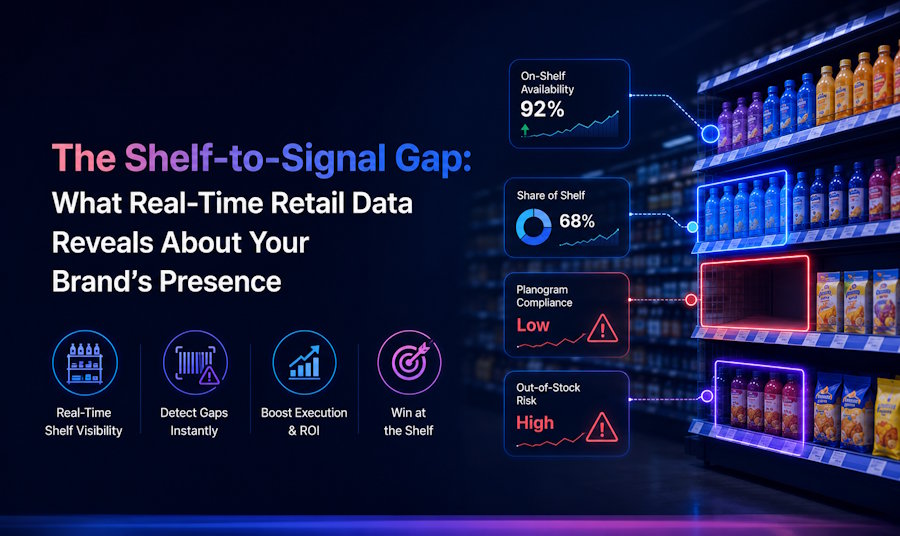
Most CPG executives are making multimillion-dollar supply chain and trade-spend decisions using data that is fundamentally lying to them. We congratulate ourselves on complex AI demand-sensing models and multi-channel marketing attribution, yet we remain willfully blind to the last three feet of the retail journey.
When a product isn't on the shelf, your syndicated scanner data doesn't report an execution failure; it records zero sales and quietly tells your algorithms that consumer demand has dropped. We treat phantom inventory, missing facings, and broken planograms as tactical retail annoyances, when in reality they are strategic blind spots that bleed margins and destroy brand equity every single day.
The Phantom Reality of "In-Stock"
Let’s be honest between peers: what does your ERP actually mean when it says a key SKU is "in-stock" at a tier-one big-box retailer?
Usually, it means the product made it through the distribution center, arrived at the loading dock, and is currently sitting on a pallet in the backroom, or trapped on a high riser three aisles over. Technically, the inventory exists. Pragmatically? It’s invisible.
The industry calls this the Shelf-to-Signal Gap: the widening chasm between what your upstream supply chain thinks is happening in a store and the physical reality a shopper experiences when walking down the aisle.
When we rely on historical point-of-sale (POS) data or weekly syndicated audits, we are steering a supertanker by looking at where the wake was two weeks ago. By the time an out-of-stock or a collapsed display registers in a monthly roll-up report, the shopper has already bought a competitor’s product—and worse, that algorithmically misread "drop in demand" will now lower your next replenishment cycle.
What Real-Time Shelf Data Actually Tells You?
When enterprise CPG brands bridge this gap by capturing daily, granular, shelf-level retail signals, whether through automated computer vision, real-time POS velocity anomalies, or digitized rep workflows, the narrative shifts dramatically.
You stop asking, "Why didn't this SKU sell?" and start seeing what is actually happening at the point of decision:
- Trade Spend Leakage is Hidden in Plain Sight: You spent hundreds of thousands of dollars to secure an endcap display for a new flavor launch. Real-time presence data often reveals that 20% to 30% of those promotional displays are never built on time, or are placed in secondary aisles with zero foot traffic. You aren't suffering from a creative failure; you’re suffering from an execution blind spot.
- Share of Shelf vs. Share of Voice: You can dominate TikTok and linear TV, but if your allocated four facings have shrunk to one because a store clerk used your empty space to spread out a competitor's overstock, your marketing ROI collapses at the shelf.
- The "Zero-Velocity" False Positive: A SKU sitting at zero sales for three consecutive days isn't always a rejected product; it is frequently an unreplenished shelf tag or a misplaced barcode. Real-time signals flag the anomaly before the automated reorder point adjusts downward.
The Philosophical Shift: From Post-Mortem to Predictive
There is a philosophical shift required here for enterprise leadership. For decades, retail execution has been treated as an audit—a policing mechanism to check boxes and score compliance after the fact.
But in an era where brand switching takes less than three seconds of hesitation, shelf presence is no longer just an operational metric; it is the ultimate moment of brand truth.
Why spend millions engineering the perfect consumer journey only to abandon the traveler at the final border crossing?
Closing the Shelf-to-Signal Gap means changing how our organizations define truth. It requires moving from siloed data—where supply chain looks at warehouse shipments, sales looks at sell-in, and marketing looks at sentiment—to a single, harmonized operational reality. Real-time shelf data acts as the unifying language that forces all three departments to look at the same physical inch of retail space.
How Leaders Bridge the Gap?
Pragmatic CPG leaders aren't waiting for retailers to magically fix store-level labor shortages. They are building resilience through three AI-driven design principles:
- Instrument the Aisle with Computer Vision and Edge AI: Move away from static, infrequent field surveys toward continuous, automated shelf ingestion. By deploying image-recognition neural networks and smart-camera integrations, brands can translate raw photos into structured shelf-share and planogram-compliance data in seconds , removing human subjectivity from the audit loop.
- Deploy Predictive Analytics for Dynamic Field Routing: Stop sending field reps into stores on rigid, calendar-based schedules. Use machine learning anomaly-detection models trained on POS velocity and inventory telemetry to predict stockouts before they occur. These algorithms dynamically route field teams to the exact doors where a high-velocity SKU is experiencing a phantom inventory void today.
- Embed Agentic Workflows for Autonomous Intervention: Transition from passive dashboards to AI agents that initiate corrective actions automatically. When the system detects a persistent shelf-to-signal discrepancy, intelligent workflows can trigger instant replenishment requests, generate real-time tickets for retail store managers, or adjust downstream demand forecasting models so artificial sales dips don't distort future production.
The Bottom Line
The shelf is not just a passive piece of metal holding your cardboard and glass; it is a live data transmitter. Every misplaced facing, every phantom out-of-stock, and every missing promo tag is a signal telling you where your operating model is leaking capital.
The competitive advantage in CPG over the next decade won't belong to the brand with the cleverest ads or the most aggressive trade discounts. It will belong to the leadership teams that have the courage to strip away delayed averages, look at the unvarnished reality of the shelf, and close the gap between what they planned in the boardroom and what the shopper sees in the aisle.

