

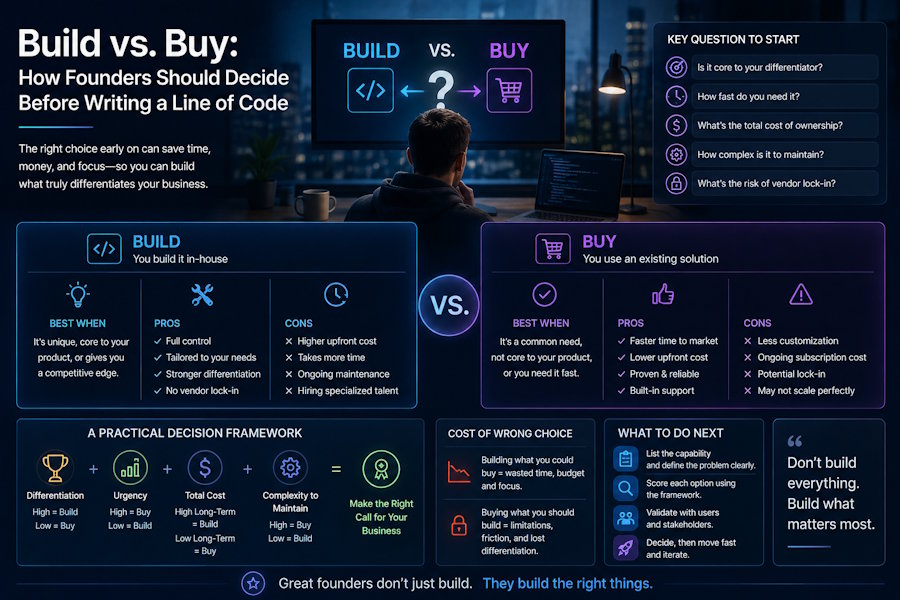
Build versus buy is one of the first serious spending decisions a founder makes, and it usually gets settled by instinct rather than arithmetic. Engineers want to build because building is the interesting part of the job. Finance wants to buy because a subscription is a known number. Whoever argues more confidently in the room tends to win, which is a poor way to set the shape of your engineering costs for the next several years.
The question worth asking isn't whether custom software beats a vendor product, because that depends entirely on what the software does. What matters is which parts of your product customers are actually paying for, what a working system costs to own rather than to ship, and whether the workflow in question is common enough that somebody already sells a good answer to it. Getting those three things straight before anyone opens an editor saves more money than any tooling choice made afterward.
Separate what customers pay for from what keeps the lights on
Every company runs on two categories of software. The first is the reason customers pick you over a competitor. The second is plumbing that every business in your sector needs in roughly the same shape, including payroll, document storage, invoicing, authentication, email delivery and compliance mailing. Committing engineers to the plumbing means the best available outcome is parity with a vendor who has spent a decade refining the same feature set, and parity isn't much of a prize.
Use the test of whether a customer would notice or care that you built it. If the honest answer is no, and if the workflow is standardized enough that your competitors all solve it the same way, the argument for building is already weak before anyone looks at a cost model. Founders reverse this more often than they'd like to admit, building the commodity piece first because it's well understood and therefore easy to scope, while the part that actually differentiates the company sits in a backlog waiting for capacity that never appears.
The build column is missing most of its costs
Most build estimates cover the first working version and stop at launch. That's the cheapest stretch in the life of a system and the only stretch anyone models properly. An analysis of nearly 1,500 technology projects put the average cost overrun at 27 percent, with roughly one in six running far beyond that, and those were projects with dedicated managers, formal budgets and executive oversight. A startup estimating in a planning doc on a Friday afternoon has less structure around the number, not more.
Maintenance is the line item that never gets estimated
Once something ships it needs security patches, dependency upgrades, bug fixes, monitoring and somebody reachable when it breaks at an awkward hour. None of that work scales down because your attention has moved on to a launch. A tool built in six weeks can comfortably absorb a day of engineering time every week from then on, and across a five-person team that's a permanent twenty percent tax charged against whatever you were planning to build next.
Attention is scarcer than cash
Money can be raised, but founder and engineering attention can't be topped up. Every internal system you own competes for the same code review cycles, the same on-call rotation and the same hiring plan as the product you're selling to customers. The cost that actually hurts isn't the salary spent building the tool. It's the customer-facing feature that slipped two quarters because two engineers spent the month fixing something a vendor would have fixed for you.
Run the numbers against a real vendor price
Pull an actual price before comparing anything, because vendor pricing for commodity workflows is usually published and charged per transaction, which turns the comparison into arithmetic instead of opinion. For a compliance mailing workflow, the Send Certified Mail cost per letter is listed openly, so you can multiply it by realistic annual volume and set that figure directly against what the same capability costs to build and keep running in-house.
On the build side, count everything a vendor invoice would have covered:
- Engineering hours to a genuinely working version, at fully loaded cost rather than base salary
- Integration and testing time against every system it has to touch
- Ongoing maintenance, estimated honestly as a share of one engineer's year
- Infrastructure, monitoring, and any third-party API fees the build still depends on
- The cost of keeping somebody on call for it once it's live
Run both columns across three years rather than one, because a build always looks strongest in year one and weakest after that. If the vendor number comes in lower over that period, the decision has made itself. If the two land close together, buying is still the better bet, since the build carries execution risk that a spreadsheet has no way of showing you.
The middle option most founders skip
Treating this as a binary choice hides the answer that works for a lot of early companies, which is to buy the capability now and keep the option to build later. Put a thin internal interface in front of the vendor from day one, so your application talks to your own function rather than directly to somebody else's API. The work involved is small at the start, usually a few days, and it means a future switch touches one file instead of forty.
That approach also gives you real usage data before committing engineering time. After a year on a vendor you know your actual transaction volume, which edge cases matter, where the product frustrates your team, and what a replacement would genuinely need to do. Those are the exact inputs a build estimate needs and the exact things nobody knows at the point the decision usually gets made. Founders who buy first and build second tend to build the right thing when they finally do it, partly because the specification came from a year of real operations rather than a whiteboard.
The reverse move is far more painful. Migrating off a system you built, once it holds live customer data and half a dozen integrations, absorbs months that nobody planned for. Buying leaves your options open at a lower cost than building does, which is worth something on its own when the business is still finding its shape.
What actually justifies building
Building earns its place when the workflow is genuinely yours. If your pricing logic, matching algorithm, underwriting model or scheduling engine is the reason customers choose you, no vendor product will fit, and forcing one to fit costs more in workarounds and glue code than building it properly would have. Regulatory constraints can push you the same way, and so can volume economics at a scale where per-transaction pricing stops being sensible and starts being the largest line in your operating budget.
The condition to check before committing is stability. Unstable or poorly understood requirements sit behind a large share of software project failures, and early-stage companies change direction constantly, mostly for good reasons. Building against a specification you'll rewrite in two months is how a six-week project quietly becomes a six-month one. If you can't write down what the system must do and reasonably expect that description to survive a year, you aren't ready to build it yet.
Where buying goes wrong
Vendor decisions have their own failure modes, and ignoring them just produces the opposite mistake. Data portability bites hardest, because a tool holding three years of records with no clean export path becomes expensive to leave regardless of how the pricing looks. Read what happens to your data on termination before you sign, and confirm the export format is something you could actually load somewhere else without a project of its own.
Pricing that scales with your growth is the second trap. Per-seat or per-transaction rates that look trivial at current volume can become a serious cost at ten times the size, and vendors understand precisely when a customer has grown too dependent to switch. Model the cost at the scale you're planning for rather than the one you're operating at today. Integration depth deserves the same scrutiny, since a tool that only half connects to your stack generates manual reconciliation work that grows into somebody's full-time job without anyone deciding to hire for it.
Making the call, then revisiting it
Write the decision down along with the reasoning and the numbers behind it, then set a date to look at it again. Conditions change, and a buy that was correct at fifty transactions a month may be wrong at fifty thousand, in the same way a build that made sense when the workflow was unusual becomes pure maintenance overhead once three vendors catch up. Founders who treat the choice as permanent end up defending old decisions instead of the business. Doing the arithmetic properly at the start is what makes revisiting it later an afternoon's work rather than a rewrite, and it gives whoever inherits the system a written record of why it exists at all.

