

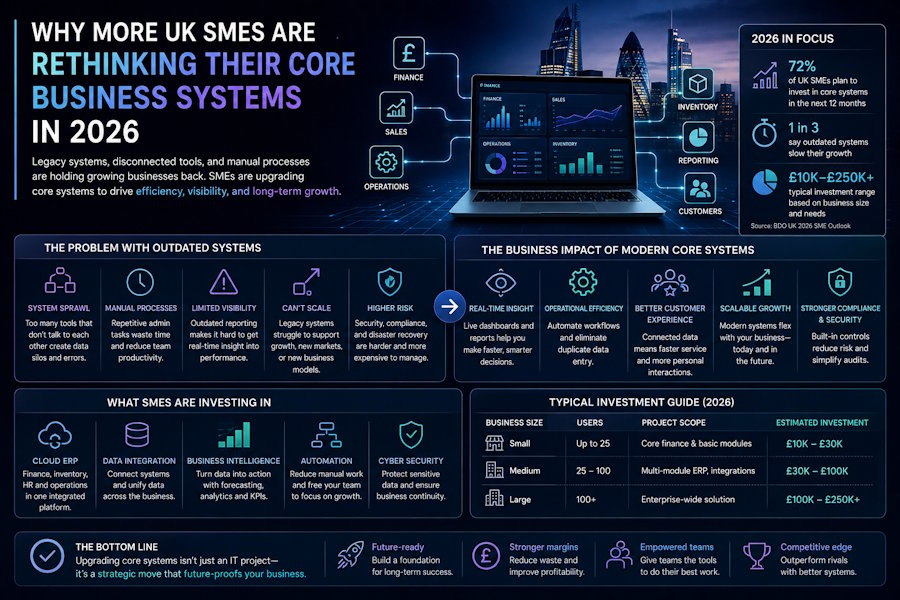
Every growing business hits the same wall eventually. The systems that got you from ten people to fifty stop working somewhere between fifty and two hundred. Finance is still running on desktop accounting software bought a decade ago. The warehouse team tracks stock on a spreadsheet that only one person really understands. Sales orders get keyed into three different places before anyone can ship anything. None of it is broken exactly — it just stops being fast enough, or accurate enough, or joined-up enough to run the business the way leadership actually needs to run it.
This is usually the point where two decisions get made almost at the same time, even though they don't always get talked about together: replacing the core finance and operations system, and finally getting IT support that can keep pace with a business that's no longer small. They're more connected than most businesses realise.
The system sprawl problem
Ask most operations directors what software their business runs on and you'll get a list, not an answer. One platform for accounts. Another for CRM. A separate tool for stock. Payroll bolted on somewhere else. Each one does its job reasonably well in isolation, but nothing talks to anything else, so someone spends hours every week re-keying the same data from one system into another, hoping the numbers still match at the end of it.
This is exactly the gap that modern ERP platforms like Microsoft Dynamics 365 Business Central were built to close. Rather than stitching together finance, sales, inventory, and project management from separate vendors, Business Central brings all of it into one connected environment — built on the same Microsoft stack most businesses already use for email, Teams, and Excel. For businesses that have outgrown standalone accounting packages like Sage or QuickBooks, that consolidation alone tends to save far more staff time than most finance directors expect going in.
What makes the difference between a Business Central rollout that pays for itself and one that just adds a new layer of complexity is usually the implementation partner. A good Business Central consultancy in the UK won't just install the software — they'll map it against how your business actually operates, migrate historical data properly, configure the modules you genuinely need rather than every module going, and stay involved long enough after go-live that the system beds in rather than gets fought against for the first six months.
Why IT support gets overlooked until it's a problem
The second half of this equation is the IT infrastructure sitting underneath all of it. A new ERP system, however well implemented, is only as reliable as the network, security, and support wrapped around it. This is where a lot of growing businesses get caught out: they've upgraded the software but left the underlying IT support arrangement exactly as it was when the company was a fraction of its current size.
For a business based in the capital, that usually means the moment has come to look properly at what a genuine IT support company in London actually offers versus a break-fix arrangement with a local freelancer. The difference isn't just response times, although that matters when a system outage is costing real money every hour it continues. It's proactive monitoring that catches a failing server before it takes down the finance system on month-end, security that's actually built around current threats rather than a firewall installed five years ago, and a support desk that understands your business well enough not to need the whole context explained from scratch every time something goes wrong.
The same logic applies just as much outside London. Businesses based in and around Manchester face an identical set of pressures — growing headcount, more complex systems, higher stakes if something goes down — and the calculation for finding the right IT support provider in Manchester is the same one: does this partner actually understand the size and complexity of business you're becoming, not just the one you were when you first signed up.
Where the two decisions meet
Here's the part that's easy to miss: a Business Central implementation and a managed IT support arrangement work best when they're not treated as two separate projects run by two separate suppliers who've never spoken to each other. Server infrastructure, network performance, cybersecurity, and the ERP system itself all depend on each other. A slow network makes Business Central feel slow, however well it's configured. Weak endpoint security around the machines accessing your finance data undoes half the governance built into the ERP system in the first place. And when something does go wrong, having one point of accountability rather than two suppliers pointing at each other saves real time in a crisis.
This is exactly why a growing number of UK businesses are consolidating both decisions with a single technology partner — one that can implement and support Business Central properly, and also run the day-to-day IT infrastructure it depends on, rather than juggling an ERP vendor and an IT provider who've never been in the same room.
What good actually looks like
If you're weighing up this decision for your own business, a few questions tend to separate the partners worth talking to from the ones who'll just sell you a licence and disappear:
- Do they ask about your actual processes before recommending a configuration, or do they pitch a standard package regardless of what you tell them?
- Can they show real UK implementation experience in your sector, not just generic case studies?
- Is ongoing support — for both the ERP system and the underlying IT — part of the conversation from day one, or an afterthought once the contract's signed?
- Are they UK-based, with consultants who understand UK compliance, UK working patterns, and UK data protection requirements, rather than a support desk in a different time zone?
Getting this right the first time matters more than it might seem. Migrating core business systems and IT support arrangements twice in three years, because the first choice didn't hold up, costs far more in disruption than most businesses budget for.
The bottom line
System sprawl and outdated IT support rarely announce themselves as urgent problems — they just quietly cost a business time, accuracy, and headroom to grow, month after month, until someone finally stops and adds it up. Businesses that get ahead of it tend to do two things at once: they consolidate their finance and operations onto a single, properly implemented platform, and they pair it with IT support that's actually built for where the business is heading, not where it started. Get both right, with a partner who understands how they connect, and the whole operation runs noticeably lighter than it did before.

