

Qatar's international school sector has grown substantially, and with it the number of families navigating British-curriculum qualifications for the first time. These are the questions that come up most often, answered plainly.
My Child's School Says They Are On Track. Should I Believe It?
Partly. On track usually means performing consistently with their predicted grade, which is itself an estimate.
The more useful question is which specific paper is weakest. A student can be on track overall and badly exposed on one component.
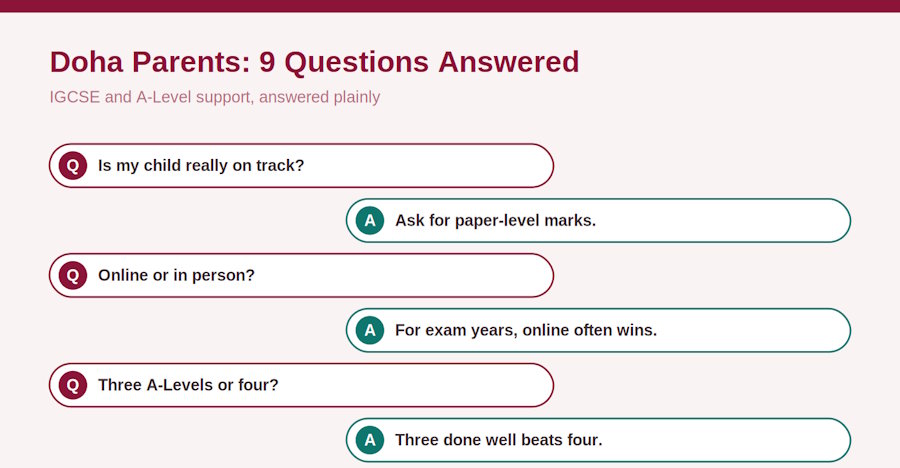
Ask for paper-level marks, not the subject grade.
When Should We Start Thinking About Extra Support?
Earlier than most families do, and for shorter periods.
Targeted work in Year 10 or Year 12, addressing a specific gap over six to ten weeks, consistently outperforms and costs less than intensive support in the spring of the examination year.
The families who spend the most are almost always the ones who started latest. Providers working across the Gulf, including Tuitional, report that the majority of enquiries arrive in the final six months, which is precisely when the available options narrow and the required hours multiply.
Is Online Tutoring Actually as Good as in Person?
For exam-year students in specific subjects, generally yes, and often better.
The reason is matching. Doha has a finite pool of tutors who have taught a particular specification for years. Online, that pool is global.
For younger children the answer flips. Primary and lower-secondary students usually do better in a room with an adult and a whiteboard.
How Do I Know Whether a Tutor Is Any Good?
Ask one question: have you taught this exact specification, and how recently?
Not the subject, the specification. Cambridge IGCSE Mathematics and Edexcel International GCSE Mathematics are different papers with different structures.
A tutor who cannot answer that precisely has not taught it recently enough.
What Does a Reasonable Trial Look Like?
A genuine trial session is now standard across most reputable providers, and many offer it free.
What you are assessing is not whether the tutor is knowledgeable. It is whether your child talks during the session.
A tutor who lectures for an hour has not diagnosed anything. A tutor who asks questions and listens has.
How Much Should We Be Doing Each Week?
Less than most people assume, done properly.
One focused session a week in one subject, with work completed between sessions, beats three unfocused sessions across three subjects.
If a student is doing tuition in four subjects simultaneously, something has gone wrong upstream and more tuition will not fix it.
My Child Understands the Material but Does Badly in Exams. What Is That?
Almost always technique, and it is the most fixable problem in the entire system.
It typically shows up as misreading command words, writing long answers to short-mark questions, running out of time, or not structuring extended answers to the mark scheme.
None of that requires more content revision. It requires working past papers with the mark scheme open alongside.
Should My Child Do Three A-Levels or Four?
Three, done well, beats four done adequately in almost every case.
Most university offers are built on three subjects. A fourth adds workload and rarely adds admissions value unless a specific course requires it.
The exception is further mathematics for students applying to engineering, mathematics or computer science courses, where it is frequently expected rather than optional.
Check the entry requirements for the actual courses your child is considering before deciding. Guessing at this costs a great deal of unnecessary work.
How Do We Handle Two Children Needing Help at Once?
Prioritise by proximity to an external examination, not by who is struggling more.
A Year 13 student six months from finals has a hard deadline. A Year 9 student has time, and a gap identified now can be closed gradually at far lower cost.
Some providers allow session packs to be shared between siblings, which is worth asking about directly. It is not always advertised.
My Child Says They Do Not Want a Tutor. Now What?
This is common and usually worth taking seriously rather than overriding.
Resistance is often about embarrassment rather than the tuition itself. A teenager who thinks needing help means being behind will resist help specifically because of what it seems to signal.
Reframing it usually works better than insisting. Strong students use coaching. The framing that lands is improvement, not remediation.
A free trial session helps here too, because it converts an abstract argument into a concrete experience. Most resistance dissolves after one good session with a tutor the student actually likes.
If it does not dissolve, forcing it rarely produces results. A student who does not engage will not benefit regardless of how good the tutor is.
What About the National Curriculum Requirements?
Schools in Qatar operate within a regulatory framework, and requirements around curriculum, Arabic language and Islamic studies apply to schools depending on their category and student population.
These are set out by the Ministry of Education and Higher Education, and it is worth confirming directly with your school how they apply to your child rather than relying on what other parents report.
The requirements are frequently misunderstood in parent groups, and the details vary.
What if the Results Are Disappointing?
Take three days before deciding anything.
Then get the component marks, establish whether the loss was spread evenly or concentrated in one paper, and check the deadlines for reviews of marking and resit registration. Both are shorter than they feel.
A concentrated loss on one paper is genuinely good news. It means the problem has a specific address rather than being a general weakness, and specific problems get fixed faster.
And it is worth saying plainly: a disappointing result at IGCSE or AS level is common, recoverable, and a very poor predictor of what happens next.
One Last Thing
The single most useful piece of information any parent in Doha can hold is which examination board and specification their child is actually entered for.
Write it down. Check every resource, every revision guide and every tutor against it.
It sounds trivial. It prevents most of the wasted money in this process.

