

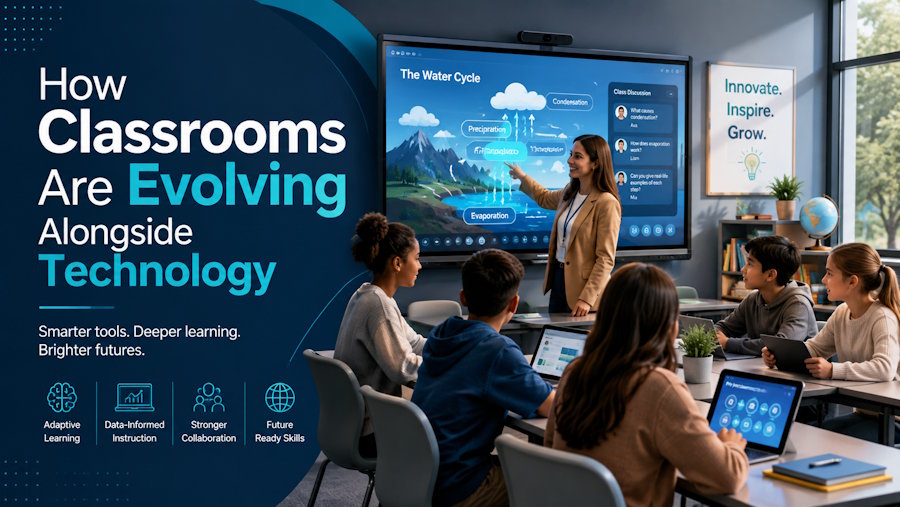
Picture a classroom from twenty years ago: rows of fixed desks, a chalkboard at the front, a teacher standing at the one spot in the room built for talking. Now picture a classroom today, robotics kits on a table, a student programming a floor robot in a corner, another group huddled around a 3D printer watching a design take shape. The technology changed dramatically. The room itself, in a lot of schools, barely changed at all.
That mismatch is a bigger problem than it sounds. A classroom built around rows facing a chalkboard was never designed to support small-group robotics work, collaborative coding, or a maker station running in the corner. When the furniture and layout don't evolve alongside the technology, the technology ends up working against the room instead of with it. Districts often notice this only after the equipment has already been purchased and installed, once teachers start describing the daily friction of trying to run a modern lesson in a room that was never built for it.
The Room That Technology Left Behind
Fixed, forward-facing desks made sense for a specific model of teaching: one person talking, everyone else listening and taking notes. That model assumed learning was mostly one-directional. Modern STEM instruction assumes the opposite. Students need to cluster around a shared robotics kit, spread out for independent design work, then regroup for a whole-class discussion, sometimes all within a single fifty-minute period.
A room that can't physically support that shift becomes the bottleneck. Teachers end up working around the furniture instead of with it, pushing desks together awkwardly before a group activity, then pushing them back before the bell rings. That's wasted time and wasted energy that has nothing to do with the actual lesson. Multiply that across every STEM class period in a building, and the losses add up to something far bigger than a few minutes here and there.
What Learning Environment Solutions Actually Change
A room and its equipment work better when they're designed together. Mobile tables that reconfigure in seconds. Seating that supports both individual focus and group collaboration. Layouts built around how STEM instruction actually moves through a class period rather than how a lecture used to. That's what learning environment solutions actually deliver: a coordinated plan for the room, the equipment inside it, and the implementation support to bring it all together, rather than two separate purchases moving on two separate timelines.
That coordination matters more than it might seem. A robotics kit or a 3D printer only delivers on its potential if students can actually gather around it, move between stations, and shift from one mode of work to another without a five-minute furniture reshuffle eating into instructional time.
The Research Behind Flexible Space
This isn't just a design preference. A research analysis combining data from IEA's TIMSS 2019 study, one of the largest international assessments of math and science education, with OECD's School User Survey found that the physical and non-physical characteristics of a learning environment together explain up to three-quarters of a year's worth of learning effect, a substantial impact for something as seemingly unglamorous as furniture and room layout.
The same research surfaced something worth sitting with: despite growing interest in flexible, modern classroom design, traditional setups with fixed seating and teacher-centered instruction remain the dominant model in most schools studied. In other words, the research supporting flexible learning spaces has been building for years, but the physical reality in most classrooms hasn't caught up to it. Technology adoption has outpaced furniture adoption almost everywhere.
Why Fixed Furniture Still Dominates Anyway
That gap isn't really a mystery once you look at how schools typically budget. Technology purchases, laptops, robotics kits, interactive displays, tend to get evaluated on their own, separate from furniture and room design, which often gets treated as a lower-priority facilities line item revisited far less often. A district can spend heavily on STEM equipment and still hand teachers a room that was laid out for a completely different teaching model decades earlier.
Breaking that pattern requires treating the room itself as part of the STEM investment, not a separate decision made by a different department on a different timeline. Districts that plan furniture and technology together tend to get meaningfully more use out of both, since neither one is working against the other by the time students actually walk into the room. That coordination is often less about spending more money overall and more about spending the same money at the same time, on a room and its equipment planned as one decision rather than two.
What Evolving Alongside Technology Actually Looks Like
In practice, this looks less dramatic than a full renovation and more like a series of deliberate choices. Tables on casters instead of desks bolted to a fixed arrangement. Seating that can support both a lecture format and a four-person robotics team within the same class period. Storage and charging solutions built into the furniture itself, rather than a tangle of cables and a cart parked awkwardly in the corner.
None of this requires abandoning traditional instruction entirely. A flexible room still supports direct instruction when that's what a lesson calls for. The difference is that it can shift to something else, small groups, hands-on stations, a full-class discussion, without the room itself getting in the way of the transition.
Conclusion
The technology inside a modern STEM classroom has changed dramatically over the past two decades. The room it sits in, in far too many schools, hasn't kept pace. That gap costs real instructional time and real learning effect, exactly the kind of impact research keeps confirming even as most classrooms remain built for a teaching model that's already been left behind. Closing that gap doesn't require a full renovation. It requires treating the room as seriously as the technology inside it, planned together rather than purchased on two entirely separate timelines, so the space a student walks into finally matches the kind of learning it's actually meant to support.

