

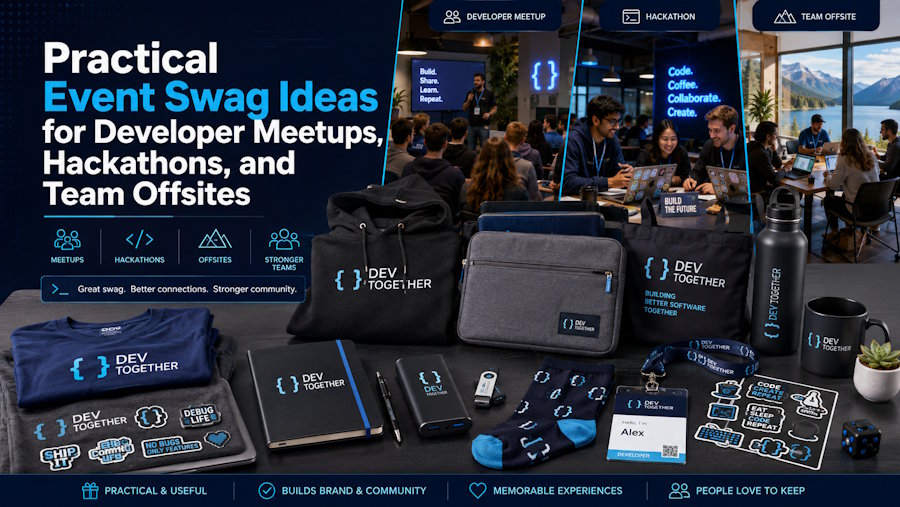
Developer events have changed a lot over the last few years. Some are still held in conference halls with badge scanners and sponsor booths. Others happen in coworking spaces, company offices, universities, or fully remote environments. What has not changed is the challenge of making people feel welcome without handing them items that end up forgotten in a drawer.
Swag can be useful when it fits the context of the event. It can help attendees remember a workshop, make a team offsite feel more organized, or give sponsors a tasteful way to be present without interrupting the experience.
The key is to think beyond the logo. A practical item, chosen for a specific moment, often has more impact than a large box of generic giveaways.
Think About the Moment, Not Just the Logo
A common mistake is starting with the product catalog. It is more helpful to start with the event itself.
Ask what attendees will be doing. Will they be coding for several hours? Traveling between venues? Meeting teammates in person for the first time? Sitting through technical sessions? Walking around a city after the event?
For a hands-on JavaScript workshop, a small notebook, a keyboard shortcut card, or a USB-C adapter pouch may be appreciated. For an open-source maintainer meetup, stickers tied to projects or inside jokes can feel more personal. For a company engineering retreat, something that supports the shared activity often feels less random.
When the item matches the moment, it does not need to be expensive. It only needs to make sense.
Match the Item to the Type of Event
Different developer gatherings call for different kinds of items. A local meetup does not need the same swag plan as a multi-day hackathon.
For evening meetups, lightweight items work well. Laptop stickers, small notebooks, enamel pins, coffee cards, or cable organizers are easy to hand out and easy for attendees to carry home. The goal is to add a small touch without making the registration table feel crowded.
For hackathons, utility matters more. Participants may spend long hours at a venue, so items like water bottles, screen cloths, charging cables, sleep masks, or snack kits can be more useful than decorative merchandise. If teams are presenting demos, simple name badges or table signs can also help people navigate the room.
For conferences, portability is important. Attendees may already be carrying a laptop, a backpack, and items from multiple booths. Flat, compact, or reusable items are easier to appreciate. A well-designed sticker sheet may travel better than a bulky object that does not fit in luggage.
For team offsites or client events, the setting can guide the choice. If a software company hosts a relaxed outdoor day or a small golf outing after a planning session, a custom golf ball marker can feel more connected to the activity than another general office item.
That kind of context matters. The same item that feels irrelevant at a coding workshop may feel thoughtful at an offsite built around casual conversation and relationship-building.
Make Small Items Feel Intentional
Small does not have to mean forgettable. Presentation can change how an item is received.
For example, a sticker handed out loose at a registration desk may be ignored. The same sticker included in a welcome card with a short note about the event theme feels more deliberate. A simple QR code leading to the workshop repository, schedule, or community chat can make the card even more useful.
If the event has a theme, use it. A conference track about AI tooling might include a prompt card with practical examples. A cybersecurity meetup could provide a privacy checklist. A cloud infrastructure workshop might include a command reference card.
These items are inexpensive, but they connect directly to the experience. They also respect the audience by offering something functional rather than just decorative.
Keep Branding Subtle and Useful
Developers are often skeptical of overly promotional merchandise. A large logo across every surface can make an item feel less like a gift and more like an advertisement.
Subtle branding usually works better. A small mark, an event name, a project mascot, or a clever phrase can make the item easier to use in public. If the design is attractive on its own, people are more likely to keep it.
This is especially true for items that live on laptops, desks, bags, or clothing. Attendees may be happy to use something that reminds them of a good event, but they may avoid anything that feels too loud.
It can also help to involve the community. If the event has an active Discord, Slack, GitHub organization, or forum, ask for design ideas before printing. A community-voted sticker or patch can create more interest than a design selected in isolation.
Plan Around Logistics Early
Even simple swag can become stressful if logistics are ignored.
Start with storage and transport. Can the items be shipped directly to the venue? Will someone need to carry them on a flight? Are they fragile, heavy, or awkward to pack? A clever idea may become frustrating if it creates extra work for organizers.
Lead time is another concern. Custom items often need design approval, production, and shipping time. If the event date is close, choose something simpler rather than rushing a complicated order.
For international events, avoid items that may create customs issues or high shipping costs. Food, liquids, batteries, and certain electronics can be difficult to move across borders. Lightweight paper goods, stickers, fabric patches, and compact accessories are often easier.
It is also worth ordering a few extras. Speakers, volunteers, late registrants, and last-minute sponsors may need materials. Having a small buffer prevents awkward moments at the registration desk.
Add a Digital Layer Without Making It Complicated
Swag does not need to stay entirely physical. A small digital layer can make it more useful.
A QR code on a welcome card can lead to the event schedule, code samples, slides, or a feedback form. A sticker sheet can include a short URL to a GitHub repository. A notebook can have a first-page link to workshop resources.
Keep this simple. Attendees should not need to create an account, download an app, or share unnecessary personal information just to access materials. The digital layer should remove friction, not create it.
For remote or hybrid events, consider mailing fewer physical items and focusing on items that support participation. A small desk accessory, printed challenge card, or digital badge can help remote attendees feel included without turning the process into a shipping project.
Measure What People Actually Use
After the event, pay attention to what remains. Did people take the notebooks but leave the pens? Did stickers disappear quickly? Did the charging cables create support questions? Did attendees mention any item in feedback?
You do not need a complex survey. A few practical questions can help:
What did you keep?
What did you use during the event?
What would you skip next time?
This feedback helps future planning. It can also prevent waste. If a particular item was ignored, remove it from the next event budget. If something simple worked well, improve the design and use it again.
Conclusion
Good event swag is not about filling a bag with as many items as possible. It is about choosing objects that support the experience, fit the setting, and feel respectful of the audience.
For developer meetups, hackathons, conferences, and team offsites, the most useful approach is to begin with the event journey. Think about what attendees will do, what they will carry, and what they may want to remember later.
When swag is practical, well-timed, and thoughtfully presented, it becomes part of the event rather than an afterthought.

