

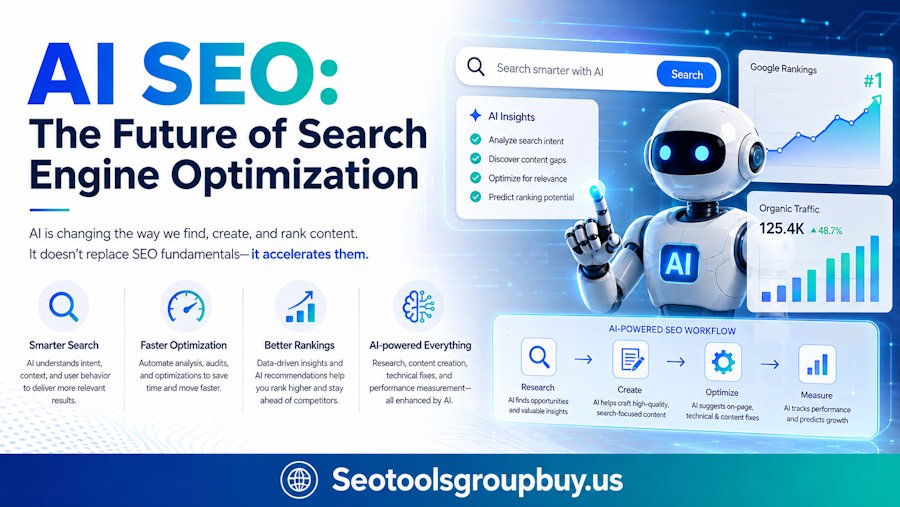
Search is being rebuilt in real time. Google's results increasingly reflect machine learning in search algorithms, Search Generative Experience–style answers, richer SERP features, and users who now ask longer, more conversational questions—often inside the "future of search with AI assistants" rather than a traditional search box. That shift is exactly why AI SEO: The Future of Search Engine Optimization isn't just a trend phrase; it's the practical reality of how brands will win visibility over the next few years.
AI doesn't replace SEO fundamentals—it accelerates them. The teams that learn how to use AI for SEO (without compromising quality, trust, or compliance) will move faster on research, content, technical fixes, and measurement. This guide breaks down what AI SEO actually is, how it differs from classic approaches, and how to build an AI-enabled workflow that improves rankings sustainably. Teams building this workflow without a large in-house budget often start by comparing affordable, shared-access options like SEO Tools Group Buy for the research and optimization platforms mentioned throughout this guide.
What "AI SEO" Really Means (and What It Doesn't)
AI SEO is the use of AI systems—especially large language models (LLMs), classifiers, and predictive models—to improve the speed and quality of SEO decisions and execution. It can support:
- Discovery (audience research, topic gaps, entity mapping)
- Creation (outlines, drafts, FAQs, schema ideas, internal link plans)
- Optimization (on-page improvements, generative AI content optimization)
- Technical (log-file analysis, crawl prioritization, AI-driven technical SEO audit)
- Measurement (SEO forecasting with predictive analytics, anomaly detection)
What it doesn't mean: publishing a huge volume of thin AI-written pages and hoping they rank. AI can scale output, but rankings still depend on usefulness, uniqueness, and trust signals.
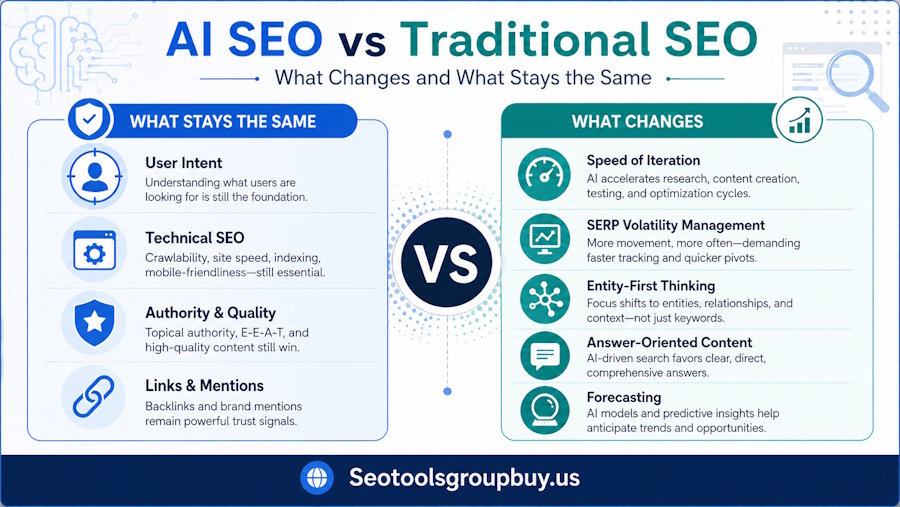
AI SEO vs Traditional SEO: What Changes and What Stays the Same
Understanding AI SEO vs traditional SEO helps you adopt AI without losing the fundamentals.
What stays the same
- Search engines still aim to satisfy user intent.
- Technical accessibility (crawlability, indexation, performance) remains non-negotiable.
- Authority, reputation, and quality matter—especially in sensitive topics.
- Links and mentions still influence discovery and trust (even if the mechanics evolve).
What changes
- Speed of iteration: AI compresses cycles (research → draft → optimize → ship).
- SERP volatility management: AI helps detect patterns and respond faster.
- Entity-first thinking: SEO is shifting from keywords-only to entity-based SEO and knowledge graphs.
- Answer-oriented content: Content must be structured for extraction, summarization, and assistant-driven experiences.
- Forecasting: AI models support scenario planning rather than reactive reporting.
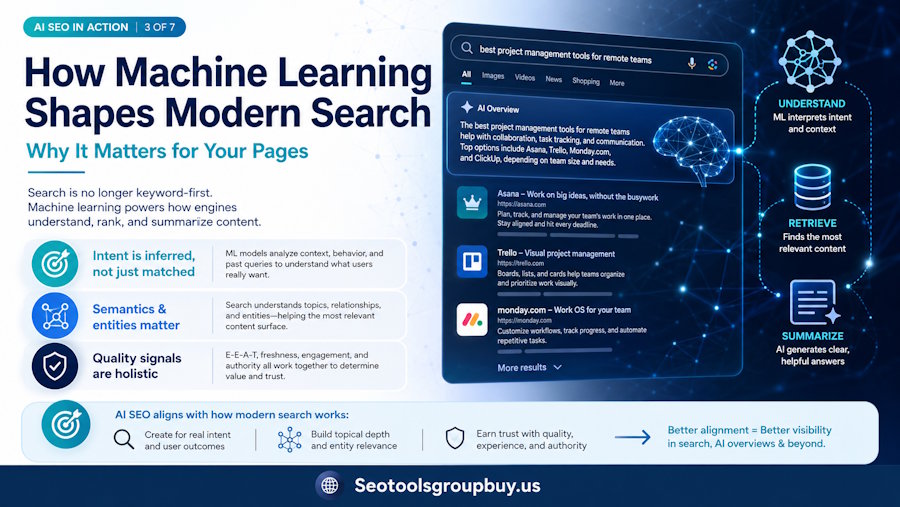
How Machine Learning Shapes Modern Search (Why It Matters for Your Pages)
"Machine learning in search algorithms" affects how queries are interpreted, how pages are evaluated, and how results are personalized or re-ranked. Practically, this means:
- Intent is inferred, not just matched: pages must satisfy the underlying need, not only include a phrase.
- Semantics and entities matter: the relationships between concepts (people, products, locations, attributes) influence relevance.
- Quality signals are holistic: consistency, topical authority, and user satisfaction carry more weight than isolated on-page tactics.
So, AI SEO isn't about "tricking" a model—it's about aligning with how modern retrieval, ranking, and summarization actually work.
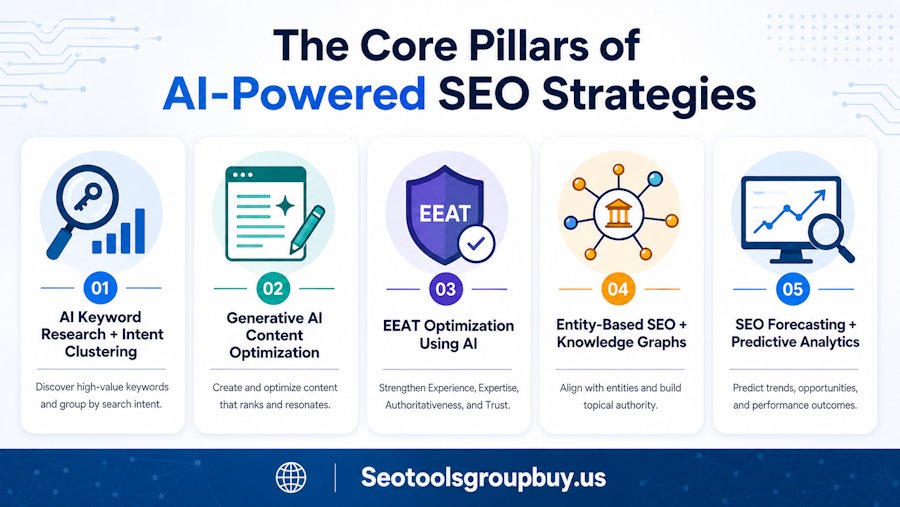
The Core Pillars of AI-Powered SEO Strategies
Below are the pillars that make AI-powered SEO strategies effective and safe.
1) AI keyword research tools + intent clustering
Classic keyword lists are too flat. AI can cluster keywords by intent, funnel stage, and entity overlap so you can build pages that win whole topic areas, not single queries.
Use AI to:
- Group keywords into intent clusters (informational, commercial, navigational, troubleshooting)
- Identify "hub-and-spoke" opportunities (pillar pages + supporting articles)
- Surface long-tail questions that map to PAA/FAQ patterns
- Detect cannibalization risks (multiple URLs targeting the same intent)
Actionable tip: After clustering, assign each cluster a single "primary URL owner" to prevent internal competition.
2) Generative AI content optimization (without sameness)
Generative AI is great at structure and clarity—but it tends to average out uniqueness. The win comes from blending AI support with human expertise and original inputs.
AI can help you:
- Build outlines that cover subtopics users expect
- Create strong intros, summaries, and comparison sections
- Draft FAQs and definitions
- Suggest internal links and anchor text variations
Humans must provide:
- Real examples, data, processes, screenshots, benchmarks, and experience
- Brand voice, point of view, and "what we learned" insights
- Editorial judgment (what to include, what to cut)
Practical checklist for generative AI content optimization
- Add a section that only your brand can write (proprietary framework, field notes, case findings)
- Include "constraints" (who it's for, who it's not for) to reduce genericness
- Add decision aids (tables, step-by-step, pitfalls, trade-offs)
- Ensure the page answers "next step" questions to reduce pogo-sticking
3) EEAT optimization using AI (with real evidence)
AI can assist with EEAT optimization using AI, but it can't fabricate trust. Use AI to systematize the presentation of trust signals:
- Author bios with credentials and relevant experience
- Source suggestions for claims that need citations
- Consistency checks across your site (policies, disclaimers, "about" info)
- Content audits that flag missing "proof" (examples, methodology, references)
Actionable tip: Build an "evidence library" (case studies, internal metrics, expert quotes) and have AI recommend where to insert evidence across related pages.
4) Entity-based SEO and knowledge graphs
Entity-first SEO is one of the clearest "future-proof" moves. AI can help you model entities and relationships:
- Your brand entity and sub-entities (products, services, locations, experts)
- Topic entities (problems, solutions, tools, standards)
- Attribute entities (price, dimensions, compliance, integrations)
- Competitor/alternative entities (comparisons, "best of" lists)
Then reinforce those entities via:
- Clear headings and definitions
- Schema markup (Organization, Product, Service, FAQ, HowTo where appropriate)
- Internal links using consistent naming
- "About" and "Who we serve" sections
- Consistent NAP and brand details for local entities
Actionable tip: Use AI to generate an entity map from your top pages, then identify missing supporting pages that "complete the graph."
Best AI SEO Tools: Categories That Actually Matter
Instead of chasing a single "best" tool, think in categories. "SEO tools" are evolving quickly, but these buckets are stable. For teams comparing where to actually get access to these tool categories at a reasonable cost, providers like SEO Groups Buy offer a shared-access route worth evaluating alongside individual subscriptions.
1) AI keyword research tools
Look for tools that provide:
- Intent classification
- Topic clustering
- SERP feature detection
- Competitor gap analysis
2) Content optimization and briefing platforms
Prioritize:
- SERP-driven outlines
- Content scoring based on coverage and intent (not keyword density)
- Internal link recommendations
- Brief templates and workflow approvals
3) Technical SEO automation and auditing
A solid stack supports:
- Crawl diagnostics and indexation monitoring
- Structured data validation at scale
- Page performance prioritization
- Log-file insights (what bots actually crawl)
4) Predictive analytics and forecasting
For SEO forecasting with predictive analytics, look for:
- Trend detection and seasonality modeling
- Scenario analysis (what happens if we publish X pages or fix Y issues?)
- Early-warning anomaly alerts (traffic drops, indexation issues, ranking shifts)
5) Generative assistants for production
General-purpose LLMs can accelerate:
- Drafts and rewrites
- Meta descriptions and titles (with constraints)
- Schema suggestions
- Internal link copy variants
- Content repurposing (blog → email → landing page)
Note: "best AI SEO tools" depends on your scale, CMS, and team maturity. The best stack is the one that integrates with your workflow and enforces quality gates.
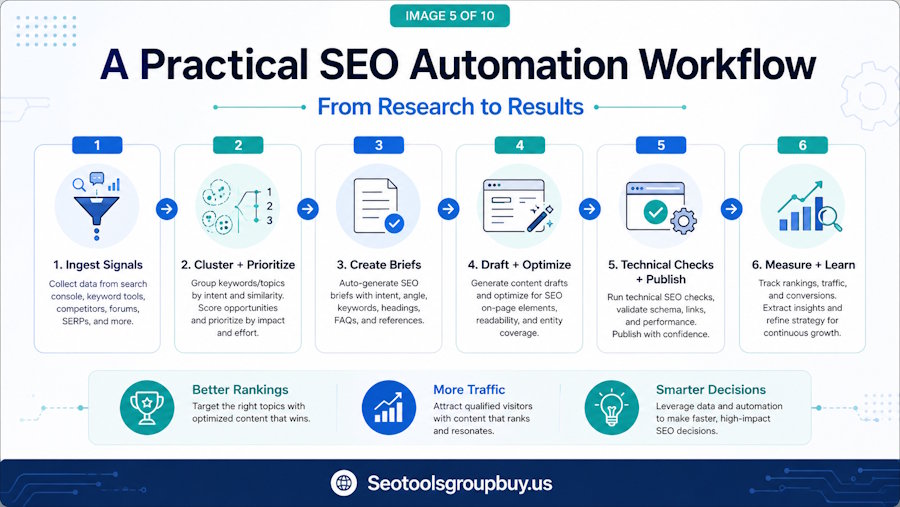
A Practical SEO Automation Workflow (That Doesn't Break Quality)
A reliable SEO automation workflow keeps humans in control while letting AI handle repeatable work.
Step 1: Ingest signals
Automate collection from:
- Search Console queries and pages
- Rank tracking and SERP snapshots
- Crawl data
- Analytics events and conversions
- Support tickets / sales calls / chat logs
Step 2: Cluster + prioritize
Use AI to classify and score opportunities by:
- Demand (volume proxies + trend direction)
- Effort (content vs technical complexity)
- Impact (conversion intent, revenue alignment)
- Risk (YMYL sensitivity, compliance needs)
Step 3: Create briefs
AI generates a draft brief including:
- Primary intent statement
- Target entities and subtopics
- Suggested headings
- FAQ candidates
- Internal link targets
- "Unique angle required" notes (what must be original)
Step 4: Draft and optimize
AI assists with:
- First draft and structure
- On-page improvements and clarity
- Snippet-friendly formatting
Humans finalize:
- Accuracy and tone
- Original examples and claims
- Final editorial and brand checks
Step 5: Technical checks + publish
Run automated checks:
- Indexability (noindex, canonical, robots)
- Structured data validation
- Performance budgets (Core Web Vitals directionally)
- Internal linking and orphan detection
Step 6: Measure + learn
AI summarizes:
- Query expansion (new keywords you're appearing for)
- Ranking/CTR shifts by intent cluster
- Content decay signals
- Next best actions
This loop is how you consistently improve rankings with AI—not by mass publishing, but by speeding up iteration and learning.
AI-Driven Technical SEO Audit: Where AI Helps Most
An AI-driven technical SEO audit is especially valuable because technical SEO produces huge datasets. AI can:
- Triage crawl errors by likely impact
- Detect patterns (template-level issues, parameter problems, faceted navigation traps)
- Identify internal linking inefficiencies (too deep, no hub structure)
- Flag duplicate or near-duplicate pages and suggest consolidation logic
- Prioritize pages for performance improvements based on traffic/conversion potential
Actionable tip: Ask AI to convert audit findings into a developer-ready backlog: ticket titles, acceptance criteria, and "how to validate" steps.
Is AI Content Safe for Google? The Real Answer
Many teams still ask: is AI content safe for Google?
AI-generated content can perform well if it's helpful, original in value (not necessarily in phrasing), accurate, and created with appropriate oversight. The risk isn't "AI" itself—it's low-quality content, misinformation, and scaled pages that add no value.
To reduce risk:
- Treat AI as a co-writer, not an autopublisher
- Keep strong editorial standards (fact-checking, citations where needed)
- Add unique experience, data, and examples
- Avoid doorway pages and templated "near duplicates"
- Ensure the page genuinely satisfies the intent better than alternatives
Rule of thumb: If removing the AI would not change your process (because humans still add the real value), you're usually on the safer side.
Using an AI SEO Agency: When It's Worth It (and What to Ask)
An ai seo agency can be a multiplier if they bring systems—not just promises. Consider hiring one if you need:
- A scalable production and QA pipeline
- Advanced technical support (log files, indexation debugging, JavaScript rendering issues)
- Content strategy tied to revenue and funnel stages
- Training for your in-house team
Questions to ask an ai seo agency:
- What's your approach to AI SEO vs traditional SEO, and where do you still rely on manual expertise?
- How do you prevent generic, copycat content?
- What quality gates do you enforce before publishing?
- How do you handle EEAT optimization using AI without fabricating authority?
- Can you show a sample SEO automation workflow, from brief to measurement?
- How do you measure success beyond rankings (leads, pipeline, retention)?
If an in-house team is a better fit than an agency retainer, checking a comparable toolkit provider like SEO GB Tools is worth doing before committing to either route, since tool cost is often the deciding factor.
Advanced Use Cases: Where AI Creates a Moat
SEO forecasting with predictive analytics (planning, not guessing)
Instead of "we hope this works," predictive models help you:
- Estimate upside by intent cluster
- Plan publishing velocity realistically
- Forecast recovery timelines after migrations
- Predict seasonal content needs months ahead
SERP + assistant optimization (the next distribution layer)
The future of search with AI assistants means visibility may come from:
- Summaries and citations in AI answers
- "Best options" lists generated dynamically
- Assistant-driven task completion (booking, purchasing, comparing)
To prepare:
- Write answer-ready sections (clear definitions, steps, constraints)
- Strengthen entity clarity (who/what/where)
- Use structured data where appropriate
- Build pages that are easy to quote accurately (tight claims, clear wording, evidence)
Content refresh at scale (content decay management)
AI can monitor:
- Drops in impressions for top pages
- Competitors adding new sections you lack
- New questions emerging in your niche
Then it can propose:
- New headings and FAQ additions
- Internal link updates
- Consolidation opportunities
Common Mistakes to Avoid with AI SEO
- Publishing without verification: hallucinations and subtle errors destroy trust.
- Optimizing only for keywords: ignoring entities and intent leads to thin coverage.
- Over-automating titles/meta: you'll get bland SERP copy unless you add brand voice and constraints.
- One-size-fits-all prompts: prompts must reflect your niche, audience, and compliance needs.
- Skipping technical SEO: AI content won't rank if indexation, canonicals, or internal linking are broken.
- No measurement loop: without post-publish learning, AI just helps you ship faster—not smarter.
A Simple "How to Use AI for SEO" Playbook (Start This Week)
If you want immediate momentum, implement this lightweight playbook:
- Pick one topic cluster tied to revenue.
- Use AI keyword research tools to cluster queries by intent.
- Build one pillar page + 4–8 supporting pages.
- For each page:
- AI drafts outline + FAQ + internal link suggestions
- Humans add: examples, POV, proof, and editing
- Run a mini AI-driven technical SEO audit: indexability, canonicals, internal linking depth, performance basics
- After 2–4 weeks, use AI to summarize: new queries, CTR changes, conversion signals
- Refresh pages based on what the data shows.
This approach avoids the "publish 200 AI articles" trap and instead builds topical authority with control.
Conclusion: AI SEO Is the Future—But Quality Is the Advantage
AI is changing how search works and how SEO gets done. The teams that treat AI as a disciplined system—pairing automation with editorial standards, entity-focused strategy, and strong measurement—will win.
If you remember one takeaway from AI SEO: The Future of Search Engine Optimization, make it this: use AI to increase the quality and speed of decisions, not just the volume of content. Build a repeatable SEO automation workflow, lean into entity-based SEO and knowledge graphs, invest in EEAT optimization using AI, and keep a close eye on where the future of search with AI assistants is taking user behavior.

