

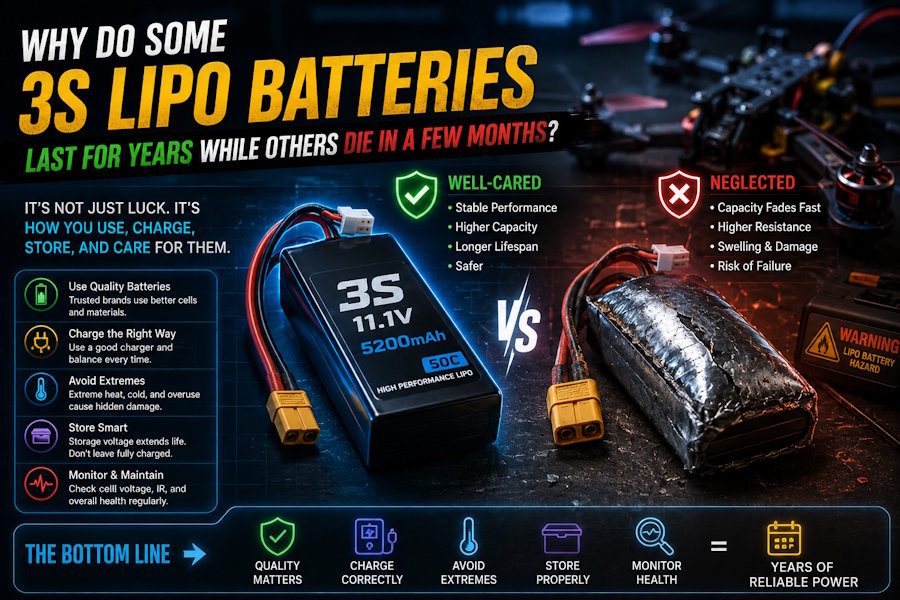
Most of the time, 3S LiPo batteries don't give up because they're poorly made. They wear out because of the little shortcuts we all take without thinking twice. We've still got it. It's sitting in a drawer with a strip of masking tape wrapped around it that says, "Don't use." Every now and then we find it while looking for spare connectors, laugh about it for a second and remember how convinced we were that the manufacturer had sold us rubbish.
Looking back? The battery never really had a chance. We'd finish driving the RC car, throw everything into the boot, get home tired and promise ourselves we'd charge it properly tomorrow. Sometimes tomorrow became next week. Sometimes we'd top it off, then leave it fully charged because another run was "probably" happening on the weekend.
Sometimes it didn't. Those little habits seemed harmless. They weren't. That's why conversations about 3S LiPo batteries usually start in the wrong place. We talk about brands first when we should probably talk about how we treat them once they're out of the box.
Batteries Have Better Memories Than We Do
Funny thing. We forget. The battery doesn't. Every time we over-discharge it. Every time we leave it sitting in a hot garage. Every time we charge it while it's still warm from a run. It all adds up, slowly, quietly, without any big warning sign. Then one day the runtime feels shorter. We blame the battery.
Industry figures suggest battery life can improve by around 35% when 3S LiPo batteries are balancedly charged and stored at roughly 3.8 volts per cell instead of staying completely full or nearly empty for weeks. That doesn't sound exciting. It works anyway.
It's a bit like looking after a good set of tyres. Skip the basics often enough and you'll be buying another set sooner than you expected.
The Fastest Way Isn't Always the Smartest Way
We've seen this happen at the local RC track. Someone buys a new charger. Someone else says, "Just crank the settings up. It'll finish quicker." Five minutes later everyone is standing around a warm battery, asking whether that's normal. Usually it isn't.
Modern chargers have become pretty clever. Systems like the ISDT Smart Charger don't just charge a pack. They balance the cells, show internal resistance, offer storage mode and tell us when something doesn't quite look right.
Years ago we ignored half those numbers. Now we pay attention. Not because they're interesting. Because replacing 3S LiPo batteries every few months gets expensive very quickly.
Most Failures Aren't Bad Luck
Here's the part that surprised us. More than 60% of early battery failures are linked to charging mistakes, poor storage or rough handling rather than factory defects. Read that again. Most of the problems start with us. Drop a battery on concrete often enough.
Run it lower than recommended every weekend. Leave it in a hot car all afternoon. None of those things destroy it instantly. They just nibble away at its life until one day the pack doesn't perform like it used to. People call that bad luck. Sometimes it's just wear catching up.
Bigger Isn't Automatically Better
We've all heard it. "Go 4S." Sounds simple. Sometimes it's the right move. Sometimes it's like putting racing tyres on a family hatchback and wondering why everything feels different. The battery is only one part of the setup. Motors, ESCs, gearing and propellers all play their part too. That's why we normally start with the job instead of the voltage.
|
Battery Specification |
Best Suited For |
Typical Performance |
|
3S LiPo Battery (11.1V) |
RC cars, RC boats, sport aircraft, beginner and intermediate drones |
A nice mix of power, runtime, manageable weight and value |
|
4S LiPo Battery (14.8V) |
Racing drones, larger RC aircraft and high-performance vehicles |
More speed and stronger acceleration with higher power demand |
|
2S LiPo Battery (7.4V) |
Smaller RC models, robotics projects and portable electronics |
Longer runtime with lower power output for lightweight gear |
For loads of hobbyists, 3S LiPo batteries sit in that sweet spot. Fast enough to keep things interesting without asking every other part of the model to work twice as hard.
The Forgotten Weekends Matter
One weekend doesn't hurt. It's the forgotten ones. We've opened a toolbox months later and found batteries sitting exactly where we left them after "just one quick run." Still fully charged. Covered in dust. That wasn't a battery problem. That was us being busy.
Storage mode exists for a reason. Leaving a pack at around 3.8 volts per cell is kinder to it than leaving it topped up while life gets in the way. Nobody buys a charger because storage mode looks exciting. They appreciate it later.
Shipping Rules Didn't Appear Out of Thin Air
Ever wondered why lithium batteries come with so many labels? Same here. The answer is simple enough. Before they're shipped around the world, they generally have to meet the UN 38.3 transport standard. That means they're tested for vibration, shock, temperature changes, altitude and short circuits before making the trip.
That's a lot of punishment before they even reach our workbench. It gives us a bit more confidence that the pack has already been through some serious testing long before we plug it into an RC model.
The Battery Usually Whispers First
Michael Chen, a senior lithium power systems engineer, put it well:
"Most battery failures we investigate aren't caused by poor manufacturing—they're the result of repeated over-discharging, incorrect storage, or charging habits that slowly shorten the battery's working life."
That rings true. Because batteries don't usually fail with fireworks. They get tired. Runtime drops. One cell starts drifting. The pack feels warmer than it used to. Performance slips so gradually that we almost adjust to it without noticing.
It's Mostly About Paying Attention
We used to think looking after 3S LiPo batteries meant learning complicated rules. Turns out it doesn't. Let the pack cool before charging. Balance charge it. Put it into storage mode if it's going to sit around. Give it a quick look before plugging it in again. That's about it. None of those jobs takes long.
Together, though, they make a noticeable difference. We'd rather spend money on a new RC car, a better transmitter or another weekend at the flying field than replace 3S LiPo batteries from RC Battery that still had plenty of good runs left in them if we'd simply treated them a little better from day one.

