

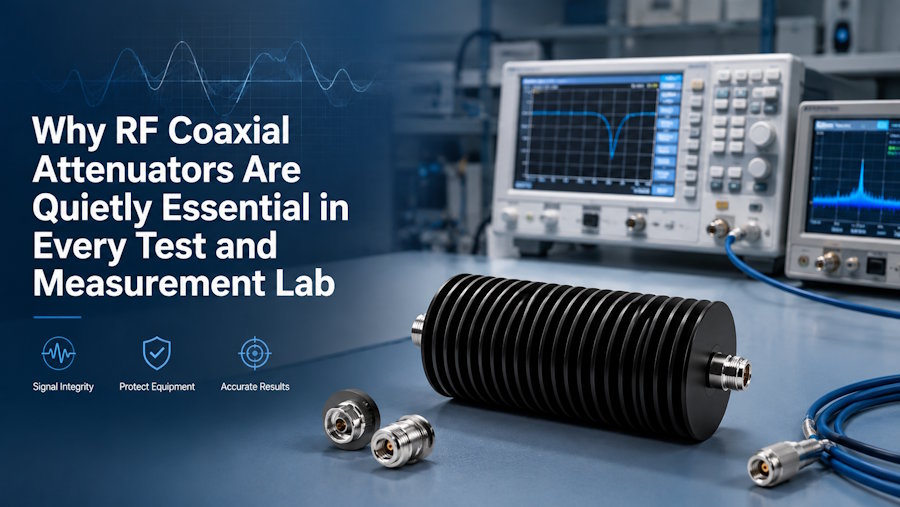
Walk into any RF test bench and you'll find a handful of components that never get much credit but hold the whole measurement chain together. The coaxial attenuator is one of them. It doesn't amplify, filter, or generate anything — its entire job is to reduce signal power by a known, repeatable amount. That simplicity is exactly why it's indispensable.
For RF and microwave engineers working with signal generators, spectrum analyzers, network analyzers, and power meters, attenuators show up in almost every setup, often as the unglamorous component that determines whether a measurement is trustworthy or not. Below are four scenarios where they earn their place on the bench.
1. Protecting Sensitive Instruments From Overload
High-end spectrum analyzers, VNAs, and receivers are precise but fragile at their front end. Feed them a signal above the specified maximum input level — even briefly — and you risk irreversible damage to the mixer or front-end amplifier. Replacing a damaged input stage isn't cheap, and downtime on a shared instrument can stall an entire team.
A fixed or step attenuator placed directly at the instrument's input reduces incoming power to a safe range before it ever reaches the sensitive circuitry. This is standard practice when testing power amplifiers, working near transmitters, or characterizing any device whose output level isn't fully known in advance. Engineers often keep a 20 dB or 30 dB pad permanently connected to analyzer inputs as a default safety margin, only removing it when working with confirmed low-level signals.
2. Delivering Precise, Repeatable Attenuation for Standard Test Setups
Beyond protection, attenuators are used deliberately to set signal levels with known accuracy. When a test procedure calls for a signal to be reduced by exactly 10 dB, 20 dB, or 40 dB before reaching a device under test, a well-characterized attenuator is the tool that makes that number trustworthy across repeated test runs, different labs, and different operators.
This matters most in environments where test results need to be reproducible — compliance testing, receiver sensitivity measurements, and dynamic range characterization all depend on attenuation values that don't drift with temperature, frequency, or time. A quality unit's insertion loss stays flat and predictable across its rated frequency range, which is what separates a lab-grade attenuator from a generic one pulled off a shelf.
3. Maintaining Impedance Matching Across the Signal Chain
Impedance mismatches cause reflections, standing waves, and measurement errors that are notoriously hard to trace back to their source. Fixed attenuators, particularly resistive pad designs, do double duty here: while lowering signal power, they also improve the return loss looking into the pad, effectively isolating a source from a load with imperfect impedance.
This is especially useful when connecting instruments or devices with less-than-ideal VSWR to a reference impedance system. Inserting a 6 dB or 10 dB pad between a source and load can noticeably tighten up the effective match, at the cost of some signal level — a trade-off that's often well worth it when measurement accuracy is the priority over raw signal strength.
4. Supporting Calibration Procedures
Calibration is where attenuator quality really shows. VNA calibration kits, power meter reference standards, and receiver calibration routines all rely on attenuators with tightly specified, traceable attenuation values across frequency. Any drift or uncertainty in the attenuator's performance propagates directly into the calibration, and from there into every measurement made afterward.
Labs performing periodic calibration — whether for internal QA or to maintain ISO/IEC 17025 accreditation — need attenuators with documented performance data and stable characteristics over repeated connect/disconnect cycles. This is also where connector quality and mechanical durability matter as much as the electrical spec sheet, since a pad that's re-mated hundreds of times during a calibration cycle needs to hold its performance without degrading.
What to Look for When Selecting One
A few practical points worth checking before adding an attenuator to a test setup:
- Frequency range — confirm flat performance across your actual operating band, not just at a single reference frequency.
- Power handling — rated average and peak power should exceed your worst-case input with margin.
- VSWR — lower is better, especially for calibration and impedance-matching applications.
- Connector type and durability — mechanical cycle life matters if the part will be connected and disconnected frequently.
Manufacturers like ZOMWAVE specialize in RF components built specifically for these lab and field conditions, with attention to the mechanical and electrical consistency that calibration and compliance work demands.
Final Thoughts
None of these four applications are complicated in principle, but they're the difference between a measurement you can trust and one you have to second-guess. Whether the goal is protecting a six-figure analyzer, hitting a precise test level, cleaning up impedance mismatches, or keeping a calibration chain traceable, the right rf coaxial attenuator is doing more work than its size suggests. For engineers setting up or maintaining a test bench, it's a component worth choosing carefully rather than treating as an afterthought.

