

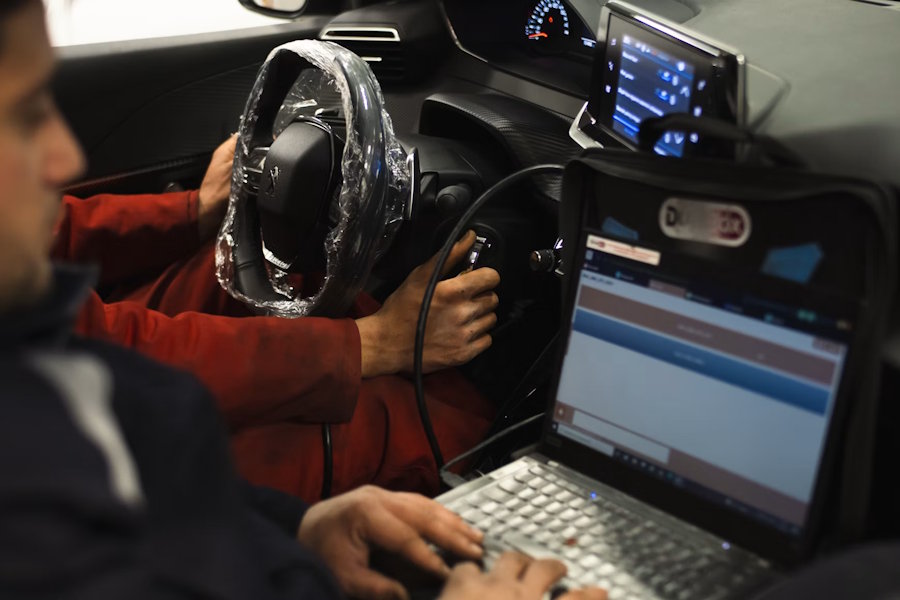
By mid-2026, the average premium vehicle ships with over 150 million lines of code — more than a modern jet fighter. AI copilots sit inside the cockpit, sensor fusion runs continuously at the edge, and all of it competes for silicon that was never built for this kind of load. Engineers aren't just writing firmware anymore; they're negotiating real-time constraints, safety budgets, and compute demands that used to belong to data centers. So here's the real question this piece digs into: how does the embedded stack actually hold together under all that weight?
Why Hardware-Bound Design Is Losing Ground
For decades, an ECU was tied to one function, one supplier, one lifecycle — brake controller here, infotainment box there, a hundred of these boxes wired together with CAN and a prayer. That model doesn't scale once software updates, AI features, and cross-domain data sharing become the product itself, not an afterthought. OEMs are re-architecting around decoupled compute and software layers, and platforms built specifically for that separation, DXC's software defined vehicle platform among them, are stepping in to handle the cross-domain middleware, validation tooling, and integration work that used to eat up half an engineering budget. Worth a look if you're mapping out where the abstraction layers should sit.
Here's the thing engineers keep running into: adding compute doesn't automatically make a car smarter. It makes it harder to certify, harder to update safely, and harder to debug when something goes sideways at 120 km/h. So the industry's real work in 2026 isn't chasing more TOPS — it's figuring out how to organize all that silicon and code so it doesn't collapse under its own complexity.
The Silicon Landscape: Fewer Boxes, Bigger Brains
Remember when a mid-range car had 70-100 discrete ECUs, each running its own tiny RTOS, each needing its own wiring harness? That approach is dying, and it's dying because it has to. Wiring harnesses in a modern EV can weigh 60kg and cost more to assemble than the engine used to. Nobody wants to keep paying that tax.
What's replacing it is domain and zonal consolidation — fewer, more powerful compute nodes handling what dozens of small controllers used to do separately.
The pattern across all of them: fewer physical nodes, each one doing more, each one mixing safety-critical and non-safety workloads on shared silicon. That's a genuinely new problem for embedded teams. Mixing ASIL-D braking logic and a Linux-based navigation UI on the same chip sounds efficient — right up until you have to prove to an assessor that a kernel panic in the infotainment partition can't touch the braking partition. That's where hypervisors like QNX Hypervisor, COQOS, or Xen-based automotive variants earn their keep, carving one SoC into isolated partitions that each get their own safety case.
Zonal Architecture: Killing the Wiring Harness Problem
Central compute doesn't work in isolation — it needs a new topology to feed it data without drowning the vehicle in copper. That's what zonal architecture solves.
Instead of running dedicated wiring from every sensor and actuator back to a central ECU, zonal designs cluster hardware by physical location — front, rear, left, right — and run a local zone controller that aggregates everything nearby before sending it upstream over a backbone, usually automotive Ethernet (100BASE-T1 or the newer 10BASE-T1S for lower-cost, lower-bandwidth zone links).
Why OEMs are betting on this layout:
- Cuts harness length and weight dramatically — some estimates put savings at 30-40% versus a fully distributed topology
- Standardizes zone controller hardware across trims and even platforms, so software teams stop maintaining a dozen slightly different variants
- Simplifies OTA campaigns, since fewer distinct hardware/software combinations means fewer branches in the update matrix
- Makes late-stage feature changes cheaper — swap software behavior in a zone controller instead of respinning a bespoke ECU
Volkswagen's ICAS (In-Car Application Server) concept, GM's Ultifi platform, and Rivian's zonal architecture all lean into this. Even legacy-heavy OEMs are retrofitting the idea into next-gen platforms because the alternative — keep bolting on more discrete ECUs — just doesn't work anymore once you're running 40+ software-defined features per vehicle.
Sounds like a clean win, doesn't it? It mostly is. But zonal consolidation also means a single zone controller failure now affects everything in that physical area of the car instead of just one function. Redundancy planning gets a lot more serious, and so does the safety case documentation.
AUTOSAR in 2026: Classic, Adaptive, and the Messy Middle
AUTOSAR isn't going anywhere, but its role is shifting. Classic AUTOSAR still owns the hard real-time, safety-critical corner — braking, steering, powertrain control — running on microcontrollers where deterministic timing isn't negotiable. Adaptive AUTOSAR handles the POSIX-based, service-oriented world: ADAS fusion, HD map processing, anything that needs dynamic resource allocation and looks a lot more like a Linux service than a fixed OSEK task.
Most production vehicles today run both, side by side, talking to each other. That's the messy part. A Classic AUTOSAR stack communicating with an Adaptive AUTOSAR service over SOME/IP, while the whole thing still has to answer to a UDS diagnostic session and pass an ISO 26262 assessment — that's not a trivial integration exercise, and it's exactly where a lot of engineering hours quietly disappear.
Common friction points teams run into:
- Signal-based communication (Classic, CAN/CAN-FD) needing to bridge into service-oriented communication (Adaptive, SOME/IP over Ethernet) without introducing latency spikes
- Timing budgets that were fine on a 500 kbit/s CAN bus suddenly becoming a bottleneck once ten times the data needs to move
- Safety case documentation that has to account for two fundamentally different execution models running in the same vehicle
- Toolchain fragmentation — Classic AUTOSAR tooling (Vector DaVinci, EB tresos) and Adaptive tooling don't always play nicely together
None of this is unsolvable. But it does mean the job of an embedded architect in 2026 looks less like writing drivers and more like designing contracts between subsystems that were never meant to talk to each other in the first place.
OTA: From Nice-to-Have to Regulatory Requirement
Over-the-air updates stopped being a Tesla-only party trick years ago. Now they're baked into regulation — UNECE R156 requires a documented Software Update Management System for type approval in most major markets, and UNECE R155 demands a Cyber Security Management System to go with it. If a vehicle can't prove it can update safely and securely, it doesn't get sold in the EU, UK, Japan, or Korea.
That regulatory pressure changes how embedded teams design from day one. A/B partitioning, rollback guarantees, cryptographic signing of every payload, staged rollout with health monitoring before a full fleet push — these aren't optional extras anymore, they're baseline requirements written into the architecture before a single line of application code gets touched.
What a compliant OTA pipeline actually needs, at minimum:
- Dual-bank flash storage so a failed update rolls back to a known-good image instead of bricking the vehicle
- Delta updates to keep payload size manageable — nobody wants to push a 4GB image over cellular to update one calibration table
- Signed and encrypted packages verified at the bootloader level, before any application code executes
- Dependency management across zone controllers, since updating one ECU's software might require a compatible version bump somewhere else in the vehicle
- Fleet-level rollout control with the ability to pause or reverse a campaign mid-deployment
Getting this wrong isn't a minor bug — it's a vehicle that can't legally ship. That's a heavier weight on embedded teams than most people outside the industry realize.
What This Actually Means for the Engineers Doing the Work
Step back and the throughline across silicon, zonal topology, AUTOSAR, and OTA is the same: software and hardware are being pulled apart on purpose, and someone has to manage what happens in the gap between them. That's not a small integration task anymore — it's practically its own discipline.
Teams that treat this as "add a hypervisor and call it done" tend to hit trouble around the third or fourth OTA campaign, once the combinatorics of hardware variants, software versions, and safety certifications start multiplying. Teams that plan the abstraction layer early — deciding upfront what lives in the safety-certified real-time domain and what lives in the flexible service-oriented domain — tend to ship faster and argue less with their functional safety assessors.
A few questions worth sitting with before the next architecture review:
- Does the current ECU topology actually need to be zonal, or is that just this year's trend?
- Which workloads genuinely require ASIL-D isolation, and which are being over-engineered out of habit?
- Is the OTA pipeline designed to survive a partial rollout failure, or does it assume the happy path every time?
None of these have universal answers — every OEM's constraints are different. But the vehicles that handle 2026's complexity well won't be the ones with the most powerful SoC on the spec sheet. They'll be the ones where someone thought hard, early, about how all these layers talk to each other. That's the actual engineering challenge hiding behind every headline about AI-powered cars.

