

Introduction
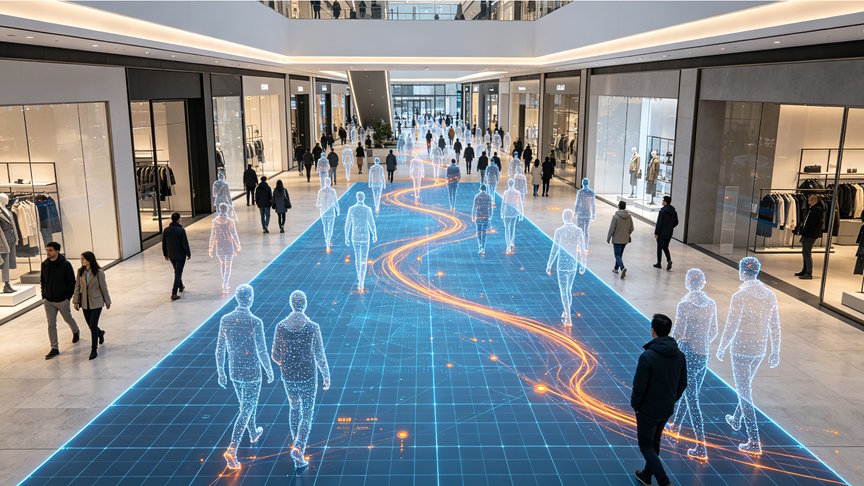
AI people counting systems are becoming an important technology for retail stores, commercial buildings, transportation facilities, and smart spaces that require reliable visitor data.
Traditional visitor counting systems were designed to answer a simple question: how many people entered or exited a location?
However, modern organizations need more than a total number. They need to understand whether traffic represents actual customers, employees, repeated visits, or other types of movement.
This is where AI-based people counting technology is changing the way physical traffic is measured.
By combining artificial intelligence algorithms with 3D stereo vision technology, modern people counting systems can analyze human movement with greater accuracy and provide more meaningful traffic insights.
Unlike traditional counters that only detect movement, AI people counting systems can use spatial information, depth perception, and intelligent recognition algorithms to improve data quality.
Why Traditional People Counting Systems Are Not Enough
People counting technology has existed for many years. Infrared counters, thermal sensors, and simple motion detection devices are still used in many environments because they are easy to install and operate.
However, these traditional visitor counting systems have an important limitation: they measure events rather than understanding situations.
A basic counter can detect that something crossed a detection area, but it may not know whether the movement represents:
- A customer entering a store
- An employee passing through an entrance
- A delivery worker visiting a location
- The same visitor entering multiple times
- Multiple people moving closely together
When businesses use this data for operational decisions, inaccurate traffic information can create problems.
For example, retail operators often analyze:
- Conversion rates
- Store performance
- Staff scheduling
- Marketing effectiveness
If visitor numbers include a large amount of invalid traffic, the analysis may not reflect actual customer behavior.
This is why AI people counting systems focus not only on counting visitors but also on improving the quality of traffic data.
How AI People Counting Systems Work
Modern AI people counting systems combine sensing technology, recognition algorithms, and data analysis methods.
A typical workflow includes several stages:
- Sensor Data Collection
- 3D Spatial Information Processing
- AI Recognition Algorithms
- Human Tracking Analysis
- Traffic Data Generation
- Analytics Platform
Each stage contributes to improving the accuracy and usefulness of visitor data.
The difference between traditional people counters and AI-based systems is the ability to understand more information about the environment.
Instead of simply detecting movement, AI systems analyze:
- Human characteristics
- Spatial position
- Movement direction
- Traffic patterns
The Role of AI 3D Stereo Vision Technology
One of the key technologies improving modern people counting systems is AI 3D stereo vision.
Traditional 2D detection methods analyze information from a flat perspective. They may struggle when people overlap, lighting changes, or entrances become crowded.
3D stereo vision works differently.
Similar to human binocular vision, a dual-lens system captures two views of the same scene. By comparing these views, the system can calculate depth information and create a three-dimensional understanding of the environment.
This allows AI algorithms to analyze:
- Distance between objects
- Human position in space
- Movement trajectories
- Object separation
The additional depth information helps improve the performance of people counting technology in complex environments.
Why 3D Stereo Vision Improves People Counting Accuracy
Accuracy is one of the most important factors when selecting a people counting system.
A higher visitor count is not always better. The quality of the data matters.
AI 3D stereo vision improves traffic measurement in several ways.
Better Human Detection
Traditional sensors often rely on simple detection rules.
AI-based systems analyze spatial characteristics to distinguish people from other objects.
This helps reduce errors caused by:
- Shopping carts
- Bags
- Moving objects
- Environmental changes
Improved Multi-Person Recognition
Crowded entrances are challenging for traditional visitor counting systems.
When multiple people enter together, 3D depth information helps the system understand the relationship between different targets.
This improves recognition in:
- Retail entrances
- Shopping centers
- Public facilities
- Transportation areas
More Accurate Movement Analysis
A person entering a location is not just a single detection event.
Movement direction and behavior patterns provide additional context.
AI algorithms can analyze:
- Entry and exit direction
- Visitor flow trends
- Traffic distribution
- Repeated movement patterns
This creates more valuable customer traffic analytics.
From People Counting to Customer Traffic Analytics
The evolution of AI people counting systems is not only about improving counting accuracy.
The bigger change is the transition from visitor counting to customer traffic analytics.
Traditional systems mainly answer:
How many people entered?
Modern analytics systems focus on:
What type of traffic entered, and what does that traffic mean?
For businesses, especially retailers, this difference is important.
A store may receive thousands of visitors every day, but operational decisions require deeper information:
- How many visitors were potential customers?
- Which periods generated valuable traffic?
- How does traffic change between locations?
- How can staffing match visitor demand?
By improving data accuracy, AI people counting technology provides a stronger foundation for retail analytics and operational planning.
AI People Counting Systems and Privacy Protection
Privacy is an important consideration when deploying intelligent analytics systems.
Modern AI people counting systems should focus on anonymous traffic measurement rather than personal identification.
Privacy-friendly approaches include:
- Anonymous statistical analysis
- Limited personal data processing
- Secure data management
- Aggregated reporting
In many applications, organizations only need information about visitor patterns, not individual identities.
A well-designed visitor counting system should balance analytical capability with responsible data practices.
Integrating People Counting Technology With Business Systems
Modern AI people counting technology is becoming part of larger digital ecosystems.
Developers and system integrators can connect traffic analytics with existing platforms through:
- APIs
- Cloud services
- Business dashboards
- IoT management systems
This enables applications such as:
Retail Analytics Platforms
Retailers can combine traffic data with sales information to better understand:
- Store performance
- Customer conversion
- Visitor trends
Smart Building Management
Building operators can analyze:
- Occupancy levels
- Space utilization
- Visitor distribution
Public Facility Management
Organizations can use traffic information for:
- Crowd management
- Resource allocation
- Facility planning
The connection between physical traffic data and software systems creates new possibilities for intelligent management.
Common Questions About AI People Counting Systems
What is an AI people counting system?
An AI people counting system uses artificial intelligence algorithms to detect, analyze, and measure human movement. Compared with traditional counters, it can provide more detailed traffic information.
Why use 3D stereo vision in people counting technology?
3D stereo vision provides depth information, allowing systems to better understand spatial relationships and improve recognition in complex environments.
Can AI people counting systems identify individuals?
Most applications focus on anonymous traffic statistics rather than personal identification. The goal is to analyze movement patterns and improve operational decisions.
The Future of AI People Counting Technology
As physical spaces become increasingly connected, accurate traffic data will become more valuable.
Future AI people counting systems will continue combining:
- Artificial intelligence
- 3D stereo vision
- IoT technologies
- Cloud analytics
- Business intelligence platforms
The development direction is not simply counting more visitors, but creating better understanding of how people interact with physical environments.
For retailers, building operators, and technology developers, AI-based traffic analytics will become an important data source for improving decisions.
Conclusion
AI people counting systems are changing the way organizations measure and understand visitor traffic.
Traditional visitor counting systems provide basic numbers, but modern solutions using AI 3D stereo vision technology can provide richer spatial information and more reliable analytics.
By combining depth perception, intelligent recognition algorithms, and data platforms, AI people counting technology helps transform simple visitor statistics into meaningful traffic intelligence.
As demand for accurate physical analytics continues to grow, AI-powered people counting systems will play an increasingly important role in retail analytics, smart buildings, and connected environments.

