

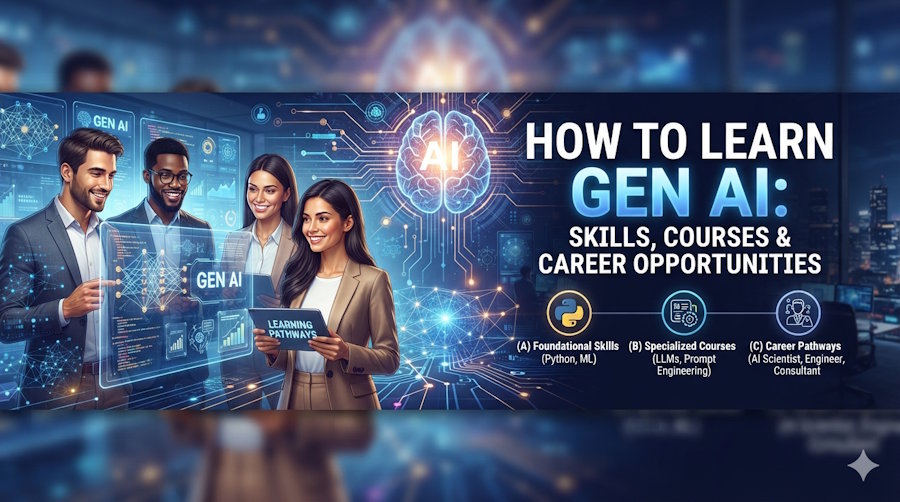
Generative artificial intelligence has quickly moved from an emerging technology to a practical business capability. Tools that can generate text, images, code, audio, and other forms of content are now being explored across industries. For professionals looking to enter this growing field, choosing the right gen ai course can provide a structured way to understand the technologies behind these applications and develop practical skills.
However, learning generative AI involves much more than learning how to write prompts. A strong foundation includes machine learning concepts, large language models, Python, APIs, model evaluation, retrieval systems, and responsible AI practices. The right learning path depends on your current technical background and the type of role you want to pursue.
This guide explains how to start learning Gen AI, which skills matter, what courses can teach you, and where these skills can lead professionally.
What Is Generative AI?
Generative AI refers to artificial intelligence systems that can create new content based on patterns learned from existing data. Depending on the model and application, generated outputs can include text, software code, images, audio, video, or structured information.
Large language models are one of the most visible examples. They can understand natural-language instructions and produce responses based on their training and the context provided to them.
Other generative AI applications include:
- AI-powered coding assistants
- Document summarisation
- Content generation
- Conversational applications
- Image creation
- Synthetic data generation
- Voice and audio generation
- Automated research assistance
The technology is developing rapidly, but understanding its underlying principles helps learners move beyond simply using consumer-facing AI tools.
Why Should You Learn Generative AI?
Generative AI is changing how organisations approach software development, customer support, marketing, research, operations, and knowledge management.
For professionals, learning Gen AI can provide several advantages.
Build New Technical Capabilities
Understanding how generative AI applications work can complement existing software, analytics, or cloud skills. Professionals can learn to integrate models into applications instead of relying only on ready-made interfaces.
Stay Relevant as Workflows Change
AI is increasingly being incorporated into everyday business processes. Learning how to evaluate and use these systems can help professionals adapt to changing workplace expectations.
Create Practical Applications
Gen AI skills can be applied to real-world projects such as:
- Customer-service assistants
- Internal knowledge bots
- Document analysis tools
- Code-generation systems
- Recommendation interfaces
- Automated content workflows
- Research assistants
Explore New Career Paths
Generative AI is creating and reshaping roles across software engineering, machine learning, data, product development, and AI consulting.
What Should You Learn Before Starting Gen AI?
You do not need to know every AI concept before beginning. However, a few foundations can make advanced topics much easier to understand.
Python Programming
Python is one of the most widely used languages in AI and machine learning. It is useful for working with models, APIs, datasets, evaluation workflows, and application logic.
If you are a beginner, start with:
- Variables and data types
- Functions
- Loops and conditions
- Data structures
- Classes and objects
- File handling
- APIs
- Error handling
You do not need to become an expert programmer before exploring Gen AI. Basic programming proficiency is a good starting point.
Mathematics and Statistics
The amount of mathematics required depends on your career goal.
Someone building applications with existing models may need only a basic understanding of probability, statistics, vectors, and model evaluation. Someone interested in developing or researching machine learning models will need a deeper understanding of linear algebra, calculus, probability, and optimisation.
This distinction is important when choosing a learning path.
Machine Learning Fundamentals
Before going deeply into generative models, it helps to understand basic machine learning concepts.
You should become familiar with:
- Training and testing data
- Features and labels
- Model training
- Overfitting
- Evaluation metrics
- Neural networks
- Embeddings
- Classification and regression
These concepts provide context for understanding how modern AI systems are developed.
Understanding Large Language Models
Large language models, commonly known as LLMs, are central to many Gen AI applications.
These models are trained on large amounts of data and learn statistical patterns in language. When given an input, they generate an output based on the learned patterns and the context available to them.
Learners should understand concepts such as:
Tokens
Models process text as tokens rather than simply reading complete words. Understanding tokenisation helps explain context limits, input costs, and model behaviour.
Context Windows
A model can only process a certain amount of information within a particular interaction. Context management therefore becomes important when building applications that work with long documents or conversations.
Embeddings
Embeddings represent information as numerical vectors. They allow systems to compare the semantic similarity between pieces of information and are widely used in search and retrieval applications.
Model Parameters
Parameters are values learned during model training. The number of parameters is one factor associated with model capacity, although it should not be treated as the sole measure of model quality.
Learn Prompt Engineering, But Do Not Stop There
Prompt engineering involves designing instructions that help AI models produce more useful and consistent outputs.
Good prompting can involve:
- Clearly defining the task
- Providing relevant context
- Specifying output requirements
- Giving examples
- Setting constraints
- Asking the model to follow a particular format
For example, instead of asking an AI system to "summarise this," a more useful instruction could specify the target audience, desired length, important points, and output structure.
However, prompt engineering should be viewed as one component of Gen AI development rather than an entire career skill set.
Professionals who want to build production applications should also learn APIs, retrieval, evaluation, application architecture, security, and model limitations.
Professionals who want to build production applications should also learn APIs, retrieval, evaluation, application architecture, security, and model limitations. Developers who want hands-on experience across different model families can evaluate the OfoxAI LLM API, an OpenAI-compatible service offering access to 100+ text, image, video, and embedding models through one API key.
Explore Retrieval-Augmented Generation
Retrieval-Augmented Generation, or RAG, is an important concept for modern AI applications.
A RAG system can retrieve relevant information from an external knowledge source and provide that information to a language model as context before generating a response.
This approach can be useful for applications that need to work with:
- Company documentation
- Product information
- Technical manuals
- Internal knowledge bases
- Research papers
- Customer records
A typical workflow may look like:
User question → Information retrieval → Relevant context → AI model → Generated response
RAG helps developers build applications that can use information outside the model's original training data.
Learn How AI Connects With Data Systems
Modern Gen AI applications often depend on reliable pipelines for collecting, transforming, storing, and retrieving information. This is where data engineering becomes relevant to AI development.
For example, an enterprise AI assistant may need access to thousands of documents. Those documents must be processed, indexed, stored, and retrieved efficiently before an AI model can generate useful responses.
Understanding this relationship can help professionals design more complete AI systems rather than treating the language model as an isolated component.
Build Practical Gen AI Projects
Projects are one of the most effective ways to turn theoretical knowledge into practical ability.
Instead of completing dozens of tutorials, build a few applications that demonstrate different capabilities.
Project 1: Document Summariser
Create an application that accepts a document and generates a structured summary.
You can experiment with:
- Prompt design
- Text extraction
- Context management
- Output formatting
- Model evaluation
Project 2: Question-Answering Assistant
Build an assistant that answers questions based on a specific collection of documents.
This can introduce you to:
- Embeddings
- Vector search
- Retrieval
- RAG
- Prompt construction
Project 3: AI Coding Assistant
Create an application that accepts a programming problem and generates an explanation or sample solution.
This project can help you understand how AI models can be integrated into developer workflows.
Project 4: Business Knowledge Assistant
Develop an internal-style chatbot that answers questions using a controlled knowledge base.
Focus on:
- Retrieval accuracy
- Hallucination reduction
- Access control
- Response evaluation
- User experience
These projects can become valuable portfolio pieces when documented properly.
What Should You Look for in a Gen AI Course?
The quality of a course matters more than the title. Since AI technologies change quickly, a useful program should teach principles that remain relevant while also providing exposure to current tools.
A Strong Technical Foundation
Look for coverage of:
- Python
- Machine learning basics
- Neural networks
- LLM fundamentals
- Generative AI architectures
- APIs
- Embeddings
- Vector databases
- RAG
- Model evaluation
Hands-On Development
A good learning experience should involve building applications rather than only watching demonstrations.
Projects should require learners to make technical decisions and solve problems independently.
Current Industry Applications
Look for examples that demonstrate how Gen AI is being used in areas such as:
- Software development
- Customer support
- Knowledge management
- Document processing
- Business automation
- Research
- Content workflows
Understanding Model Limitations
Responsible AI should be part of the curriculum. Learners need to understand that AI systems can generate incorrect, biased, incomplete, or misleading information.
A strong program should introduce concepts such as:
- Hallucination
- Bias
- Data privacy
- Security
- Evaluation
- Human oversight
- Responsible deployment
How Long Does It Take to Learn Gen AI?
There is no universal timeline because the required depth depends on your career objective.
A beginner who wants to build applications with existing models can start developing basic projects relatively quickly after learning Python and API fundamentals.
Someone aiming to become an AI or machine learning engineer will need a much deeper foundation.
A practical progression could look like:
Beginner → Python → ML fundamentals → LLM concepts → Prompting → APIs → RAG → AI applications → Evaluation → Deployment
The important factor is not how quickly you complete each stage but whether you can apply what you learn.
Career Opportunities in Generative AI
Gen AI skills can support several career directions.
Generative AI Engineer
These professionals build applications that integrate generative models into products and business workflows.
Their work may involve:
- Model APIs
- Prompt design
- RAG
- Evaluation
- Application development
- AI integrations
Machine Learning Engineer
Machine learning engineers work more broadly across model development, deployment, optimisation, and production systems.
A strong Gen AI background can complement traditional machine learning expertise.
AI Application Developer
AI application developers focus on creating user-facing products that use AI capabilities.
They may work on chatbots, intelligent search, automation tools, productivity applications, or specialised assistants.
AI Solutions Architect
Experienced professionals may move toward designing AI systems at an organisational level.
This can involve selecting models, planning infrastructure, integrating data sources, managing security, and evaluating performance.
AI Consultant
AI consultants help organisations identify practical opportunities to use AI and determine how those solutions should be implemented.
This career path can be particularly relevant to professionals who combine technical knowledge with business understanding.
What Skills Can Make You More Competitive?
Learning one AI tool is unlikely to be enough for long-term career development. A broader combination of technical and problem-solving abilities can provide greater flexibility.
Focus on developing:
- Programming
- Machine learning fundamentals
- LLM concepts
- Prompt engineering
- API integration
- RAG
- Vector search
- Cloud computing
- Model evaluation
- AI security
- System design
- Communication skills
The ability to understand a business problem and translate it into a practical AI solution can be just as important as knowing a particular framework.
Common Mistakes When Learning Gen AI
The speed of AI development can encourage learners to jump from one new tool to another. This can create the illusion of progress without building lasting knowledge.
Learning Only Prompting
Prompting is useful, but it represents only one part of the Gen AI ecosystem.
Chasing Every New Framework
New libraries and platforms appear frequently. Learning fundamentals first makes it easier to adapt when tools change.
Building Only Simple Chatbots
A basic chatbot is a useful starting project, but a stronger portfolio can demonstrate retrieval, evaluation, data integration, security, and deployment.
Ignoring Evaluation
An AI application that produces impressive responses during a demonstration may still fail in production. Learning how to measure accuracy, relevance, consistency, latency, and other quality factors is essential.
Forgetting Data Privacy
AI applications may process sensitive or confidential information. Developers need to understand what data is being sent to models and how that information is handled.
How to Build a Gen AI Career Step by Step
If you are serious about entering the field, avoid trying to learn everything simultaneously.
Start by identifying your target role.
If you want to become an AI application developer, prioritise Python, APIs, LLMs, RAG, application development, and deployment.
If your goal is machine learning engineering, spend more time on mathematics, machine learning, neural networks, model development, and infrastructure.
If you are interested in AI solutions, combine technical learning with cloud architecture, system design, business analysis, and responsible AI.
Once you choose a direction, build projects that align with it. Your portfolio should tell a clear story about what you can build and the problems you can solve.
The Future of Generative AI Careers
Generative AI is likely to continue influencing software development, business operations, research, customer experiences, and knowledge management.
At the same time, the technology will continue to evolve. Models may become more capable, smaller models may become useful for specialised applications, and AI systems may increasingly interact with external tools and data sources.
This means professionals should avoid building their careers around one specific model or platform. Instead, develop transferable skills and learn how to evaluate new technologies as they emerge.
The strongest professionals will likely combine AI knowledge with another domain such as software engineering, cloud infrastructure, cybersecurity, data, marketing, finance, healthcare, or product development.
Final Verdict
Learning Gen AI can be a valuable career investment when approached as a technical discipline rather than simply learning how to use AI chat tools. Start with programming and machine learning fundamentals, understand how large language models work, and gradually progress toward APIs, RAG, evaluation, deployment, and responsible AI.
A well-designed course can shorten the learning curve by providing structure, practical projects, and exposure to real-world applications. However, your ability to build useful solutions will ultimately matter more than a certificate.
If you are exploring a structured path to develop practical Gen AI skills, contact TrendyTech to learn more about available learning options and how they may align with your career goals.
Frequently Asked Questions
1. What is the best way to start learning Gen AI?
Start with Python and basic machine learning concepts before moving into LLMs, prompting, APIs, embeddings, and RAG. Building small projects alongside your learning can help reinforce each concept.
2. Do I need programming knowledge to learn Gen AI?
It depends on your goal. You can use many Gen AI tools without programming, but technical Gen AI roles generally require programming skills. Python is a practical language to learn for this field.
3. Is prompt engineering enough for a Gen AI career?
Prompt engineering is useful but generally not enough for a broad technical career. Developers and engineers can benefit from learning APIs, retrieval systems, evaluation, application development, cloud platforms, and AI security.
4. What is RAG in generative AI?
RAG stands for Retrieval-Augmented Generation. It allows an AI application to retrieve relevant information from an external source and provide it to a generative model as context when producing an answer.
5. How long does it take to learn Gen AI?
The timeline depends on your existing skills and career objective. Basic application development can be learned relatively quickly, while becoming proficient in AI engineering or machine learning requires substantially more time and practice.
6. What careers can I pursue after learning Gen AI?
Potential career directions include Generative AI Engineer, AI Application Developer, Machine Learning Engineer, AI Solutions Architect, and AI Consultant. Existing software, cloud, or data skills can also be combined with Gen AI knowledge.
7. Should I take a Gen AI course or learn independently?
Both approaches can work. A course may provide a structured curriculum, projects, mentorship, and a defined progression, while self-learning offers greater flexibility. Your choice should depend on your learning style, existing knowledge, and career goals.
8. Is Gen AI a good career choice for beginners?
It can be, provided beginners build foundational technical skills instead of relying only on AI tools. Learning Python, basic machine learning, LLM concepts, and practical application development can provide a stronger starting point.

