

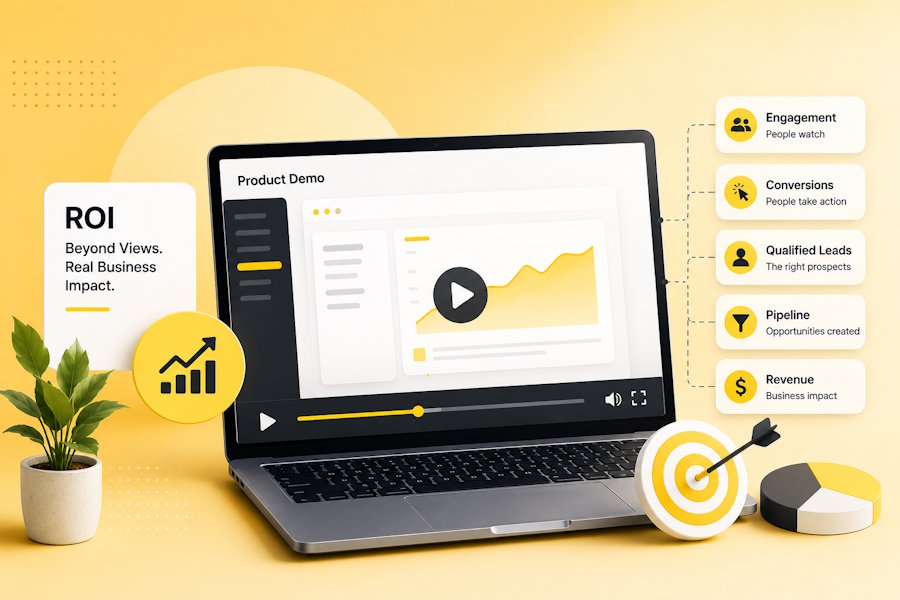
A product demo video can generate thousands of views and still produce little business value. It can also attract a smaller audience but influence high-value prospects and contribute to several closed deals.
That is why video views alone are a poor measure of ROI.
To understand what a product demo video is actually contributing to the business, marketers need to connect video engagement with actions, qualified leads, pipeline, and revenue.
The right measurement framework depends on where the video is used, what action it is designed to generate, and how closely that action is connected to a purchase.
What Is a Product Demo Video?
A product demo shows a product in use. For software and SaaS companies, that often means showing the interface, a specific workflow, or how the product solves a particular problem. For physical products, it may demonstrate operation, setup, performance, or a specific use case.
The important distinction is that a demo should answer a buyer's practical question:
“How does this product help me do something I need to do?”
That makes a product demo different from a brand video or a general explainer. A brand video may build awareness, while an explainer may simplify a concept. A demo needs to provide evidence of how the product works.
What Makes a Product Demo Effective?
The strongest demos don't attempt to show everything.
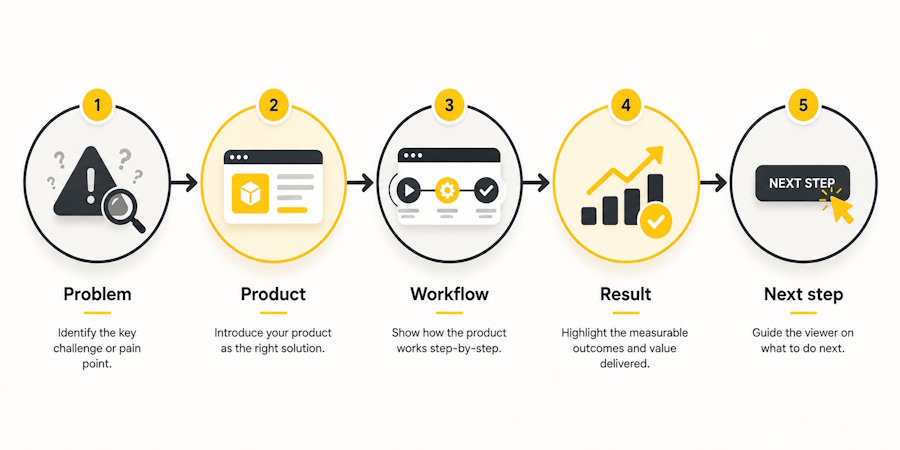
They focus on a specific problem, audience, and use case. Instead of moving through every feature in the product, the video can follow a simple sequence:
Problem → Product → Workflow → Result → Next step
For example, a SaaS demo for a reporting platform could begin with the difficulty of manually combining data from multiple sources, show how the platform connects those sources, demonstrate the reporting workflow, and finish by showing the resulting dashboard.
This gives viewers context for every feature they see.
The production itself matters, but polish is not the same as effectiveness. Clear screen recordings, readable interfaces, deliberate editing, useful narration, and well-timed on-screen elements should make the product easier to understand, not simply make the video look impressive.
Different Types of Product Demo Videos
Not every demo should be measured in the same way because different formats serve different purposes.
Screen-recorded demos show software interfaces and workflows. They are useful when prospects need to understand how a product operates.
Explainer videos use animation, graphics, or live action to simplify a product, process, or technical concept. They are often used earlier in the buying journey.
Product launch videos introduce a new product or major feature and are usually designed to create awareness and initial interest.
Interactive demos let prospects explore selected features themselves rather than watching a fixed video from beginning to end.
Use-case demos focus on one customer problem or business scenario. These can be particularly useful in B2B sales because the viewer can quickly determine whether the product is relevant to their situation.
Because the objectives differ, comparing their performance using one metric can produce misleading conclusions.
The Metrics That Actually Matter
A useful measurement framework starts with three levels: engagement, conversion, and business impact.
1. Engagement Metrics
These tell you whether people are actually consuming the demo.
Track:
- Play rate
- Average watch time
- Percentage watched
- Completion rate
- Replays
- Drop-off points
Views tell you how many times the video was played. Watch-time data tells you how much of the product demonstration people actually consumed.
Drop-off points can be especially useful. If a large percentage of viewers leave before the product is demonstrated, the introduction may be too long. If viewers consistently leave immediately after a particular section, that section may not be relevant or may be difficult to follow.
However, engagement is not ROI. A viewer who watches 95% of a video has shown interest, but that does not mean they are a potential customer.
Engagement shows whether viewers are watching. To understand whether that attention leads to action, you also need to measure SaaS video conversion rates and the actions viewers take after watching.
2. Conversion Metrics
The next question is what viewers do after watching.
Depending on the purpose of the video, this could include:
- CTA clicks
- Free-trial registrations
- Demo requests
- Contact-form submissions
- Product sign-ups
- Pricing-page visits
- Downloads
- Sales inquiries
A simple video conversion rate can be calculated as:
Video conversion rate = Conversions attributed to the video ÷ Relevant video viewers × 100
The denominator matters. Using total page visitors instead of qualified video viewers can produce a very different number.
3. Lead Quality
A video can generate conversions without generating good leads.
Suppose 500 people click the CTA and 50 request a sales call. If only five match your ideal customer profile, the video has generated activity but limited sales value.
That is why product demo reporting should include qualified leads, not just total conversions.
Useful indicators include:
- Marketing-qualified leads
- Sales-qualified leads
- Leads matching the ideal customer profile
- Opportunity creation
- Pipeline generated
- Revenue influenced
For B2B SaaS, these metrics are usually much more meaningful than raw view counts.
How Product Demos Influence the Sales Funnel
A demo can perform a different job depending on where it appears.
At the awareness stage, a short demo may help prospects understand what the product does.
During consideration, a more detailed demonstration can answer questions about workflows, integrations, features, and usability.
Closer to purchase, a use-case-specific demo can help remove objections or show how the product fits an existing process.
This means the same video should not necessarily be expected to generate an immediate sale.
For example, a demo embedded on a blog post may introduce a prospect to the product. A prospect who later visits the pricing page, attends a sales call, and becomes a customer may have been influenced by that original video even though the video did not directly generate the final conversion.
How to Calculate Product Demo ROI
The basic ROI formula is:
ROI = (Revenue attributable to the video − Video investment) ÷ Video investment × 100
The difficult part is determining revenue attributable to the video.
Video analytics alone cannot answer that. The video needs to be connected to your analytics and CRM data.
At a minimum, track:
Video viewer → CTA click → Lead → Qualified lead → Opportunity → Customer → Revenue
For example, suppose a company spends $5,000 producing and distributing a product demo.
The video generates 300 leads, 30 qualified opportunities, and eventually contributes to $20,000 in attributable revenue.
Using the basic formula:
($20,000 − $5,000) ÷ $5,000 × 100 = 300% ROI
The calculation becomes more reliable when attribution rules are clearly defined and applied consistently.
Don't Confuse Attribution With Influence
This distinction is particularly important for B2B marketing.
If someone watches a product demo and immediately submits a form, the relationship is relatively straightforward.
But consider another prospect:
Google search → Website → Product demo → Pricing page → Sales call → Customer
The video may have influenced the purchase without being the final conversion point.
For this reason, companies should distinguish between directly attributed revenue and revenue influenced by video.
A last-click model may give the video little credit, while a multi-touch model may assign it a portion of the customer's journey. Neither approach is automatically correct for every business. The important thing is to establish a consistent attribution method and understand its limitations.
Walkthrough vs. Product Demonstration
A walkthrough and a product demo are related but serve different purposes.
A walkthrough is generally instructional. It takes the viewer through a process step by step and may cover several features.
A product demo script is usually more selective. It demonstrates how the product solves a particular problem and why that solution matters.
A detailed walkthrough might be valuable after someone has signed up. A shorter use-case demo may be more effective on a landing page where the objective is to persuade a prospect to take the next step.
Choosing between them should therefore start with the buyer's information need, not the preferred video format.
Should You Use AI to Create Product Demos?
AI tools can reduce the time required for parts of production, including script drafts, voice generation, editing, screen-recording workflows, and variations of existing content.
But faster production does not automatically produce better ROI.
The most important decisions still involve the product, audience, message, workflow being demonstrated, and evidence used to support the value proposition.
AI can help a team produce and test more versions. It cannot replace the need to decide what the viewer actually needs to understand before taking the next step.
What Should You Optimize?
Don't optimize a product demo simply because its view count is low.
First identify where the problem occurs.
If few people start the video, improve its placement or thumbnail.
If viewers leave during the introduction, shorten the setup.
If viewers watch but rarely click, examine the CTA and the relevance of the offer.
If the video generates many leads but few qualified opportunities, the targeting or message may be attracting the wrong audience.
If qualified prospects watch the video but sales cycles do not improve, the demo may not be addressing the objections that matter at that stage.
This is where video analytics becomes useful: not as a vanity report, but as a diagnostic tool.
The Real Measure of Product Demo ROI
The value of a product demo cannot be determined from views alone.
A useful reporting structure should connect:
Views → Watch time → Engagement → CTA actions → Qualified leads → Opportunities → Revenue
Once these stages are connected, you can answer more useful questions:
- Does the video attract the right audience?
- Do qualified prospects actually watch it?
- Which sections hold or lose attention?
- Does watching the video increase the likelihood of conversion?
- How many qualified opportunities involve the video?
- How much revenue can reasonably be attributed to or influenced by it?
- Is the return higher than the cost of producing and distributing the video?
That is the difference between measuring video performance and measuring business performance.
A product demo is successful when it helps a potential buyer understand the product well enough to take the next meaningful step, and when that contribution can be traced through the sales process to measurable business results.

