

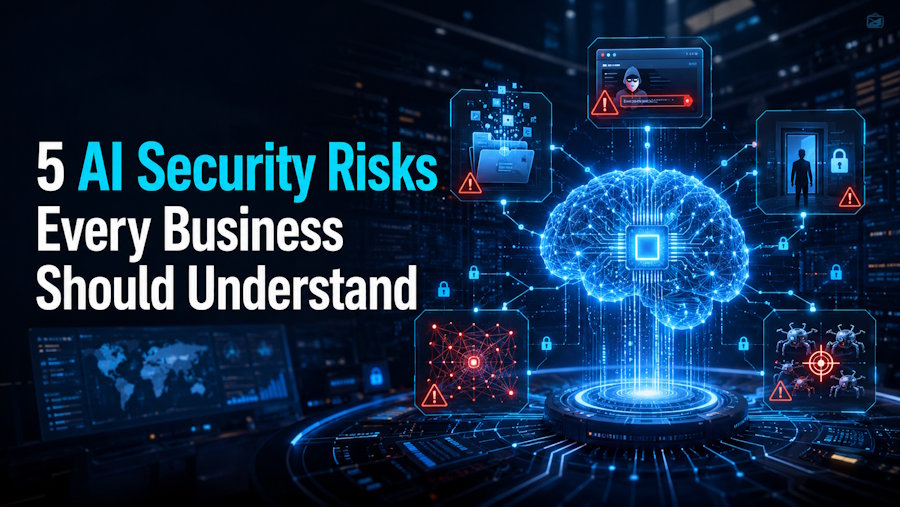
AI Security has moved out of the innovation lab and into board risk discussions because AI systems now touch customer data, code, identity workflows, support desks, fraud checks, and SOC operations.
The hard part isn’t deciding whether AI is useful. It’s knowing where the blast radius starts when a model, plug-in, prompt, data set, or agent behaves in a way nobody planned for.
Picture a mid-size financial services firm rolling out an internal AI assistant for analysts. It summarises customer files, answers policy questions, and drafts case notes.
Three months later, the SOC finds staff pasting regulated data into unsanctioned tools, a plug-in calling an API with too much privilege, and model outputs being copied into customer communications without review. That’s not science fiction. That’s Tuesday.
Why AI Security Needs a Different Risk Lens
Traditional security programs were built around users, endpoints, networks, applications, and data. AI adds something awkward: systems that interpret intent, generate outputs, ingest untrusted content, and sometimes take actions through connected tools.
There are several government-backed frameworks giving security and risk teams a useful starting point because it treats AI risk as an operating model issue, not just a technical control problem. That matters.
If AI is being deployed by app teams, business units, analytics groups, and third-party platforms, the CISO can’t manage the risk with a single policy PDF.
The better question is: where can AI change decisions, expose sensitive information, or trigger actions faster than your controls can catch up?
1. Prompt Injection and Manipulated Inputs
Prompt injection is the AI version of “the system did what the attacker asked, not what the business intended.” It can happen directly, when a user sends malicious instructions to a model, or indirectly, when the model reads poisoned content from a webpage, document, email, ticket, or knowledge base.
This risk gets nasty in retrieval-augmented generation systems. A chatbot that only answers basic HR questions is one thing. A model that can search internal documents, summarise contracts, and open workflow tickets is another animal.
What should teams do?
Start with trust boundaries. Treat prompts, documents, web content, file uploads, and retrieved knowledge as untrusted input. Then add output validation before anything reaches downstream systems. If the model can trigger an action, approval gates matter. Not always. But for payments, access changes, customer notices, legal language, and production activity, don’t let the model freewheel.
A useful review question: can untrusted content alter the model’s instructions or permissions? If yes, you’ve got work to do.
2. Sensitive Data Exposure Through Shadow AI
Shadow AI is already one of the messiest problems in enterprise security because it rarely begins as rebellion. It starts with someone trying to move faster.
An analyst pastes customer records into a public tool to clean up a report. A developer uses an AI coding assistant with proprietary source code. A sales team uploads call transcripts for summarization. Nobody calls it a breach at the moment. It’s just “getting work done.”
But regulated data doesn’t become less regulated because it passed through a model interface.
Security teams need visibility into where AI tools are being accessed, what data categories are moving, and which business processes depend on them. Blocking everything usually fails. People find side doors.
A more practical approach is to create sanctioned options, classify data that can and can’t be used, and monitor uploads to unsanctioned services through existing web, endpoint, and data controls.
Don’t make this only a training issue. Training helps, but technical control is where intent meets reality.
3. Model and Data Poisoning
AI systems are hungry. They ingest training data, fine-tuning sets, embeddings, user feedback, documents, logs, tickets, code, and threat intelligence. That appetite creates a problem: if attackers can influence what the model learns from or retrieves, they can bend future outputs.
Poisoning can be subtle. A manipulated document in a knowledge repository. A compromised data pipeline. A fake support article. Polluted embeddings that cause the wrong answer to rank first. In security settings, poisoned data can make detection weaker, flood analysts with noise, or push bad remediation advice.
Controls here look less glamorous than the demo. Data provenance. Approval workflow before new content enters trusted corpora. Hashing and versioning. Change logs. Periodic sampling of results. Red-team exercises against retrieval logic.
Yes, it’s tedious. So is rebuilding trust in a decision system after nobody can explain why it gave the wrong answer for six weeks.
4. Excessive Agency in AI Agents
The phrase “AI agent” sounds harmless until you list what the agent can actually do.
Can it read email? Query databases? Create tickets? Change firewall rules? Disable an account? Push code? Call external APIs? Chain tasks together without a human looking?
Agency is where AI risk stops being theoretical. The model isn’t just answering. It’s acting.
The cleanest control pattern is least privileged, but applied with unusual strictness. Give agents narrow permissions, short-lived credentials, scoped APIs, transaction limits, and clear break-glass paths. Separate reading from writing. Separate recommendation from execution. Log every tool call in a way the SOC can search without needing a data scientist to translate it.
There’s a real argument for letting agents handle low-risk repetitive work. Fine. But don’t confuse low effort with low risk. A small action repeated at machine speed can still create an incident.
5. AI-Accelerated Attacks Against the Business
Attackers don’t need magical AI to cause trouble. They need small gains at scale.
Better phishing lures. Faster reconnaissance. More convincing social engineering. Synthetic voices. Fake invoices. Malware variants that change just enough to annoy detection. None of this means defenders are doomed. It means old assumptions about volume, quality, and timing need a refresh.
SOC leads should look hard at detection logic for identity abuse, business email compromise, anomalous data movement, and unusual admin behaviour. Network architects should expect more encrypted traffic tied to AI services and APIs.
CISOs should revisit incident response exercises with AI-specific scenarios, especially those involving executive impersonation, poisoned internal content, and unauthorized data sharing.
Several cybersecurity vendors publish significant work around Advanced AI Security Strategies. Enterprise users would usually go for frameworks that solve their overall requirements instead of single isolated security needs. They aren’t looking for another isolated AI control. They need AI-aware detection, policy, and response to fit into the same operating fabric their teams already use.
A Practical AI Security Checklist
Before approving a new AI use case, ask these questions in plain language:
- What data will the system ingest, store, retrieve, or generate?
- Can the model call tools, APIs, workflows, or production systems?
- Who owns the risk decision if output is wrong, biased, unsafe, or exposed?
- Are prompts, files, retrieved documents, and plug-ins logged?
- Can security teams see usage across sanctioned and unsanctioned tools?
- What happens if the model leaks sensitive information?
- How will the system be tested against prompt injection and poisoned content?
- Is there a human approval point before high-impact actions?
- Are vendors, models, data sets, and integrations reviewed like supply chain components?
- Can the business shut the system down quickly without breaking operations?
That last one gets skipped. It shouldn’t.
For teams building or evaluating AI systems, internal education helps too. A resource such as AI model training guidance can support better conversations between security, data science, and business owners before risky patterns become production habits.
Closing the Gap Between AI Ambition and Business Risk
AI Security isn’t only about stopping exotic model attacks. It’s about keeping control as AI starts influencing decisions, moving data, writing code, and taking action across the enterprise.
The organizations that handle this well won’t be the ones with the longest policy documents. They’ll be the ones that map AI use cases to real permissions, real data flows, real failure modes, and real incident playbooks. Start there. Then the business can move faster without pretending the risk isn’t already in the room.

