

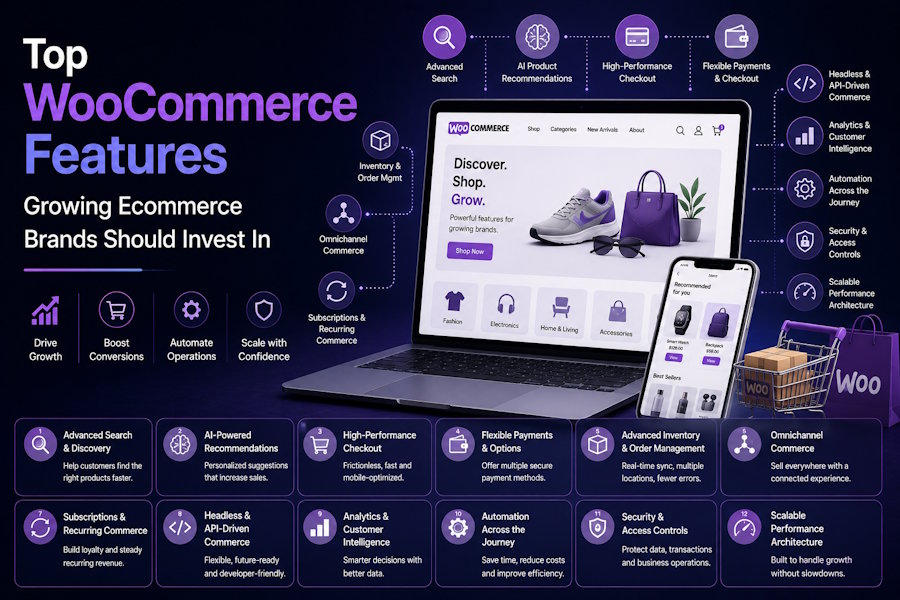
Changes in growth require a shift in what an ecommerce store needs.
The smooth-running, small-scale brand WooCommerce site may begin to get tougher to manage as more traffic flows, orders increase, products multiply and integrations pull further.
As more traffic, orders, products, and integrations begin to load on the site and customer expectations grow, a perfect small brand WooCommerce site can get a bit harsher to run. When that happens, it is difficult to see how additional plugins for additional requirements is a viable approach.
For growing brands, it's not just about their features. They require a commerce architecture that enables improved customer experiences, operational efficiency, automation, personalization and scalability.
WooCommerce is also a rewarding option for expanding companies with its open architecture, which enables brands to grow the platform in line with their particular business model. That flexibility, however, is only a benefit if its capabilities are put in place strategically.
With that said, what are the key WooCommerce features that are worth your serious investment as your ecommerce shop grows?
1. Advanced Product Search and Discovery
As the catalog grows, the more difficult it will be for customers to find the right product.
Simple keyword search can be limited by synonyms, product attributes, natural language and high purchase intent. Today's modern ecommerce shoppers demand search to comprehend their intention and not just match their typed words.
With advanced search, intelligent auto-completion, typo correction, semantic relevance, filters, personalized results, and natural language discovery can be introduced.
For instance, when someone types in “running shoes,” they may be looking for something like “lightweight running shoes for long distance training that are under $150.”
The more seamless the search journey is, the less "friction" there is between product discovery and purchase.
Sophisticated search is then a conversion strategy and not just a navigation tweak for growing brands.
2. AI-Powered Product Recommendations
One of today's key features of ecommerce is personalization.
Customers don't necessarily want to browse hundreds of products. They would like the stores to be able to tell them what's relevant in a flash.
AI algorithms can leverage relationships among products, browsing habits, purchase history, and contextual cues to provide more relevant recommendations.
A store can, instead of displaying “You May Also Like” products, also potentially suggest complementary, upgrade, alternative or bundle products, or replenishment products for a customer in their situation.
Recommendation systems, if used wisely, can be effective tools for cross-sales, upsales, product discovery, and customer retention without being intrusive.
Here, well-planned WooCommerce development services can help you develop functionality with regard to a brand's catalog and customer journey, not just generic suggestions.
3. High-Performance Checkout
It's rare for customers to complain about a checkout being technically sophisticated.
They gripe about its slowness, confusion, repetition, and difficulty.
When a store expands, checkout can become more complicated and involve taxes, shipping rules and options, payments, subscriptions, discounts, customer accounts, fraud checks, and third-party integrations.
It is important for growing brands to invest in an architecture for checkout that is non-essential and streamlines the checkout process.
It can be done with guest checkout, express payment options, autofill addresses, optimizations for mobile, clear error handling, and streamlined form fields.
However, as important as the interface design is the performance.
Too many external requests or sub-optimal custom functionality in the checkout process can be a major revenue blocker.
4. Flexible Payment and Checkout Options
Flexibility of payment is becoming a customer expectation.
These can range from digital wallets to buy-now-pay-later solutions to local payment methods, credit and debit cards to bank transfers and other regional payment options.
The key point in growing brands is not just providing a maximum number of payment options.
It is choosing payment methods that are suited for customers as well as ensuring a smooth and safe checkout process.
A good WooCommerce setup will also enable you to easily add or switch payment gateways as the business expands to new territories.
5. Advanced Inventory and Order Management
The more things change, the more things get complicated.
The amount of inventory a brand needs for 50 products in a single warehouse is significantly different from the amount needed for thousands of SKUs in multiple locations.
As the number of sales channels grows, real-time inventory sync becomes more crucial.
WooCommerce stores might need to interact with warehouses, ERP, fulfillment providers, marketplaces and physical retail.
The goal is to provide a single version of the truth about inventory instead of multiple versions of the truth in multiple systems.
That's where the proper planning of integrations can prove to be one of the most valuable WooCommerce development services for scaling ecommerce businesses.
6. Omnichannel Commerce Capabilities
Today's buyer is not only not making a distinction between print and web marketing, but they're not even buying and selling online.
The social media contact, the Google search, the online shopping, the customer service call and the pick-up or return of the product are all possible steps they could take.
If the journey is fragmented, growing brands must have infrastructure that can handle it.
WooCommerce can serve as a commerce hub, and integrates with marketplaces, social media, physical locations, fulfillment systems, CRM, and more customer touchpoints.
The idea is not to have all channels the same.
It's for the reliable transfer of key information like products, stock, orders, customers and prices, between relevant systems.
7. Subscription and Recurring Commerce
Subscription models have gained significant traction in beauty, food, wellness, software, membership and consumer products and are now a major focus of interest.
With the right extensions and customizations, WooCommerce can be used to facilitate recurring commerce models.
However, there's more to subscription infrastructure than just payments.
Flexible billing schedules and upgrades/downgrades, pauses and renewals, failed-payment recovery, customer self-service, product changes, and subscription-specific reporting may be required by businesses.
A scalable subscription architecture can turn WooCommerce into a long-term customer relationship platform for brands looking for recurring revenue.
8. Headless and API-Driven Commerce
The sophistication of ecommerce experiences is evolving, and some brands are moving away from integrating the front end with the back end, commerce engine.
With a headless design, businesses can leverage WooCommerce for eCommerce capabilities and share their experience via various front-end technologies.
This can be very useful when a brand is creating a highly customized storefront, mobile application, content-driven commerce experience, or several digital touchpoints.
APIs are the focus of this method.
WooCommerce can be seen as a website, or as a commerce engine that can interact with other applications.
For some businesses, the necessity for headless isn't a requirement, but it can offer significant flexibility for businesses with more complex digital needs.
9. Analytics and Customer Intelligence
Growing businesses can't simply "feel their way" to decisions.
With order growth, brands can collect valuable data on products, customers, marketing channels, campaigns, transactions, and more.
Advanced analytics can provide answers to questions like:
- What are the products that instigate repeat buying?
- What is the exit point of customers?
- How can you determine which channels offer the highest value customers?
- What are some products that tend to be bought together?
- Which margins are leaking?
WooCommerce integration with analytics, CRM, customer data, and business intelligence systems can leverage operational data to drive action.
The key takeaway is to build a solid data base and not pile on individual dashboards that present multiple narratives.
For growing ecommerce brands, this data can also help an ecommerce ppc agency identify which products, campaigns, and customer segments are generating the strongest returns.
10. Automation Across the Customer Journey
Automation truly becomes a valuable tool for business expansion.
If it wasn't for automation, teams can lose lots of time on repetitive tasks like updating inventory, sending notifications, customer segmenting, processing orders, generating reports and handling follow-ups.
Many of these can be automated with a well-integrated WooCommerce system.
It's not about automation for automation's sake.
It's eliminating repetitive operational tasks to free up time for teams to focus on strategy, customer experience, product development and growth.
11. Strong Security and Access Controls
As a WooCommerce business expands, their site becomes a more significant target.
Customer information, order information, business-critical integrations, payment workflows and proprietary business information can be stored in the store.
Security, as such, should thus be seen as a continuous architectural need, rather than a configuration;
Regular updates, secure authentication, access controls, API protection, monitoring, backups, vulnerability management, and well-thought-out third-party extensions all gain in significance.
Don't let a growth in a brand's features be matched by a growth in security risk.
12. Scalable Performance Architecture
Last, each of the above features relies on one factor - performance.
Some features of WooCommerce, such as AI recommendations, advanced search, analytics, integrations, personalization and automation, can add technical complexity to a WooCommerce store.
Without architecture, if those are put in place, the customer experience can slow down over time.
For growing brands, the key areas to focus on are caching, optimizing database queries, effective API communication, image optimization, scalable infrastructure, background processing, and performance monitoring.
The goal: Growth is not a time-penalizing process.
Choosing Features Based on Business Maturity
All WooCommerce merchants do not require all the features at once.
A growing brand must focus on their capabilities based on the business model and bottlenecks of their operations.
For the retailer who has a large catalog, intelligent search and inventory architecture is likely to be the most beneficial. Recurring commerce can be a focus for a subscription business. For a global brand, you might require multi-region payment and fulfillment options.
For a B2B company, it can be necessary to offer account-specific pricing, approvals and complex purchasing processes.
That's why generic feature checklists can be confusing.
Isn't the right question:
“What are the top features of the largest WooCommerce stores?”
It is:
“What are the skills we're lacking that will eliminate our biggest growth barriers?”
That question is a much better guide for making technology decisions.
As the business grows, working with an experienced ecommerce ppc company can also help connect paid advertising data with broader ecommerce analytics and growth strategies.
The Bigger Opportunity Behind WooCommerce Development
Not all WooCommerce websites can be the best, but they are not necessarily the most plugins-heavy or the most feature-packed.
They are the ones where technology is not competing with the business, but is a partner to the business.
Discovery should be facilitated by advanced search. Recommendations should be more relevant with personalization. Automation must cut down the work effort. Integrations should be easier thanks to APIs.
The goal of analytics is to help make better decisions. The ecosystem needs to be protected by security. Future growth should be less painful, thanks to a scalable architecture.
This is the actual benefit of hiring a professional WooCommerce development company.
The objective should not be to develop the most complex store for growing ecommerce brands.
It should be designed to create a smarter, faster, more connected, and flexible commerce platform that can keep up with today's customer demands, and be future-proof enough to adapt to the future of ecommerce.

