

Piracy is no longer a background cost of doing business in online video. In 2023, Parks Associates projected that cumulative revenue loss to piracy for streaming services serving US consumers would reach $113 billion by the end of 2027, with the piracy rate for film and television content rising from 22% in 2022 to 24.5% by then. Behind those numbers sits a shift in how piracy operates: instead of scattered file-sharing, unauthorized subscription operations increasingly run as organized, multi-layered businesses, with resellers who market subscriptions through social media and messaging apps. That changes the calculation for any legitimate video service, because a competitor with a sales channel and a renewal cycle is a very different problem than a one-off upload of a leaked file.
From scattered file-sharing to an organized business model
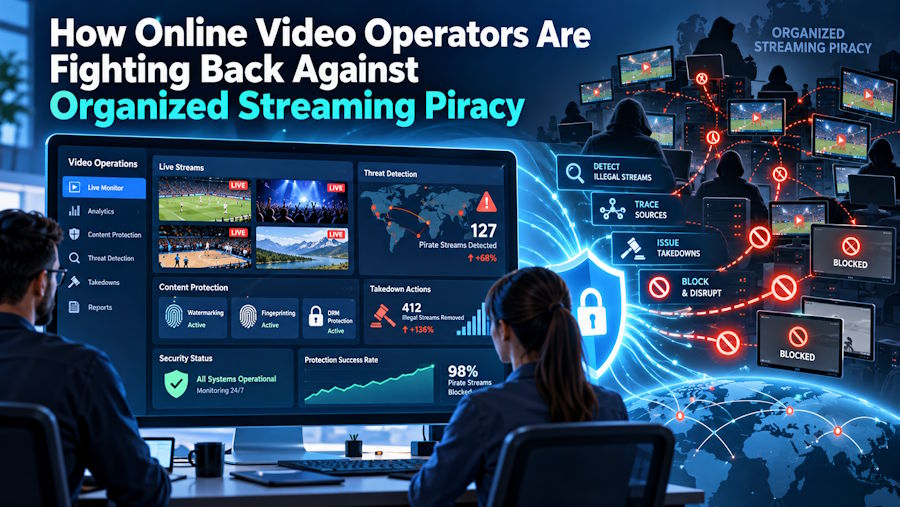
That shift changes what a video service is actually defending against. Unauthorized subscription operations increasingly work as layered supply chains: core operators capture and redistribute content, and resellers sell access through social media and messaging apps. Fighting an organized business takes a comparably organized response: services that successfully combat video piracy rely on a documented strategy covering detection, takedown, and access control together, rather than a single tool aimed at one symptom.
Why blocking access alone stopped working
Omdia's 2026 research on next-generation anti-piracy argues that piracy can no longer be viewed solely as a technical or legal issue: it increasingly affects revenues, operating costs, and the return on investment in content. That reframing matters operationally. A service that only reacts after a stream has already been captured and redistributed is always a step behind whoever built the pirate infrastructure in the first place.
Prevention has to start earlier — at the point where content is packaged and rights are enforced, not after a leaked stream is already circulating on someone else's channel. Takedown requests still matter, but by the time one clears, a pirate outlet running as a real business has usually already remapped the same feed to a new domain or a different set-top box app, which is exactly why treating enforcement as the whole strategy tends to lag the problem rather than close it.
The technical and operational levers that actually reduce leakage
In practice, the response that works combines several layers rather than relying on any single one: encrypting content with modern rights-management standards, authenticating each session with tokens instead of a static password, restricting access by region where content rights require it, and watching login and viewing patterns for the account-sharing or credential-reselling behavior that often precedes large-scale redistribution. None of these steps eliminates piracy outright, but together they raise the cost and effort required to keep a pirate operation running.
Forensic watermarking adds another layer when premium content is redistributed after legitimate access. By embedding a session- or subscriber-specific identifier into the video, an operator can trace a leaked stream back to its source and disable the compromised account or distribution path. This is particularly useful for high-value live events, where identifying the source quickly matters as much as removing individual pirate links.
Real-time monitoring adds a second benefit beyond detection: it turns piracy response into a feedback loop instead of a one-off cleanup. A sudden spike in concurrent sessions from a single credential, or a burst of new accounts sharing the same payment details, is a pattern a monitoring layer can flag within hours rather than the weeks it might take an external watch service to notice and report the same activity.
Treating anti-piracy as ongoing operational discipline
The video services making real progress against piracy are not the ones that shipped a single fix and moved on. They are the ones that review and adjust these layers on an ongoing basis, the same way they would adjust pricing or content spend in response to new information about how viewers, and pirates, are behaving.
With losses projected to keep climbing through 2027, treating anti-piracy as a one-time project rather than a continuous discipline carries its own cost — one that shows up later as lost subscribers rather than a line item anyone budgeted for.

