

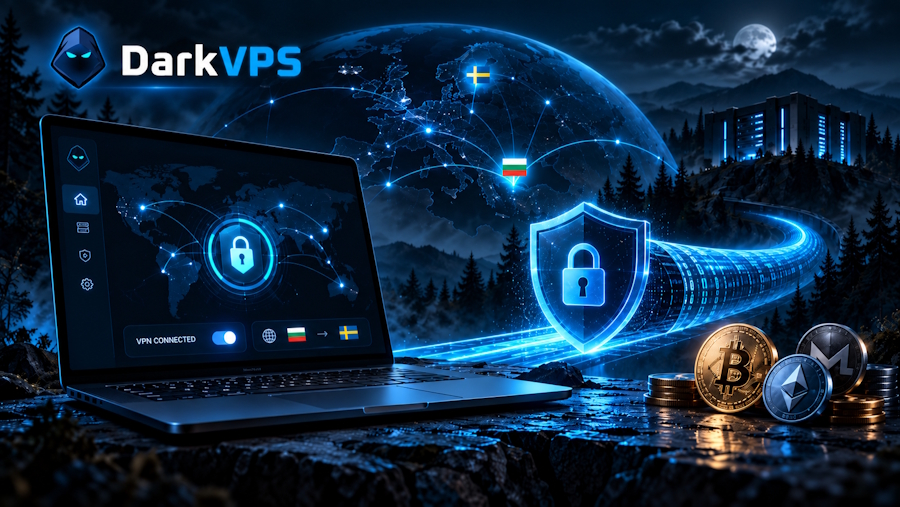
A VPN purchase starts with a practical question: what do you need the connection to do? Some readers want a particular exit location, while others care most about payment options or using familiar software. DarkVPS is worth considering when those requirements match its focused VPN offer. This guide explains the published plan and the checks that help turn a subscription into a useful everyday connection.
The DarkVPS VPN plan at a glance
The DarkVPS VPN service lists the following specifications. Prices and terms were checked on October 11, 2026.
| Plan feature | Published specification |
|---|---|
| Price and term | €4.99 for 30 days |
| Protocol and encryption | WireGuard with ChaCha20-Poly1305 |
| Exit IP and infrastructure | Shared Bulgarian exit IP on Swedish infrastructure |
| Traffic and port | Unmetered bandwidth with a listed 100 Mbps port |
| Device allowance | One device at a time |
| Compatible systems | Windows, macOS, Linux, Android and iOS |
| Signup and payment | Email signup without KYC; crypto or account balance |
| Accepted cryptocurrencies | Bitcoin, Monero, Litecoin, Ethereum, Tron and USDT |
| Refund policy | Payments are final and non-refundable |
Why the VPN protocol matters
WireGuard creates an encrypted tunnel using public keys to authenticate peers. Its official documentation describes a compact design and support across desktop and mobile platforms. For users, the practical benefit is a familiar client rather than a requirement to learn a separate application for every provider.
The protocol is only one part of the experience. Server load, routing, local connectivity and device settings also affect how a VPN behaves. Choosing a well documented protocol is a sensible starting point, but it does not establish the speed or reliability of a particular subscription.
For a first purchase, think about the tasks you repeat most often. Opening work dashboards and browsing documents place different demands on a connection than transferring large files. Judge the service against your actual routine rather than assuming that a protocol name guarantees a particular result.
Choosing an exit location that fits your needs
An exit IP is the address that destination websites see for traffic sent through the tunnel. The physical location of infrastructure and the apparent country of an exit address can differ, so check both before ordering. A service with a specific regional focus can be useful when that region is your requirement.
A shared exit address also deserves consideration. Other subscribers use the same public IP, so its reputation can affect access to individual websites. A VPN subscription should not be treated as a dedicated address for IP allowlisting unless the provider explicitly offers that feature.
If a particular website matters to your work, ask about compatibility before paying. Location alone cannot guarantee access, and an IP address does not change the information a website already knows from your account or browser.
Reading the privacy promises carefully
DarkVPS states that its VPN does not retain browsing destinations, DNS queries or traffic contents. That is a provider statement rather than proof from an independent audit.
Its privacy policy also describes retaining minimal operational information, including account email, billing records and support correspondence. It says billing records are deleted within 30 days after account closure and resolved tickets are deleted. Much of the policy concerns VPS hosting, so VPN-specific questions deserve a direct answer from support.
For readers comparing privacy focused VPN services, the useful distinction is between activity information and the records needed to operate an account. Read both categories. A short signup process may reduce the information requested at registration, but it does not make every later interaction anonymous.
Treat payment privacy as a separate decision as well. Using cryptocurrency avoids entering card details with the provider, but it does not by itself establish that a payment cannot be linked to its sender. Choose a payment method based on how it works, rather than on the word crypto alone.
Understanding bandwidth and connection speed
Unmetered bandwidth describes the traffic allowance. Port speed describes a connection capacity. Neither is a measured promise that every download will reach the listed rate.
Your own internet connection may be the limiting factor. Distance, network congestion and the destination server can also influence results. If you regularly join video meetings, test a normal call. If you transfer project files, compare a representative transfer with the tunnel connected and disconnected.
Use the same device and similar conditions for that comparison. A single speed test provides less useful evidence than repeating your usual tasks at the times you normally work. Watch for stability and responsiveness as well as headline download numbers.
Getting started and checking the connection
DarkVPS describes an email signup, payment confirmation and a downloadable configuration file in the client area. Import that file into the official WireGuard client and activate the tunnel.
Keep the configuration file private. It can contain the credentials needed to establish your connection, so avoid posting it in public support threads or sending it with screenshots. If troubleshooting requires sharing settings, remove sensitive values first.
After connecting, check the public IP shown by an IP lookup service. Check DNS behavior too, and confirm how your device handles IPv6. These checks help establish whether the traffic you expect to route through the VPN actually follows that path.
Also find out what happens when the tunnel disconnects. Ask whether your operating system and chosen client can block traffic outside the tunnel, and verify the behavior before relying on it. A successful initial connection does not establish protection during every interruption.
Who should consider DarkVPS VPN
Based on its published specifications, DarkVPS suits readers who want the advertised regional exit, accept the device allowance and prefer a configuration file workflow. Someone already comfortable with WireGuard may find that approach straightforward.
Readers who need several simultaneous connections, a dedicated IP or many exit countries should confirm those requirements with support before buying. A focused plan can be useful when it matches the task; features outside the published offer should not be assumed.
Frequently asked questions
Does a VPN make every online activity anonymous
No. Signing into personal accounts, browser identifiers and information you submit can still identify you. An encrypted tunnel addresses part of the connection, not every way a website can recognize a visitor.
Can a VPN replace a VPS
A VPN routes traffic through a tunnel. A VPS provides a server environment for running software and hosting services. Choose according to whether you need a network connection or a machine you administer.
What should I ask before subscribing
Ask about the websites you need, simultaneous device use, routing and DNS settings, and the renewal process. Resolving those practical questions makes the purchase easier to assess.
Making the right choice
DarkVPS offers a clearly defined VPN plan that readers can compare against their own requirements. Start with the exit location, client workflow and account terms, then check the connection on your device. That approach gives the product a fair assessment and helps you decide whether it belongs in your daily setup.

