

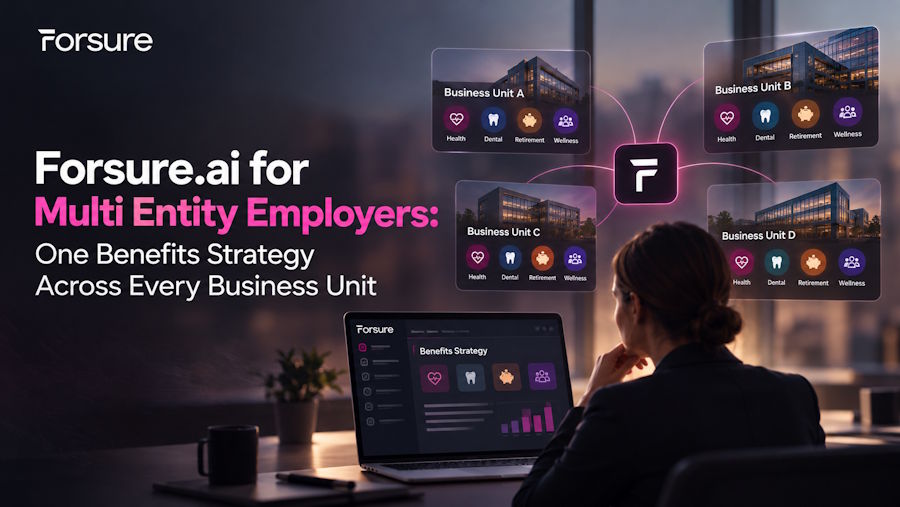
Forsure.ai for Multi Entity Employers: One Benefits Strategy Across Every Business Unit
Growth through acquisition, expansion into new states, and the addition of new business lines all bring the same headache for HR and finance: benefits fragmentation. A company that started with one health plan may end up with several carriers, different plan designs, multiple renewal dates, separate brokers, and data that lives in systems that do not talk to each other. Leadership asks a simple question, how much are we spending on healthcare and why, and nobody can answer it quickly.
This article looks at the specific challenges multi entity employers face and how Forsure.ai is designed to bring those pieces together into one coherent strategy.
Why Multi Entity Benefits Get Complicated
- Acquisitions: Each acquired company brings its own plans, carriers, and contracts.
- Geography: Different states have different carriers, networks, and regulations.
- Workforce differences: Hourly, salaried, union, and seasonal employees may have different eligibility and plans.
- Funding models: Some entities may be self funded while others are fully insured.
- Separate data: Claims, enrollment, and payroll data are scattered across systems and vendors.
The result is a patchwork that is expensive to administer, hard to analyze, and nearly impossible to manage strategically.
The Cost of Fragmentation
Fragmentation is not just inconvenient. It can be expensive. Without a consolidated view, employers miss chances to negotiate as a larger group, duplicate vendor fees, and overlook cost drivers that only appear when data is combined. With average family premiums reaching $26,993 in 2025 according to KFF, and Mercer projecting the largest increase in fifteen years for 2026, those missed opportunities add up quickly across multiple entities.
How Forsure.ai Brings It Together
Unified Data
The platform's integration API connects with existing HR systems, payroll, and carrier data across entities without forcing employers to replace systems. Data from different business units can be viewed together, making true enterprise analysis possible.
Unified Strategy
Forsure.ai states that it supports a unified strategy across business units, locations, and plan structures. That does not mean forcing every entity onto the same plan. It means making decisions with a complete picture, so differences are intentional rather than accidental.
Continuous Analytics
The SureSystem platform provides real time analytics on cost drivers and risk, so leaders can compare entities, spot outliers, and understand where spending is growing fastest.
Expert Guidance
The SureConsult team brings strategy, governance, and execution support, helping employers decide when to harmonize plans, when to keep local differences, and how to communicate changes across the organization.
Integrating Acquisitions More Smoothly
Acquisitions are one of the most common causes of benefits sprawl. When a new company joins, leaders need to understand its plans, costs, and risks quickly. A platform that can connect new data sources and compare the acquired workforce with the existing one makes integration decisions faster and better informed. Teams can model what happens if the acquired employees move to the parent plan, stay on their current plan, or transition over time.
Consistency for Employees
Employees in different locations often receive inconsistent information about their benefits. Forsure.ai provides a member facing digital assistant, Ollie, offering coverage insights, claims help, and scheduling support around the clock. A consistent support experience across every entity helps employees feel like part of one company, even when plan details differ.
Governance Across the Enterprise
With multiple entities come multiple compliance obligations, vendors, and contracts. The company describes compliance and vendor management support as part of the platform. Centralizing this oversight helps reduce the risk of missed deadlines or inconsistent practices across business units.
Reporting for Leadership
Executives and boards want a simple answer to a complex question: what are we spending on healthcare across the whole company, and is it under control? A consolidated view makes that answer possible. Leaders can see total spend, cost per employee by entity, trend over time, and the biggest drivers in each business unit. That level of clarity supports better budgeting, more productive conversations with carriers, and faster decisions when something changes.
Common Mistakes in Multi Entity Benefits
- Harmonizing too fast. Moving everyone to one plan immediately can disrupt employees and damage retention at acquired companies.
- Never harmonizing at all. Leaving every entity on its own plan forever leaves savings and simplicity on the table.
- Ignoring renewal timing. Staggered renewal dates make it harder to negotiate as one group.
- Relying on separate advisors. Different brokers for each entity often produce conflicting advice.
- Underinvesting in communication. Changes land poorly when employees do not understand why they are happening.
A thoughtful, data driven roadmap helps employers avoid these mistakes and move at a pace that works for their people.
Getting Started
- Inventory every plan, carrier, broker, and renewal date across entities.
- Identify where data lives for each business unit.
- Connect data sources through the integration API.
- Review consolidated analytics to find the biggest opportunities.
- Build a roadmap, entity by entity, with consultant guidance.
The company describes its process as starting with a conversation to assess current healthcare operations, with no lengthy onboarding required.
Frequently Asked Questions
Can Forsure.ai work with different carriers across entities?
Yes. The platform is designed to integrate with existing carrier, HR, and payroll data rather than replace it.
Do all entities need the same plan?
No. A unified strategy means decisions are made with full information, not that every entity must have identical benefits.
Does Forsure.ai support both self funded and fully insured plans?
The consulting team works with both funding models.
One Company, One Strategy
Multi entity employers deserve a benefits strategy that matches how they actually operate. By connecting data, providing continuous analytics, and guiding decisions across every business unit, Forsure.ai helps turn a patchwork into a plan. Learn more at Forsure.ai.
Sources: KFF 2025 Employer Health Benefits Survey (kff.org); Mercer National Survey of Employer Sponsored Health Plans, 2025 preliminary results (mercer.com).

