

The short answer
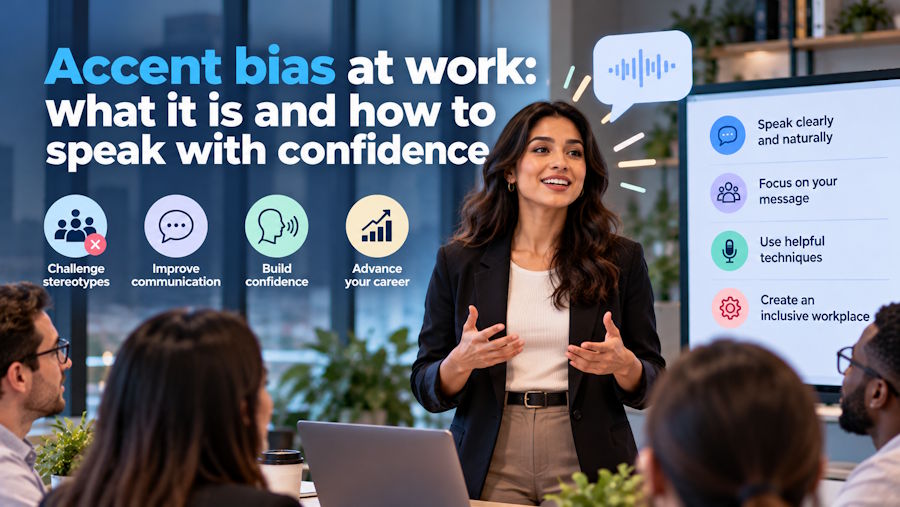
Accent bias is judging someone's ability, intelligence or trustworthiness from the way they pronounce English rather than from what they say. It affects regional accents as well as the accents of people who speak English as a second language.
Employers can reduce it by scoring answers against fixed criteria. Speakers can reduce its effect by being easy to follow, which is about pace and clarity, not about erasing their accent.
How accent bias shows up
Researchers have studied attitudes to accents for more than fifty years. In Britain, the Accent Bias Britain project, led by linguists Devyani Sharma, Erez Levon and Dominic Watt, found that people still rank accents in much the same order of prestige as they did in surveys from the 1960s and 1970s. Accents associated with wealth and education sit near the top. Some urban, working-class accents and some ethnic-minority accents sit near the bottom.
Their work, summarised for employers by the Sutton Trust in its 2022 report Speaking Up, also looked at job interviews. In mock interviews where candidates gave the same answers in different accents, accent could still colour how listeners rated them.
Non-native accents face a further problem. In a study published in 2010, Shiri Lev-Ari and Boaz Keysar asked people to rate trivia statements, such as "Ants don't sleep", read aloud by native and non-native speakers. Listeners rated the same statements as less true when they came with a foreign accent. The authors suggested that harder-to-process speech feels less credible, even though the speaker has nothing to do with whether the statement is true.
Why it happens
None of this means people are deliberately unfair. Accent bias grows from three ordinary habits of the brain.
- Familiarity feels like competence. Speech we've heard all our lives is easier to process, and ease is easily mistaken for quality.
- Accents carry stereotypes. We absorb associations from television, school and family long before we're old enough to question them.
- First impressions are fast. We form a view of a voice within seconds, and then look for evidence that confirms it.
Because the bias is quick and unconscious, good intentions alone don't fix it. Structure does.
What employers can do
The approaches that help most are the same ones that reduce other kinds of interview bias.
- Score the content. Agree in advance what a strong answer contains, and mark against that list during the interview, not afterwards.
- Use the same questions for everyone. Structured interviews leave less room for a voice to sway the result.
- Separate clarity from accent. "I couldn't follow the answer" is useful feedback. "I didn't like the accent" isn't.
- Train interviewers to notice it. Simply knowing that accent bias exists makes interviewers more careful about where their impressions come from.
- Listen for a few seconds longer. Listeners adjust to an unfamiliar accent quickly, and understanding usually improves after only a few sentences.
What you can do as a speaker
If you're worried about how your accent comes across at work, here is the most important thing to know: your accent is not the problem. Clarity is what listeners need, and clarity is a set of skills anyone can practise.
- Slow down slightly. Nerves speed most people up. A steady pace gives listeners time to tune in to your voice.
- Pause between ideas. Short pauses work like punctuation. They show where one point ends and the next begins.
- Land the ends of sentences. Many speakers trail off as they finish. Keeping your voice strong through the last word makes you easier to follow and sound more certain.
- Lead with the point. State your answer first, then explain it. A clear structure carries any accent.
- Know how you sound. Record a practice answer and listen back. It's hard to hear your own voice objectively, and a recording shows you what an interviewer hears.
That last step is easier than it sounds. Record a minute of yourself answering a common interview question, then listen for pace and pauses rather than accent. If you're curious which accent a listener with no context would hear, a free accent test will listen to you read a short passage aloud and name the accent it hears most. Treat the answer as information, not a verdict.
Should you change your accent?
That is your choice, and there is no right answer. Some people enjoy learning a new accent and do it for work, for acting or simply for fun. Others keep the accent they grew up with and are proud of it.
What matters is that the choice is yours, made for your own reasons, and not forced on you by a biased listener. Plenty of leaders, broadcasters and experts speak with strong regional or international accents, and their voices are part of what people remember about them.
The takeaway
Accent bias is real, measurable and usually unconscious. Employers can reduce it by scoring answers instead of impressions. Speakers can reduce its effect by focusing on pace, pauses and structure, which make any accent easy to follow.
You don't need to sound like anyone else to be understood. You need to be clear, and that is something you can practise.
Further reading
- The Sutton Trust, Speaking Up: Accents and social mobility (2022)
- Accent Bias Britain, research project led by Devyani Sharma, Erez Levon and Dominic Watt (accentbiasbritain.org)
- Shiri Lev-Ari and Boaz Keysar, "Why don't we believe non-native speakers? The influence of accent on credibility", Journal of Experimental Social Psychology 46 (2010)
- Katherine D. Kinzler, How You Say It: Why You Talk the Way You Do, and What It Says About You (Houghton Mifflin Harcourt, 2020)
About the author: Yusuf Tör makes Sterling, an AI-powered accent coach that teaches you how to speak English with a British accent confidently and clearly.

