

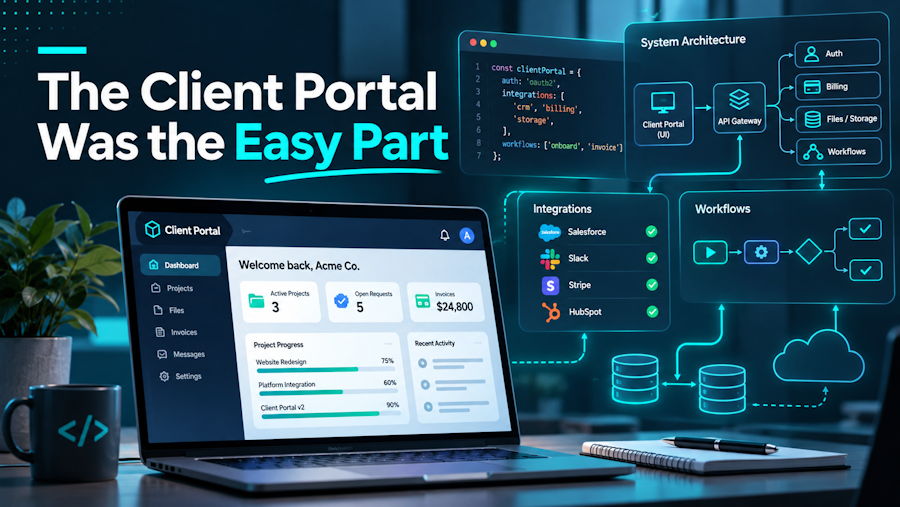
A regional insurance broker asked its two-person data team for a simple client portal: each business customer would log in and see its claims history. The team said yes, figuring a month of work.
Then they opened the data. Claims lived in four systems, each refreshed on its own schedule, and the field labeled “policy number” meant three different things depending on where it came from. Building the portal took a week. Agreeing on what counted as a claim took two months.
Pipelines Are Where Projects Stall
Client-facing apps get the attention and the deadlines. The work underneath, joining sources, cleaning duplicates, deciding which system wins when two disagree, gets estimated last and runs longest.
Reopened claims show the problem well. A claim closes, the customer disputes it, and one system creates a new record while another updates the original. Count naively and that customer looks like it filed twice. Every number on the portal inherits that mistake.
AI tools have started helping here, though more slowly than on the app side.
Visual Pipelines That Still Produce Code
Prophecy is one of the platforms data teams are adopting for this layer. Engineers and analysts design transformations visually, joining, filtering, and aggregating, and the platform generates SQL that lands in version control. An AI assistant can propose a transformation from a plain description, like “deduplicate claims by keeping the most recent status per claim ID.”
The generated code is the important part. Purely visual tools tend to trap logic inside a canvas nobody can diff or review. When the output is ordinary SQL in a repository, a senior engineer can read a pull request, spot the bad join, and comment on line 42.
There’s a limit. The assistant writes plausible deduplication logic quickly, and plausible is the dangerous word. In the broker’s case, its first suggestion kept the most recent record per claim ID, which sounded right and silently dropped the disputed claims that had been issued new IDs. Someone still has to know the business well enough to catch it.
Building the App on Top
Once the curated tables existed, the portal itself went fast. The team used an AI app builder to generate login, a claims table with filters, and a few charts, then spent most of their time on three things the generator handled poorly.
Row-level security came first. Each client could see only its own claims, and brokers could see every client they managed. The generated app checked permissions on the page, but the database queries didn’t filter, so a modified request could return someone else’s data. They rewrote the query layer by hand.
Freshness came next. Clients called asking why yesterday’s claim hadn’t appeared. The fix was a small line on each page showing when data last refreshed, which cut those calls almost entirely.
Third, the app had to read only from curated tables, never raw sources. Developers drift toward raw tables when a field is missing, and that brings the reopened-claim problem straight back.
Where Teams Get Burned
Generated code is fast to accept and slow to audit. Treat every AI-produced query like a pull request from a capable new hire who doesn’t know your data yet.
Write tests for the numbers clients will see. A test that compares total claims per client against the source system each night caught two pipeline regressions for the broker within its first month.
And watch the compute bill. Pipelines generated quickly also get rerun quickly, and a full refresh scheduled every fifteen minutes costs real money when hourly would do.
The Two Months Nobody Budgeted For
The broker’s team now plans projects backward from the data. Before anyone opens a builder, they write down every number a client will see and trace each one to a source. The tools made the building fast. They didn’t decide what a claim was.

