

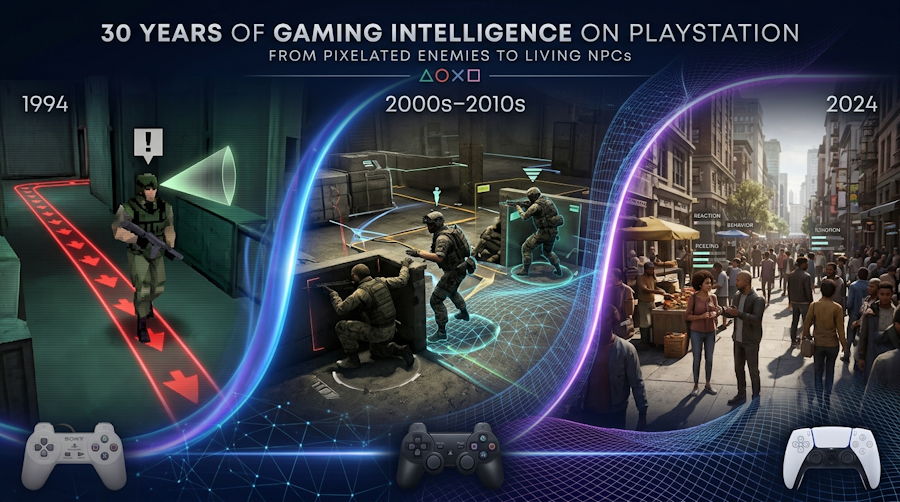
Artificial intelligence has been part of video game development for decades, but the technology behind it has changed dramatically. Early gaming systems relied on predefined instructions to control characters, while modern platforms can support complex decision-making algorithms, machine learning models, and adaptive behavior.
The evolution of PlayStation illustrates this progress. Since the original console launched in 1994, developers have improved how non-player characters (NPCs) interact with environments, respond to user input, and make decisions.
These advances reflect broader developments in software engineering and computational processing. Similar principles now support applications ranging from autonomous systems to digital entertainment platforms, where software continuously processes information and responds to changing conditions.
Early Game AI: Rule-Based Programming
During the first PlayStation generation, hardware limitations significantly influenced AI development. Limited processing power and memory required developers to create convincing behavior using efficient algorithms.
One common approach was the finite state machine (FSM), a programming model that organizes character behavior into predefined states.
For example, an enemy character might operate in several conditions:
- Patrol: Following a predefined route.
- Alert: Investigating suspicious activity.
- Combat: Attacking after detecting the player.
- Search: Attempting to locate a missing target.
- Return: Resuming normal behavior.
Transitions occur when specific conditions are met. Although these systems cannot learn independently, carefully designed rules can create surprisingly believable interactions.
Metal Gear Solid, released in 1998, demonstrated this approach. Enemy guards responded to visual detection, environmental clues, and changing alert conditions.
Finite state machines remain relevant in software development, particularly in automation, interface design, and applications requiring predictable responses.
More Complex Behavior and Adaptive Software Systems
The PlayStation 2 generation introduced more sophisticated interactions between players and computer-controlled characters.
Games such as ICO and Shadow of the Colossus demonstrated how behavioral programming could make digital companions appear independent.
Instead of responding instantly to every command, characters sometimes hesitated, adjusted their movements, or reacted differently depending on environmental conditions.
These behaviors were generally created through scripted animations, navigation systems, contextual triggers, and state-based logic rather than machine learning.
The underlying principle of software reacting to user behavior extends beyond gaming. Modern streaming platforms, recommendation engines, and digital entertainment services continuously process interaction data to personalize experiences. Even platforms such as https://parimatch.com/en/crypto-casino operate within the broader ecosystem of interactive web applications, although their specific functionality differs from game AI.
In each case, effective software architecture depends on processing inputs, managing application states, and delivering timely responses.
Behavior Trees and Context-Aware AI
During the PlayStation 3 and PlayStation 4 generations, more advanced AI architectures became increasingly important.
One widely adopted approach involved behavior trees, which organize decisions into hierarchical structures.
Unlike traditional finite state machines, behavior trees make complicated decision-making processes easier to manage and expand.
For example, an enemy AI might:
- Determine whether the player is visible.
- Evaluate nearby cover positions.
- Check available resources.
- Select an appropriate action.
- Reassess conditions as the environment changes.
The Last of Us, released in 2013, demonstrated how coordinated AI systems could improve character interactions.
Ellie, the player's companion, navigated environments, avoided obstacles, and participated in encounters while remaining consistent with gameplay mechanics.
Such systems depend on interconnected technologies, including pathfinding algorithms, navigation meshes, animation controllers, and environmental awareness.
Similar navigation principles appear in autonomous robotics, warehouse automation, and simulation software.
Machine Learning and Adaptive Decision-Making
Traditional game AI relies on rules written by programmers. Machine learning introduces a different approach by enabling systems to improve behavior through training.
Instead of manually defining every possible action, developers train models using data or simulated interactions.
Reinforcement learning is particularly relevant to interactive environments.
An AI agent performs actions, observes consequences, and receives rewards or penalties based on predefined objectives. Over time, it learns which decisions are more likely to produce successful outcomes.
A simplified reinforcement learning system includes:
- Agent: The AI responsible for decisions.
- Environment: The simulated world.
- Action: A selected behavior.
- Reward: Feedback measuring performance.
This approach is valuable when environments contain too many variables for conventional programming.
However, machine learning introduces challenges involving computational cost, model reliability, and testing. Developers must ensure that intelligent systems behave consistently while operating within hardware limitations.
AI Technology in Digital Sports Simulations
One notable application of reinforcement learning involves sports simulation technology, particularly racing environments.
Modern racing simulators require computer-controlled opponents to calculate braking points, predict competitors' movements, evaluate racing lines, and avoid collisions.
Gran Turismo Sophy, developed by Sony AI in collaboration with Polyphony Digital and other partners, demonstrates how machine learning can improve virtual racing opponents.
In February 2022, research describing GT Sophy's achievements was published in the scientific journal Nature. The AI demonstrated its ability to compete against highly skilled human Gran Turismo drivers.
Unlike conventional racing AI, Sophy developed driving strategies through reinforcement learning.
The system needed to balance multiple objectives, including maintaining speed, controlling the vehicle, and responding to competitors.
These decisions must be made continuously as racing conditions change.
The technology has implications beyond sports simulation. Similar reinforcement learning principles can support autonomous vehicle development, robotic control, and intelligent transportation research.
Generative AI and Interactive Characters
Another important development involves generative artificial intelligence.
Traditional NPC dialogue systems rely on predefined conversation trees. Players choose available responses, and characters deliver scripted dialogue.
Generative AI creates opportunities for more flexible interactions.
Large language models can produce text based on user input and contextual information. Combined with speech recognition, voice synthesis, and animation systems, they can support characters capable of responding to open-ended questions.
In March 2025, a demonstration video showed an experimental Sony prototype involving Aloy from Horizon Forbidden West answering spoken questions.
The demonstration illustrated how language generation, synthetic voices, and facial animation could work together in future interactive experiences.
However, integrating generative AI into commercial games introduces technical challenges.
Response latency is a major concern because players expect immediate reactions. Developers must also maintain narrative consistency and prevent generated dialogue from contradicting established game events.
Potential solutions include constrained language models, structured knowledge databases, and additional validation systems.
Technical Challenges and Future Development
Despite significant progress, advanced game AI requires balancing computational efficiency, reliability, and behavioral complexity.
Modern games allocate processing resources across graphics, physics, networking, animation, and artificial intelligence.
AI systems must operate without significantly reducing overall performance.
Testing also becomes more complicated as developers introduce machine learning models whose decisions may be difficult to interpret.
Hybrid architectures offer one solution by combining learned behavior with deterministic programming.
For example, a machine learning model might recommend an action while a rule-based controller checks whether it meets predefined constraints.
This approach can provide adaptive behavior while preserving greater control over system performance.
The evolution of PlayStation AI demonstrates how improvements in hardware and software engineering continue to expand interactive technology.
From simple state machines to reinforcement learning and generative models, game AI has become a sophisticated field combining algorithms, simulation, and intelligent decision-making.
Future progress will depend not only on making systems more advanced but also on ensuring they remain efficient, reliable, and useful in real-world applications.

