

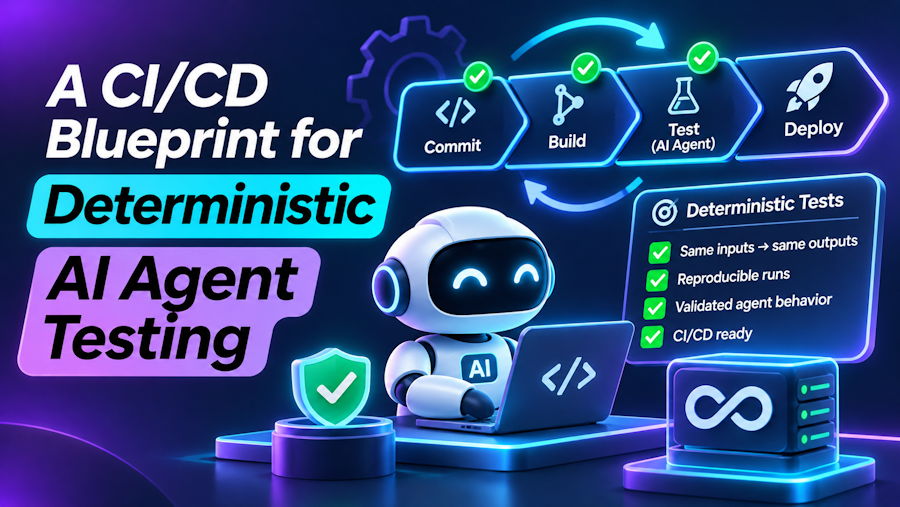
Standard CI/CD pipelines were built for deterministic software that produces the same output for the same input every time. AI agents do not work that way. The same prompt can produce different responses on consecutive runs. A workflow that passes once can behave differently later after a model update nobody explicitly triggered.
AI agent testing demands exact output matches, but it shows too many false positives when teams try to integrate it into a standard CI/CD pipeline without making modifications. This may become too permissive and miss real regressions because the team stopped trusting the results.
The right approach is a purpose-built blueprint, an AI agent testing platform integrated into CI/CD in a way that handles non-determinism deliberately, not as an afterthought. This guide covers what a blueprint for deterministic AI Agent testing looks like in practice.
What Does Deterministic Testing Mean For AI Agents?
Deterministic testing means building a testing process that is predictable and produces reliable results. The testing system should produce consistent signals about whether the agent is performing well even when individual outputs vary.
For traditional software, CI/CD pipelines answer three basic questions:
- Did the change make things better or worse?
- Is the current version ready to ship?
- What broke and why?
For AI agents, these questions require different measurement approaches. Rather than exact output comparison, it requires statistical baselines, semantic evaluation, and trend tracking across multiple runs, not just a single pass or fail. A testing process is deterministic when it consistently catches real regressions and consistently avoids flagging acceptable output variation as failures.
How Do You Know When The Pipeline Needs To Be Updated?
A pipeline that worked well before may miss regressions later. As AI agents evolve, model updates, prompt changes, and use cases expand. The testing infrastructure needs to keep pace, or it becomes less useful over time without the team noticing.
Signs the pipeline needs attention:
- A pipeline with no failures means it's missing coverage; it doesn't mean the agent is perfect. Review whether the test dataset still reflects real production inputs or has drifted toward only the easy cases.
- Recurring failures that get approved and closed without a fix. This signals the pipeline to pass things it should be catching.
- When developers start ignoring pipeline failures as noise without actually checking them, the pipeline loses credibility. This usually traces back to too many false positives or poorly defined acceptable ranges.
- Every time the agent is extended to handle a new use case, the test dataset and acceptable ranges need to update to match. A pipeline built for the original scope will not catch regressions in new functionality.
Review the pipeline structure, dataset coverage, and acceptable ranges at least once a month. After any significant agent change, review before the next deployment rather than waiting for the scheduled review.
How Do You Build A CI/CD Blueprint For AI Agent Testing?
- Define Determinism in Non-Deterministic Systems
Before building the pipeline, the team needs to define what reliable performance looks like for the specific agent being tested. This means shifting from exact-match thresholds to range-based metrics.
For each agent type, define:
- Accuracy range - The percentage of test outputs that need to be correct for the build to pass. Set a floor, not a fixed number.
- Latency range - The response time range acceptable under normal and peak conditions.
- Variance range - The output variation across multiple runs is acceptable before it signals instability.
- Hallucination threshold - For agents that generate text, what percentage of outputs containing unsupported claims is acceptable?
These ranges become the pass/fail criteria for the pipeline. A build passes when all metrics fall within their acceptable ranges. A build fails when any metric falls outside. This approach produces reliable signals without requiring identical outputs on every run.
- Define AI Agent tests placement in the Pipeline
Placement determines when failures surface and how quickly the team can act on them. AI agent tests are more expensive to run than unit tests; they take longer and require more resources. Running the full suite on every commit is rarely practical.
A layered approach works better:
- On every pull request, run lightweight smoke tests: Running a small set of high-priority test inputs covers the most critical agent behaviors. Keep this suite small, so it runs quickly and provides feedback before a review is finished.
- On merge to main target regression suite: Once a change merges, run a broader regression suite covering all major agent behaviors and input categories. This is where edge case coverage matters.
- On scheduled intervals, perform a full evaluation run: AI agents can regress without any code change, model updates, data drift, or dependency changes. Schedule a full evaluation run at least daily, independent of deployment events. This catches the class of regressions that code-change-triggered pipelines miss entirely.
- Before production deployment release gate: Run the full evaluation suite and require all metrics to fall within their defined acceptable ranges before allowing deployment. This is the final check; a build that fails the release gate does not go to production.
- Handle Flaky Results in AI Agent CI/CD
Flaky results are the biggest threat to AI agent CI/CD adoption. When the team cannot tell whether a failure is a real regression or normal output variation, they start treating all failures as noise. The pipeline stops being trusted and stops being useful.
Practical approaches to reduce flakiness:
- Run each test input multiple times per build. This filters out run-to-run variation and surfaces patterns that indicate real regressions.
- Use semantic evaluation rather than exact match. This catches wrong answers while tolerating acceptable variation in wording.
- Separate output correctness from output format in the pipeline. Formatting failures may be acceptable in some contexts and critical in others.
- Tag known flaky tests and track their failure rates separately rather than letting them inflate the overall failure count.
- Set a minimum number of runs before declaring a failure. Instead, require a metric to fall outside its acceptable range across multiple runs before the pipeline treats it as a real failure.
- Gate Releases Based on AI Agent Test Results
Release gating for AI agents requires more nuance than traditional software because not all failures carry the same risk. A failure on a critical workflow input is a different risk from a failure on an edge case input.
A tiered gating approach handles this:
- Tier 1 - blocking failures: These are the behaviors the agent must handle correctly. Any regression here is a release blocker regardless of how small it looks in the aggregate numbers.
- Tier 2 - warning failures: A human reviewer sees the warning, assesses whether the regression is acceptable given the change, and makes an explicit decision to proceed or hold.
- Tier 3 - tracked failures: Failures on known flaky inputs or inputs outside the agent's primary design scope are logged and tracked but do not trigger blocking or warning states. They inform future dataset maintenance rather than release decisions.
What To Consider Before Building CI/CD Pipeline For AI Agent Testing?
A few things determine whether the CI/CD blueprint for AI agent testing holds up over time:
- Start with a small, high-quality test dataset: A large dataset with poor coverage is less useful than a small dataset that covers canonical inputs, edge cases, and historical failures well. Build the dataset deliberately before the pipeline goes live.
- Define acceptable ranges before the first run: Ranges defined after seeing the first results are influenced by what the results look like. Define them based on the agent's requirements, not based on what the first run produces.
- Assign ownership for the pipeline: Someone from the team needs to own the regression process, reviewing results, updating the dataset as the agent evolves, and making go/no-go calls based on metrics. Without ownership, the pipeline becomes inconsistent and loses credibility with the team.
- Treat model updates as deployment events: If the AI infrastructure provider can push model updates without triggering a deployment event on the application side, schedule evaluation runs that catch model-level regressions independently of code changes.
- Expect the pipeline to evolve: The first version of the pipeline will not be the right version. Build in a regular review cadence to assess whether the test dataset, acceptable ranges, and pipeline structure still reflect the agent's current requirements.
What Goes Wrong When Teams Skip This Blueprint?
Teams that deploy AI agents without a purpose-built CI/CD process tend to face a few challenges that need consideration.
- Regressions reach production undetected. Without a structured evaluation process, output drift piles on silently. Users notice before the team does, which is the worst time to find out.
- Flakiness kills confidence in results. Teams that start with standard CI/CD tools often experience false failures early on. If not addressed, the team may quickly ignore failures. Once they start doing it, it is hard to reverse.
- Model updates break things with no warning. Without scheduled evaluation runs independent of code changes, a model update can degrade agent performance before anyone notices. By then, user-facing damage has already accumulated.
- Release decisions become guesswork. Without defined acceptable ranges and tiered gating, the team is making release decisions based on intuition rather than data.
- The test dataset stops reflecting reality. A dataset that never gets updated eventually reflects how the agent used to behave. New failure modes from production usage accumulate in reports instead of the test dataset where they could prevent recurrence.
This is where TestMu AI addresses issues that most CI/CD tools were not built for. Rather than logging individual failures and leaving the team to connect the dots, the platform's approach starts at the analysis layer.
TestMu AI (Formerly LambdaTest) is an agentic AI quality engineering platform; its AI intelligence layer reads failures across runs and environments simultaneously. It then groups failures with a shared explanation of what they have in common.
The platform distributes test runs in parallel through HyperExecute across 3,000+ environments and 10,000+ real devices without extending pipeline time. It also integrates with Jenkins, GitHub Actions, GitLab CI, and similar pipeline tools. Tests trigger automatically on relevant changes. Every run produces session logs, video recordings, screenshots, and failure analysis attached directly to the pipeline result.
TestMu AI’s KaneAI, an AI-powered test authoring and maintenance agent, simplifies test creation and maintenance by allowing teams to describe scenarios in natural language. When the agent or its integration points change and existing test steps break, KaneAI automatically detects the breakage and repairs the affected steps. This keeps the regression dataset aligned with the current agent without requiring testers to review and update it after every change manually.
Its SmartUI adds a layer that most AI agent testing tools skip entirely: visual output validation. The SmartUI captures and compares what the interface actually renders across browsers and devices. A model update that shifts response formatting or changes how output displays in the UI surfaces in SmartUI before it reaches users.
Together, these capabilities extend AI agent testing beyond response evaluation. It gives teams a broader regression layer covering both what the agent does and how that behavior appears to users.
Conclusion
Standard testing approaches need adjustments in building a CI/CD pipeline for AI agent testing to produce reliable results. Exact match assertions, single-run evaluations, and binary pass/fail thresholds do not transfer to non-deterministic systems without producing noise that undermines confidence in the results.
The blueprint that works uses statistical measurement over multiple runs, semantic evaluation for text outputs, and tiered release gating based on failure severity. It also includes scheduled evaluation runs that should be part of the pipeline to catch regressions independent of code changes.
Test teams require tools that handle the execution volume, make failure analysis actionable, and stay connected to the pipeline automatically.

