

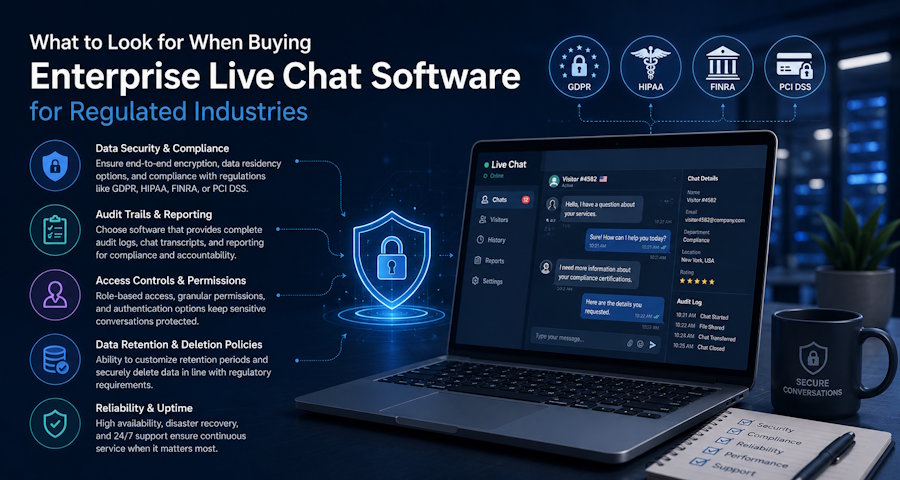
Customers no longer sit on hold. Two-thirds expect a live-chat reply within 10 minutes, and they judge us on that speed.
For healthcare, finance, government, and higher-ed teams, the bar is higher: protect every byte, stay 100 percent compliant, and still answer in real time. One sloppy tool can mean fines and frantic incident calls.
This guide is your checklist for choosing enterprise live chat software for regulated industries. We’ll tackle security first, then AI, integrations, scalability, user experience, analytics, support, pricing, and long-term fit, so you can serve customers instantly without inviting regulators.
Regulatory compliance and security
Certifications and standards: pass the gate first.
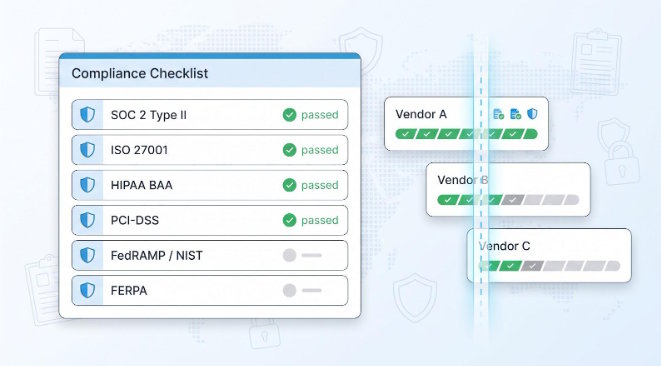
Skip the widgets. If a platform can’t prove it meets your industry’s rules, the search stops. Business associates appear in roughly one in three reported healthcare breaches, and a single miss can cost millions.
Comm100 embeds SOC 2 Type II and ISO 27001 controls into its enterprise live chat software and makes the latest audit summaries readily available.
Start with paperwork, not demos. Ask every contender for current SOC 2 Type II and ISO 27001 audit reports: evidence that independent auditors found no cracks. Accept nothing less.
In healthcare, require a signed Business Associate Agreement at the tier you will buy. Some vendors flaunt HIPAA on the home page but hide the BAA behind a premium plan; surface that gap early.
Banks and broker-dealers add PCI-DSS for card data plus FINRA or SEC 17a-4 for records retention. Public-sector teams look for FedRAMP or, at minimum, matching NIST controls in a state framework. Universities check for FERPA coverage before student data moves.
Certifications are table stakes, not trophies. Verify every claim with dated reports, scope statements, and an auditor contact. If a vendor hesitates, move on.
Clear that bar, and we can dig into day-to-day security practice next.
Data security and encryption
We have the paperwork. Now we protect the packets. A live chat session can carry medical charts, bank balances, or student IDs in a single message, so our guardrails must be airtight at every hop.
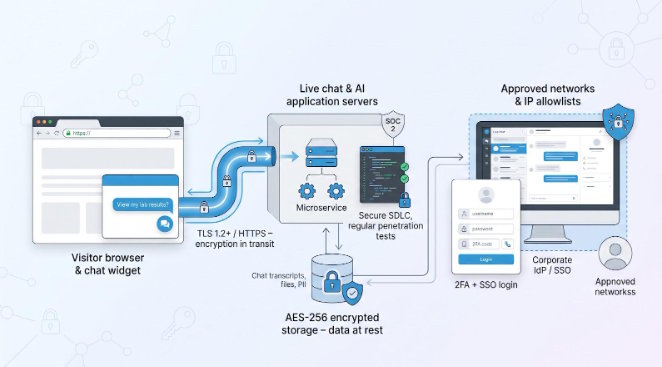
First, demand end-to-end encryption in transit and at rest. Anything less is a red carpet for threat actors. TechRadar notes that platforms rely on “encryption algorithms such as AES-128 or AES-256 to prevent unauthorized access to user data,” and we agree. Look for TLS 1.2 or higher on the wire and AES-256 for storage. Ask the vendor to show cipher suites and key-rotation schedules, not just a marketing badge.
Access control tightens the perimeter. Two-factor authentication should be standard for every agent login. Single sign-on keeps identities in sync with your IdP, so de-provisioning an employee instantly seals chat access. Layer in IP allowlists if agents only work from approved networks.
Inside the platform, the code pipeline matters as much as the chat tunnel. Probe for a secure software development lifecycle, regular penetration tests, and a staffed security operations center. The best vendors publish a vulnerability disclosure policy and share recent pen-test summaries under NDA. Transparency signals maturity.
Finally, scan for safeguards that map to regulations: automatic session timeouts, role-based transcript redaction, and field-level masking for credit cards or patient numbers. When those controls are proven, you can move forward with confidence.
Data residency and sovereignty
Compliance does not end with encryption. Regulators care where the encrypted bits sleep. If patient or citizen data crosses the wrong border, your organization (not the vendor) pays the penalty.
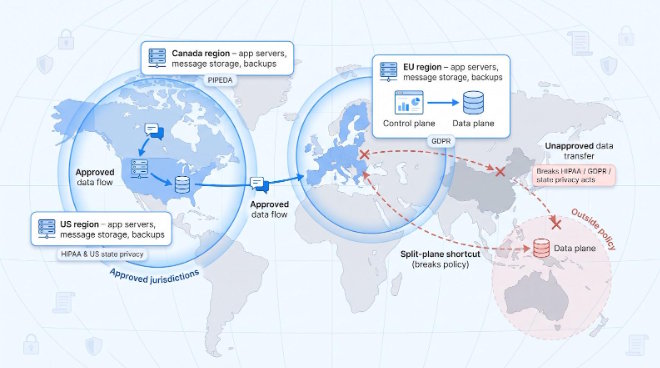
Begin every conversation with a map. Ask the provider to name the exact regions that host application servers, message storage, and backups. Get a written commitment that chat traffic and transcripts stay in the jurisdictions your policy requires.
Beware split-plane designs. Some services keep the interface in one region but route the message payload through another to trim costs. That shortcut breaks HIPAA, GDPR, and many state privacy acts in a single hop. Require confirmation that both control and data planes stay local.
Agencies and defense contractors may need a private cloud or on-premises deployment to meet sovereignty rules. Seasoned vendors expect this need and offer single-tenant environments or export-controlled builds. If a provider hesitates or adds a mystery surcharge, they likely lack experience in regulated sectors.
If you cannot sketch the data path on a whiteboard, walk away before procurement drags you into deeper risk.
Audit trails and access control
A chat tool without rigorous logging is a compliance nightmare. Regulators need to see who touched sensitive data, when, and what they did next, and so do you.
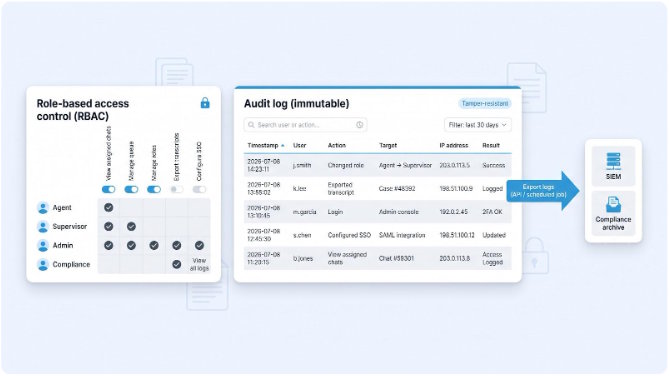
Choose a platform that records every administrative move in an immutable audit trail. User login, permission change, transcript export: each action must show a timestamp and user ID. No gaps, no manual toggles.
Role-based access control builds on that foundation. Agents view only the conversations they handle, supervisors manage the queue, and system admins hold the keys. Least privilege is the fastest way to cut insider risk.
Look for native single sign-on so a departing employee loses chat access the moment their corporate account closes. Add automatic session timeouts to shut stale browser tabs and block shoulder surfing.
Finally, confirm you can export logs to your SIEM or compliance archive. When an auditor arrives or a security incident strikes, you will be glad you chose a chat platform that delivers forensic-grade evidence in seconds, not days.
AI readiness and responsible automation
AI-powered chatbots for 24/7 support.
Great security means little if customers still wait until Monday for answers. A modern chat platform needs an AI teammate that never clocks out.
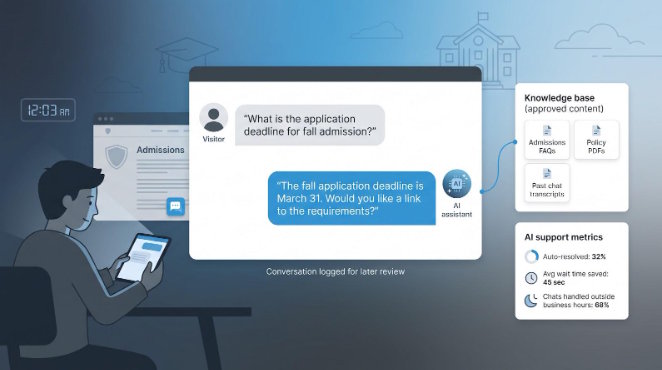
Picture a university admissions site at midnight. Prospective students fire off questions about application deadlines. An AI chatbot greets them instantly, pulls the exact date from your knowledge base, and logs the exchange for later review. No ticket backlog, no overtime hotline.
Train the bot on the right content. Feed it internal FAQs, policy PDFs, and past transcripts so its replies match a seasoned agent. Refresh that library often; stale data erodes trust.
Graceful hand-off matters, too. When a chat drifts outside safe ground (for example, a patient seeks medical advice), the bot should bring in a live agent without delay. The transcript, context, and sentiment score must travel with the transfer so the human picks up smoothly. Customers feel heard, agents feel prepared.
Track success with clear targets: percentage of chats auto-resolved, average wait time saved, and agent capacity gained. Show the CFO that AI deflects a third of routine queries, and budget talks get easier.
Integration and omnichannel capabilities
Live chat cannot sit in a corner. It must connect to the tools your teams already use and meet customers on their channel of choice.
Start with the essentials: CRM, ticketing, and core databases. When a visitor opens a chat, the platform should pull their profile from Salesforce or Dynamics and show past interactions in the agent sidebar. After the chat, the transcript should flow back into the same record. No swivel-chair data entry, no missing history.
Think beyond the website. A single console that merges email, SMS, and social messengers keeps agents from hopping between tabs and losing context. The best platforms treat each channel as another thread in a shared inbox, so your routing rules and service levels stay consistent.
Open APIs matter, too. Even if a vendor lacks a pre-built connector, a clean REST or GraphQL layer lets your developers sync chat data into analytics stacks, identity verification services, or archival vaults. Look for clear webhooks and transparent rate limits.
Test the integration story during a trial. Spin up a sandbox, connect your staging CRM, and push real test traffic across every channel. If the wiring takes days instead of hours, keep shopping.
Scalability, performance, and reliability
High concurrency and volume handling.
Picture your busiest day: tax deadline, enrollment week, or a storm alert. Hundreds of users click the chat button at once. The platform must stay responsive.
Ask vendors for hard numbers. How many concurrent sessions have they handled in production? What message-per-second rate holds under load? Seasoned providers track these stats and share architecture diagrams that show load balancers, container clusters, and auto-scaling rules.
Agent experience matters, too. Agents should juggle multiple chats with zero lag, receive clear cues when a visitor arrives, and switch between conversations instantly. Any pause raises stress and extends customer wait.
Finally, test the back end. Can the database tier absorb a burst of transcript writes? Does reporting stall when millions of rows pour in? Stress-test a sandbox with realistic traffic before you sign. If the tool stays smooth while numbers climb, you have cleared the first performance hurdle.
User experience and accessibility
Agent interface and usability.
A chat platform rises or falls on the screen your agents view all day. If the console feels clunky, response times slow and morale sinks. Keep the layout clean. Key customer details (name, history, sentiment) should surface automatically so agents spend brain-cycles solving problems, not hunting for data.
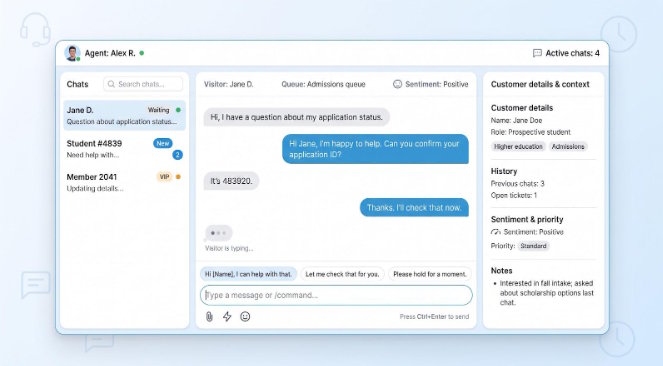
Speed is everything. Switching between active chats must feel as quick as pressing a browser tab. Visual cues such as subtle color shifts, unread counters, and gentle sounds help agents triage without anxiety. The goal is calm efficiency, not arcade chaos.
Shortcuts matter, too. Canned responses, slash commands, and keyboard navigation shave precious seconds off each reply. Over a shift, those seconds add up to hours of reclaimed productivity.
Onboarding tells the real story. Sit a new hire in front of the console with minimal instruction. If they can greet a visitor, escalate a case, and close the chat within minutes, you have a winner. If they fumble through nested menus, picture that pain multiplied across a team of fifty.
An intuitive workspace cuts handle times, lifts satisfaction scores, and frees mental bandwidth for complex cases. Invest here and the rest of your stack feels lighter overnight.
Customer chat experience.
Now step into your visitor’s shoes. The widget is often their first direct contact with your brand, so every click must feel effortless.
Visibility comes first. Place the launcher where eyes naturally land (bottom right on desktop or a full-width bar on mobile), and keep it present on every key page. Hide it behind a tiny icon and you lose conversations before they start.
Once opened, the window must load in a flash. Slow widgets kill engagement and drag site performance scores. Use asynchronous scripts and limit third-party trackers so your page speed stays green.
Ask only for essentials up front. A short pre-chat form that captures name and intent helps routing without scaring people away. If you already know the visitor (for example, they are logged into a patient portal), pass those details silently through single sign-on and skip the form entirely.
Make replies feel human. Typing indicators, emojis, and quick-reply buttons turn a sterile chat into a natural dialogue. Allow file uploads when context matters, such as x-ray images, bank statements, or enrollment documents. Keep the upload path inside the encryption boundary you approved earlier.
Finally, close the loop. Trigger a one-click satisfaction survey as the chat ends and email a transcript if policy allows. Customers leave with proof in hand, and you collect data that guides product fixes and training.
Analytics and reporting capabilities
Real-time monitoring and dashboards.
Data is your early-warning radar. Without live metrics, a small queue can snowball into missed SLAs before anyone notices.
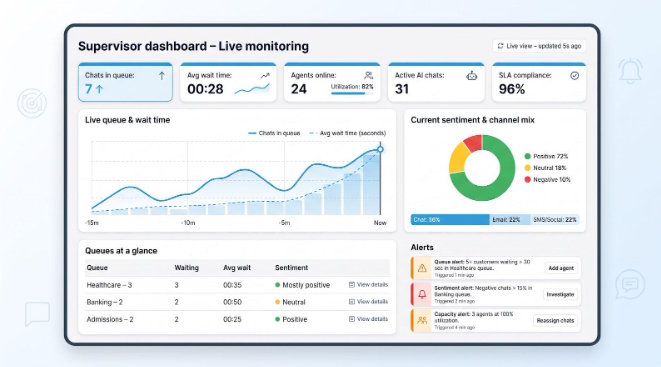
Look for a supervisor view that lights up the moment wait times climb, agents hit capacity, or sentiment trends sour. The best dashboards refresh every few seconds and flag issues with clear color cues, so no one squints at tiny charts.
Granularity matters. Drill from a high-level heat map to a single conversation in two clicks. That jump lets managers coach an agent in real time or reroute a VIP chat before frustration takes root.
Alerts seal the deal. Configure thresholds, for example five customers waiting more than 30 seconds, and trigger email, SMS, or Slack pings. Automation keeps everyone honest even after hours.
Shadow your operations team during a pilot. If they rely on manual refreshes or spreadsheets, the tool is not enterprise-ready. Real-time visibility protects service levels, compliance targets, and your team’s sanity.
Historical reporting and KPIs.
Real-time views keep the lights green, but trend data shows whether the engine stays healthy. You need history to spot bottlenecks, justify staffing, and satisfy auditors.
Your chat platform should store every metric you care about (chat volume, first-response time, handle time, customer satisfaction), broken down by team, agent, and time slice. Filters and date pickers must stay snappy even when you query millions of rows. If reports take minutes to load, analysts export to spreadsheets and the single source of truth disappears.
Customization counts. Pre-built dashboards cover the basics, yet each organization tracks unique indicators: escalation rate for medical cases, financial complaint codes, or student deferral questions. Look for drag-and-drop widgets or, better, an export API that pipes data into Tableau or Power BI.
Retention length matters, too. Health-care rules often demand transcripts for six years, while finance can stretch to seven or more. Confirm that the vendor’s default retention matches your needs or can be extended without shocking fees.
Finally, schedule automated email reports for stakeholders who never log in. A polished weekly summary keeps leadership aligned and funding secure. Data that travels is data that drives change.
Vendor support, training, and services
Onboarding and implementation assistance.
The best software fails without a guide who knows the terrain. That guide is the vendor’s onboarding team, and their work starts before the contract ink dries.
Expect a named project manager who maps every milestone: discovery, integration, pilot, and go-live. They host regular calls, chase dependencies, and stop technical jargon from blocking business decisions. If a provider hands you a PDF and says “good luck,” walk away.
Enterprise rollouts are rarely plug-and-play. You may need a single sign-on handshake with Azure AD, a webhook into your case-management system, or an on-premises install behind strict firewalls. Ask for war stories that match your scenario. Have they migrated a hospital from a legacy chat tool? Integrated with a state agency’s mainframe queues? Real examples beat polished slide decks.
Clear timelines protect the budget. A mature vendor supplies a playbook with realistic hours for each task, spells out who provides certificates, and flags known roadblocks, such as change-control windows or legal reviews for a Business Associate Agreement. Surprises shrink when the plan is honest.
Finally, insist on a sandbox with your data and users at zero licence cost during setup. A hands-on pilot reveals edge cases faster than any discovery workshop. When onboarding feels this organised, the rest of the relationship tends to follow suit.
Pricing and total cost of ownership
Pricing models and clarity.
Sticker prices mean little until you decode how a vendor measures use. Some charge by named agent, others bill only for concurrent logins, and a few meter total chat volume. Pick the wrong model and costs climb every time marketing launches a campaign.
Ask each provider to quote the same scenario: number of agents, expected peak chats, must-have compliance add-ons, and premium support. Line those quotes up in a simple grid. Hidden fees surface fast when the comparison is level.
Read the fine print. HIPAA or FedRAMP options may sit in a higher tier, and AI modules that impressed in the demo can live behind a separate licence. Confirm whether connectors, extra data retention, or sandbox space carry extra charges.
Finally, model growth. If chat volume doubles next year, will your rate double, or does pricing step down at higher thresholds? A transparent vendor shares a rate card or at least a scaling formula. Clarity up front prevents budget fights later.
Vendor reputation and future-proofing
Track record in regulated industries.
When you adopt live chat, you entrust years of sensitive conversations to a third party. That trust should rest on more than glossy testimonials. Probe the vendor’s history in environments as strict or stricter than yours.
Ask for named reference customers in healthcare, finance, government, or higher education. Request permission to speak with their security or compliance leads. Stories about successful audits and zero-incident years outweigh any brochure.
Public evidence helps, too. Scan analyst reports, security bulletins, and breach databases. A clean record is telling; a vague blog apology for “a recent security event” is a red flag.
Finally, study the roadmap. Is the company investing in AI governance frameworks, new encryption standards, and emerging privacy laws? A vendor looking ahead keeps you compliant tomorrow. Pick one coasting on legacy code and you inherit technical debt the day you sign.
Agent assist and AI productivity tools.
Bots help customers after hours, but AI can also boost the humans on shift. Picture an agent juggling six chats. A built-in copilot listens, drafts a response, pulls a billing policy snippet, and highlights the customer’s mood, all before the agent touches the keyboard.
Start with response suggestions. The AI should learn from your approved knowledge base and past transcripts, not from a public data pool. That tight focus keeps replies accurate, brand-aligned, and compliant. Good tools let agents edit the draft with a keystroke, so final accountability stays with humans.
Look for real-time summarisation, too. Long threads should condense into two crisp sentences when a supervisor jumps in or a colleague takes over at shift change. No one scrolls for context, and the customer avoids repeating their story.
Sentiment tracking serves as an early warning. A spike of negative mood across chats can prompt a floor lead to add headcount or escalate a service outage. When AI flags trouble in the moment, you solve issues before they hit social media.
Finally, turn insights into coaching. Post-chat, the platform should auto-score conversations for tone, script adherence, and resolution quality. Supervisors focus on genuine outliers and spend less time grading routine excellence. Productivity climbs, and agents get feedback while the interaction is fresh.
AI data privacy and compliance.
An AI feature is only as safe as the data diet you feed it. If transcripts leak into a public model, regulators view that as a breach. Demand written proof that your data never trains external engines and is purged from temporary buffers on schedule.
Prefer platforms that run language models inside the same compliance boundary as the rest of the chat stack: your private cloud, dedicated tenancy, or on-prem cluster. That keeps encryption keys, audit logs, and retention rules consistent across human and machine responses.
Transparency builds trust. Ask for an AI usage policy that states where prompts are processed, how long they persist, and who can access generated logs. A one-page marketing sheet is not enough; you need a data-flow diagram and a security contact who owns it.
Finally, bake in consent. Show a brief notice when a customer first interacts with the bot, explaining that an AI assistant is in play and that transcripts follow your privacy policy. In regulated markets, that simple disclosure prevents future headaches and proves informed transparency.
Governance and human oversight.
Automation is powerful, but regulators still expect a human at the helm. A compliant chat platform lets you see and steer every move the AI makes.
Start with visibility. Supervisors should monitor live bot sessions, peek into transcripts, and intervene in real time. A simple “take over” button turns a risky exchange into a personal rescue before misinformation spreads.
Next, demand version control for bot content. Each answer in the knowledge base needs an edit history and approval workflow. When legal updates a policy or marketing adjusts pricing, change logs show who approved what and when. Auditors like that paper trail.
Guardrails matter, too. Set hard limits on the data the bot can display, ban sensitive phrases, and throttle free-text generation if your industry avoids creative wording. Think of it as content filtering for the AI era.
Finally, schedule periodic audits. The platform should export a digest of AI interactions: what questions were asked, which articles served, and which chats escalated. Reviewing those metrics keeps bias, drift, and outdated answers in check. Human oversight turns a smart bot into a safe one.
Uptime and reliability (SLA)
Availability is a compliance metric. A chat tool that flickers offline during a claims deadline or enrollment surge sparks regulator questions and customer anger.
Insist on a written service-level agreement that guarantees at least 99.9 percent monthly uptime. Ask for a public status page and a full year of historical numbers. Transparency today signals honesty tomorrow.
Redundancy proves the promise. Look for multiple availability zones, automatic failover, and hourly backups stored in a second region within the same jurisdiction. Verify that disaster-recovery drills run on a fixed schedule, not “as needed.”
Support response times close the loop. The SLA should define how quickly a critical ticket reaches a human, ideally within 15 minutes, and what remedies apply if targets slip. Service credits help, but a clear escalation ladder is better.
Run your own chaos test before signing. Pull a network plug, throttle bandwidth, or simulate a database failover in the vendor’s sandbox. If chats stay live and transcripts remain intact, you have real resilience, not just reassuring prose.
Scalability for future growth
Today’s peak load is tomorrow’s baseline. A chat platform that coasts at current volume but cracks when demand doubles forces an expensive re-platform. Plan ahead.
Ask vendors for their largest deployment numbers: daily chat volume, agent count, geographic spread. Concrete case studies such as “supports 3,000 agents and four million monthly conversations” speak louder than vague cloud claims.
Licensing should grow as smoothly as the tech. Confirm you can add agents mid-contract without renegotiating and that per-unit pricing drops at higher tiers. Growth should unlock savings, not penalties.
Architecture flexibility counts. Will you spin up a new regional instance when the organisation opens a European office? Can you segment data by business unit without cloning the whole environment? Modular, multi-tenant designs make expansion and acquisitions easier.
Finally, share your three-year digital-service goals (voice, video, or new AI routes) and see how the vendor maps those needs to the roadmap. When visions align, scaling becomes a partnership, not a procurement cycle.
Mobile and cross-device support
People tap for help while commuting, in the kitchen, or from a clinic hallway. If chat feels clumsy on a small screen, those moments become abandoned sessions.
The widget must resize smoothly from wide desktop panels to narrow phone displays without hiding controls or shrinking text below a readable size. Test on legacy browsers and low-end Android devices; many public-sector and healthcare users still rely on them.
Agents need a secure mobile console, too. On-call staff can triage urgent chats from a phone when a storm cuts power, keeping response times steady. The app should require two-factor login and avoid storing transcripts locally, so a lost device is an inconvenience, not a breach.
Remember upload flows. Patients send prescription photos, students snap scholarship forms, and citizens share ID scans. Mobile uploads need the same encryption and size limits as desktop, plus a clear progress bar so users know the file is moving.
Finally, monitor performance. A bloated SDK can add seconds to load time and drag Google Lighthouse scores. Lean code, deferred loading, and CDN delivery keep your site fast and the mobile experience friction-free.
Accessibility and inclusivity
A slick chat widget is useless if customers with disabilities cannot operate it. Regulators care, and so should we.
Insist on conformance with WCAG 2.1 AA at minimum. That means proper aria-labels for screen readers, high-contrast color palettes, and full keyboard navigation. Ask the vendor for a recent VPAT and verify it covers both visitor and agent interfaces.
Screen readers are only half the story. Deaf users rely on real-time text, so confirm the platform supports live captions for any video hand-off and clear visual alerts for new messages. Users with limited mobility benefit from large click targets and the option to resize text without breaking the layout.
Language inclusivity counts, too. The chat UI should auto-localize prompts based on browser settings, and real-time translation can bridge gaps when agents and visitors speak different tongues. A mistranslated medical instruction is more than an inconvenience; it is a liability.
Finally, run your own tests. Navigate the widget with a keyboard, toggle high-contrast mode, and fire up a screen reader. If you stumble, so will your audience. True accessibility widens reach, reduces legal risk, and keeps the promise of customer-centric service.
Hidden costs and scalability of costs
Low list prices look tempting, but the real bill hides in footnotes. Implementation fees, premium support tiers, per-API call charges, and extra storage for seven-year transcript retention can strain the budget long after procurement celebrates the “deal.”
During negotiations, request a full rate card. List every optional module (AI assistants, WhatsApp channel, sandbox environments) and map each one to your roadmap. If the vendor hesitates, assume surprises await in year two.
Growth can hurt, too. Some platforms double rates the moment you cross a chat-volume threshold or add a regional data-residency requirement. Simulate three scenarios: steady state, 50 percent growth, and worst-case spike, then price each one. An honest provider shows how costs step up and where discounts begin.
Remember opportunity cost. Choosing a tool without native integrations could force custom middleware later. Budget that developer time now rather than explaining overruns to finance next quarter.
When you surface every hidden cost early, procurement becomes a predictable line item instead of an annual scramble for emergency funds.
Value and ROI considerations.
A premium chat platform is not just a cost line; it is a revenue driver and risk shield. Faster answers raise customer satisfaction, and satisfied customers stay, spend, and recommend. Studies show live chat can lift sales conversion and loyalty, so translate those gains into dollar terms for finance.
Next, quantify cost avoidance. Automating 30 percent of routine questions means fewer seasonal hires. Strong encryption and audit controls cut the odds and legal cost of a data-breach nightmare. When you price those avoided pains, the “expensive” option often becomes the bargain.
Finally, tally soft returns. Shorter handle times free agents to cross-sell, upsell, or tackle complex cases that demand human skill. Better analytics spot product defects before they spark churn. These improvements may not appear on the first invoice, but they echo through budgets for years.
Trial periods and proof of concept.
A free trial is more than a marketing hook; it is your safety check. Nothing reveals hidden integration snags, performance bottlenecks, or workflow gaps faster than real agents serving real customers in a sandbox.
Demand at least 14 days with full enterprise features active: compliance modules, APIs, and every channel. A stripped-down “lite” environment only hides problems until after the invoice lands.
During the pilot, mirror production. Connect the CRM, import a slice of the knowledge base, and have front-line staff handle live traffic during a predictable surge. Track key metrics such as first-response time, chat abandonment, and agent sentiment, then compare them to your incumbent tool.
Document every hiccup. If support response drags or a promised feature needs custom code, surface it before signing. A transparent vendor welcomes scrutiny; they know the test will spotlight strengths and build trust.
Close with a clear scorecard. When the numbers and agent feedback align, procurement shifts from gamble to sure bet, and you launch with confidence.
Conclusion
Choosing enterprise live chat software for a regulated industry is a balancing act: you have to answer customers in real time without ever loosening your grip on compliance. Treat certifications, encryption, data residency, and audit trails as the gate every vendor must clear first, then weigh AI readiness, integrations, scalability, agent and customer experience, analytics, vendor support, and the true total cost of ownership. Score each contender against this checklist, put the finalists through a full-featured trial with your own data and agents, and you will sign with a platform that serves customers instantly and keeps regulators satisfied for years to come.

