

Introduction
The retail landscape is evolving faster than ever. In 2026, customers expect seamless shopping experiences, personalized service, and shorter wait times, while retailers face increasing competition from both online and offline businesses. To stay competitive, retailers must rely on real-time data instead of assumptions. This is where a footfall counter and retail video analytics become essential.
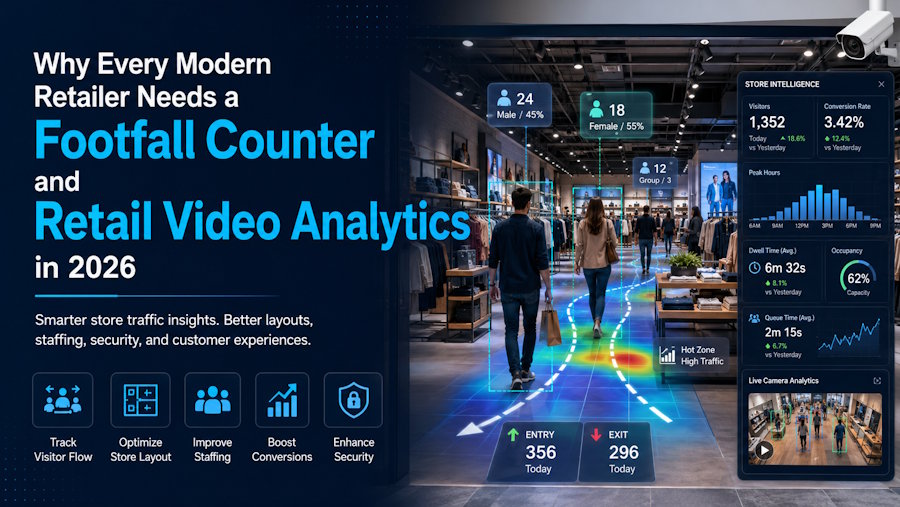
A footfall counter accurately measures the number of people entering and exiting a store, providing valuable insights into visitor traffic. Retail video analytics complements this data by analyzing customer movement, dwell time, shopping patterns, queue lengths, and interactions with products using AI-powered technology.
Together, these solutions enable retailers to optimize store operations, improve customer experiences, increase conversion rates, and make smarter business decisions. In this blog, we'll explore why every modern retailer should invest in a footfall counter and retail video analytics in 2026.
The Shift Toward Data-Driven Retail
Retail is no longer just about stocking shelves and offering discounts. Today's successful businesses rely on analytics to understand customer behavior and continuously improve performance.
A footfall counter provides accurate visitor data, while retail video analytics reveals what customers actually do once they enter the store. Instead of guessing why sales fluctuate or certain products underperform, retailers gain actionable insights that support informed decision-making.
As AI and automation continue to shape the retail industry in 2026, businesses that embrace these technologies are better equipped to adapt to changing consumer expectations.
1. Gain Accurate Insights Into Customer Traffic
Knowing how many customers visit your store each day is the foundation of effective retail management.
A footfall counter helps retailers monitor:
- Daily visitor numbers
- Peak shopping hours
- Weekly and monthly trends
- Seasonal fluctuations
- Store occupancy
When paired with retail video analytics, retailers can also understand how customers move through the store, which sections attract the most attention, and where congestion occurs.
This combination allows businesses to plan operations more efficiently.
2. Improve Customer Conversion Rates
High visitor numbers don't always result in high sales.
A footfall counter enables retailers to compare store traffic with completed purchases, making it easier to calculate conversion rates.
Meanwhile, retail video analytics identifies behaviors such as:
- Browsing without purchasing
- Frequently visited product displays
- Customer hesitation points
- Shopping journey bottlenecks
These insights help retailers optimize merchandising strategies and encourage more visitors to become buyers.
3. Deliver Better Customer Experiences
Customer experience has become a key differentiator in retail.
A footfall counter helps managers anticipate busy periods and allocate staff accordingly, while retail video analytics monitors customer flow, checkout queues, and service interactions.
Retailers can use this information to:
- Reduce waiting times
- Improve store navigation
- Ensure adequate staffing
- Create a more comfortable shopping environment
A smoother shopping experience increases customer satisfaction and encourages repeat visits.
4. Optimize Store Layouts Using Real Customer Behavior
An effective store layout can significantly influence purchasing decisions.
With retail video analytics, retailers gain access to heatmaps and movement reports that show:
- Popular shopping paths
- High-engagement areas
- Underperforming sections
- Customer dwell time
A footfall counter supports zone-based traffic analysis, helping retailers identify which areas attract the most visitors.
These insights allow businesses to reposition products, improve signage, and create layouts that encourage customers to explore more of the store.
5. Strengthen Marketing and Promotional Campaigns
Marketing campaigns should be measured by results, not assumptions.
A footfall counter tracks changes in visitor traffic during promotions, seasonal sales, or product launches.
At the same time, retail video analytics measures customer engagement by analyzing:
- Interaction with promotional displays
- Time spent near featured products
- Customer movement after entering the store
Retailers can identify which campaigns successfully attract customers and drive purchases, making future marketing investments more effective.
6. Improve Staff Productivity
Efficient staffing is essential for delivering excellent customer service while controlling labor costs.
A footfall counter predicts customer traffic throughout the day, helping managers create optimized staff schedules.
Meanwhile, retail video analytics provides insights into:
- Customer wait times
- Staff response efficiency
- Employee coverage across store zones
- Service quality during busy periods
This ensures employees are available where and when customers need assistance most.
7. Reduce Operational Inefficiencies
Hidden inefficiencies can negatively impact store performance.
Using a footfall counter and retail video analytics, retailers can identify issues such as:
- Checkout congestion
- Underutilized departments
- Poor customer flow
- Staffing imbalances
- Overcrowded entrances
By addressing these challenges early, businesses improve operational efficiency while reducing unnecessary costs.
8. Make Smarter Inventory Decisions
Knowing which products attract customer attention is valuable for inventory planning.
Retail video analytics tracks product interaction, browsing behavior, and shelf engagement.
Combined with zone-based insights from a footfall counter, retailers can determine:
- Which products deserve premium shelf placement
- Which displays need improvement
- Where inventory should be increased
- Which product categories require promotional support
Better inventory decisions reduce stock-related issues while improving sales opportunities.
9. Support Multi-Store Performance Management
Retail chains managing multiple locations require consistent performance monitoring.
A footfall counter provides standardized visitor data across stores, while retail video analytics compares customer behavior between locations.
Retailers can benchmark:
- Store traffic
- Conversion rates
- Customer engagement
- Queue management
- Operational efficiency
These insights help businesses identify best-performing stores and replicate successful strategies across all locations.
10. Future-Proof Retail Operations
Technology continues to redefine retail, and businesses that invest in intelligent solutions today will be better prepared for tomorrow.
A footfall counter and retail video analytics provide scalable solutions that support:
- AI-powered decision-making
- Smart store management
- Predictive analytics
- Real-time operational monitoring
- Continuous business improvement
As customer expectations continue to evolve in 2026 and beyond, retailers using advanced analytics will remain more agile and competitive.
Best Practices for Maximizing Results
To achieve the greatest value from a footfall counter and retail video analytics, retailers should:
- Install a footfall counter at every customer entrance.
- Integrate retail video analytics with existing surveillance systems.
- Regularly monitor traffic and behavioral reports.
- Compare visitor data with sales performance.
- Use heatmaps to improve store layouts.
- Optimize staffing based on customer traffic.
- Evaluate marketing campaigns using analytics.
- Continuously review insights to refine business strategies.
A consistent, data-driven approach enables retailers to improve performance over time.
Conclusion
In 2026, retail success depends on understanding customer behavior and making informed decisions based on accurate data. A footfall counter provides reliable visitor counts, while retail video analytics delivers meaningful insights into how customers interact with the store environment.
Together, these technologies help retailers optimize store layouts, improve staffing, strengthen marketing campaigns, enhance customer experiences, increase conversion rates, and streamline operations. More importantly, they replace guesswork with measurable insights that support long-term business growth.
For retailers looking to remain competitive in an increasingly data-driven marketplace, investing in a footfall counter and retail video analytics is no longer optional; it's a strategic necessity that drives smarter decisions, higher efficiency, and stronger sales performance.
Frequently Asked Questions (FAQs)
1. What is a footfall counter?
A footfall counter is a people-counting system that measures the number of visitors entering and leaving a retail store. It helps businesses analyze traffic patterns and improve operational planning.
2. How does retail video analytics work?
Retail video analytics uses AI-powered cameras to analyze customer movement, dwell time, queue lengths, heatmaps, and product interactions, providing actionable insights to improve store performance.
3. Why should retailers use both a footfall counter and retail video analytics?
A footfall counter measures visitor traffic, while retail video analytics explains customer behavior inside the store. Together, they provide comprehensive data for optimizing operations, marketing, staffing, and customer experience.
4. Can retail video analytics help improve sales?
Yes. Retail video analytics identifies shopping patterns, customer engagement, and operational bottlenecks, enabling retailers to optimize layouts, product placement, and service, which can lead to higher sales.
5. Are footfall counters and retail video analytics suitable for all retail businesses?
Yes. Whether it's a boutique, supermarket, shopping mall, convenience store, or multi-location retail chain, a footfall counter and retail video analytics provide valuable insights that support better decision-making and sustainable business growth.

