

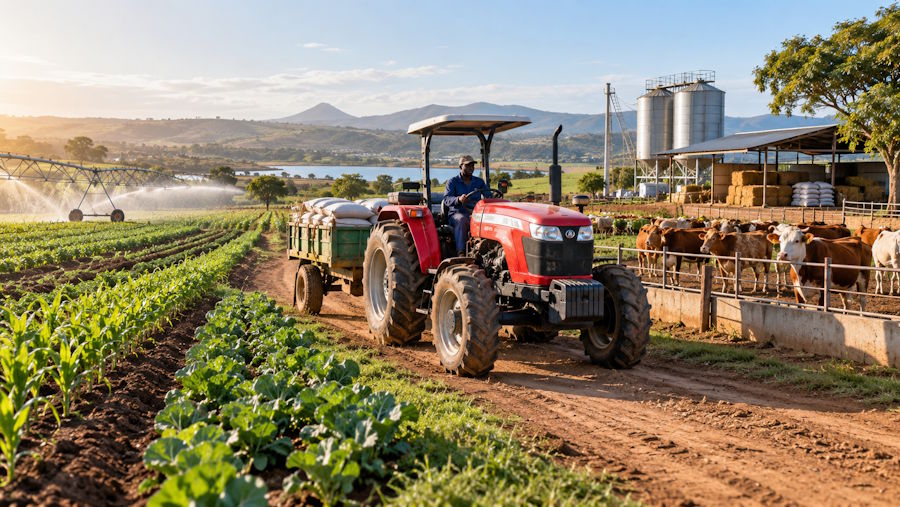
A tractor can do much more than prepare soil. On many farms, it becomes one of the most useful machines for supporting growth, reducing labor pressure, improving transport, and allowing farmers to take on new activities. This is especially important in regions where farms are expanding, labor is limited, or farmers want to produce more than one type of crop.
For anyone comparing the best tractor for African farms, it is useful to think beyond the first season of use. A tractor that can handle several jobs may help a farm grow gradually over time. It can support cultivation, livestock work, transport, irrigation, harvesting, and even income-generating services for nearby farms. The real value comes from how well the machine fits into the farm’s wider development plan.
A Tractor Can Help a Farm Move Beyond Manual Work
Manual labor remains important in agriculture, but some farm tasks become difficult to manage by hand as land area increases.
Preparing several hectares with basic tools can take a long time. Transporting fertilizer, harvested crops, water, or animal feed can also require many workers and repeated trips.
A tractor can reduce some of this physical workload.
It can help complete heavy tasks faster while allowing workers to focus on jobs that still require human attention.
This does not mean mechanization removes the need for people.
Instead, it can change how labor is used.
Workers may spend less time on repetitive heavy work and more time on crop management, sorting, maintenance, irrigation, livestock care, or other productive activities.
Farm Expansion Becomes Easier to Manage
Many farmers begin with a relatively small area and gradually expand when production becomes more stable.
As cultivated land increases, timing becomes more difficult.
A farmer may be able to prepare two hectares manually, but handling ten, twenty, or more hectares in the same way can create delays.
A tractor can make expansion more practical because it increases the amount of work that can be completed in a day.
With suitable implements, the same machine can support:
- Ploughing
- Harrowing
- Planting
- Spraying
- Fertilizer application
- Mowing
- Trailer transport
- Post-harvest movement
This flexibility allows farmers to increase land area without needing a separate powered machine for every operation.
Crop Diversification Can Create New Machinery Needs
Some farms depend mainly on one crop, while others grow maize, vegetables, grains, legumes, forage crops, or other products.
Diversification can reduce dependence on a single harvest, but different crops often require different field operations.
A tractor can support this change if it is compatible with a range of implements.
For example, one crop may need deep soil preparation, while another may need lighter cultivation.
A vegetable operation may require frequent transport and spraying.
A forage crop may require mowing and material handling.
Farmers who plan to diversify should therefore consider how flexible their tractor setup is.
The most useful machine is often one that can adapt to several tasks rather than one designed only for a single operation.
Livestock Farms Can Also Benefit From Tractor Use
Tractors are not only useful for crop production.
Livestock farms may use them for several everyday jobs.
These can include moving feed, transporting hay, clearing waste, towing trailers, preparing forage, carrying water, and maintaining farm roads.
Where mixed farming is practiced, a tractor can serve both crop and livestock activities.
This can increase the number of useful working hours the machine provides each year.
A tractor that operates during land preparation, crop production, and livestock management may offer better value than one that remains unused for long periods.
The more productive tasks a machine can perform, the easier it becomes to justify its ownership cost.
Transport Can Become a Major Part of Farm Growth
As a farm grows, transportation becomes more important.
Larger production means more seed, fertilizer, fuel, crop material, tools, and harvested produce must be moved.
Fields may also be located far from storage areas or local roads.
A tractor and trailer combination can help move materials around the farm more efficiently.
This can be useful for:
- Carrying harvested crops
- Moving fertilizer
- Transporting feed
- Delivering planting materials
- Moving tools and equipment
- Carrying water
- Hauling crop residue
Farmers should still consider load limits, braking, road conditions, and safe operation.
Transport work can place different demands on a tractor compared with field work, so it should be included in long-term planning.
Tractor Ownership Can Support Custom Farming Services
In some farming communities, one tractor may serve more than one farm.
A farmer who owns suitable machinery may be able to provide paid ploughing, harrowing, transport, or other services to neighboring farmers.
This can create an additional source of income.
Custom services can also help make better use of a tractor during periods when the owner’s own fields do not require work.
However, this type of activity needs careful planning.
The owner should consider:
- Fuel cost
- Operator wages
- Travel distance
- Maintenance
- Tire wear
- Repair risk
- Service pricing
- Scheduling
The tractor must also have enough capacity to handle additional working hours without creating excessive downtime.
When managed properly, custom work can turn farm machinery into a productive business asset.
Irrigation and Water Management May Benefit From Mechanization
Water access is an important issue in many farming areas.
Although a tractor does not replace an irrigation system, it can support water-related activities.
Depending on the farm, tractors may help move water tanks, operate PTO-driven pumps, transport irrigation pipes, or assist with land preparation for water channels.
This can be especially useful on farms where water sources are not located close to every field.
Good water management requires planning, but having suitable machinery can reduce the time and labor needed to move equipment and supplies.
Farmers considering irrigation expansion should check whether the tractor has the right PTO, hydraulic, or towing capacity for the equipment they plan to use.
Post-Harvest Work Is Another Important Area
Farm production does not end when crops leave the field.
After harvest, farmers may still need to move produce, transport crop residue, prepare storage areas, or handle materials for processing.
A tractor can support many of these activities.
For example, trailers can move crops from the field to storage or collection points.
Some farms may also use PTO-driven equipment for post-harvest work.
This can help reduce delays between harvesting and storage.
Quick movement is especially important for crops that may lose quality if left exposed to rain, heat, or moisture.
Using machinery effectively after harvest can therefore be just as important as using it during land preparation.
Farm Roads and Internal Access Need Attention Too
Growing farms often need reliable access between fields, storage buildings, livestock areas, water points, and public roads.
Poor internal roads can slow transport and increase wear on vehicles and equipment.
Tractors may be used to support basic farm-road maintenance when paired with suitable equipment.
Even simple work such as moving soil, leveling rough sections, or clearing light obstacles can improve farm access.
Better internal movement can save time during planting, harvesting, and transport.
It can also make it easier for trucks, workers, and other machines to move around the property.
Choose Equipment That Can Grow With the Farm
A tractor purchased for current needs should also have some flexibility for future use.
A farmer may start with basic tillage and transport but later add planting equipment, a mower, a sprayer, or other implements.
For this reason, it is useful to check specifications such as:
- PTO options
- Hydraulic capacity
- Three-point hitch
- Tire configuration
- Towing capacity
- Available attachments
- Implement compatibility
A machine that can support future equipment may remain useful for longer.
This does not mean buying far more power than necessary.
The goal is to select a tractor with enough flexibility to handle realistic future changes.
Maintenance Becomes More Important as Usage Increases
The more jobs a tractor performs, the more carefully it should be maintained.
A tractor used only a few hours each week may have a different service pattern from one working daily across several farm activities.
Frequent use increases the importance of routine checks.
Farmers should monitor:
- Engine oil
- Hydraulic fluid
- Coolant
- Air filters
- Fuel filters
- Tire condition
- Belts
- Hoses
- Battery condition
Service intervals should not be ignored simply because the tractor is still running well.
Preventive maintenance helps reduce the risk of unexpected breakdowns.
It can also protect the machine’s long-term value.
Record Keeping Helps Measure the Tractor’s Real Value
Farmers often know how much they paid for a tractor, but fewer track what the machine costs and saves over time.
Simple records can provide useful information.
A farmer can record:
- Hours worked
- Fuel used
- Maintenance expenses
- Repair costs
- Area completed
- Custom-work income
- Transport jobs
- Seasonal operating time
These records help show which activities provide the most value.
They may also reveal when the tractor is underused or when a particular job is becoming too expensive.
Better records can support future decisions about new implements, tractor replacement, or expansion.
Think About Productivity, Not Only Ownership
Owning a tractor does not automatically make a farm more productive.
The machine must be used efficiently.
Poor implement matching, unnecessary idling, weak maintenance, or incorrect operation can increase costs.
Farmers should think about what each hour of tractor use is achieving.
Useful tractor time should contribute to real farm work, whether that means preparing land, moving crops, serving livestock, supporting irrigation, or providing services.
When comparing the best tractor for African farms, farmers should consider how many different productive roles the machine can realistically perform throughout the year.
Final Thoughts
A tractor can become much more than a land-preparation machine. When chosen carefully, it can support farm expansion, crop diversification, livestock activities, irrigation, transport, post-harvest work, and even custom services for nearby farmers. The greatest value often comes from using one machine across several productive tasks instead of limiting it to a short part of the farming season.
Farmers who plan future needs, match implements properly, maintain the machine well, and track operating costs can make better use of their investment. For farmers and agricultural buyers looking at machinery that can support different stages of farm development, gengjiaagri.com provides information about tractors and other agricultural equipment for a range of farming needs.

