

Ticketing looks deceptively simple. A request enters a queue, someone investigates it, an action is taken, and the case is closed. At enterprise scale, however, that sequence sits on top of identity systems, asset data, automation, permissions, service-level rules, reporting, and integrations with the rest of the IT stack.
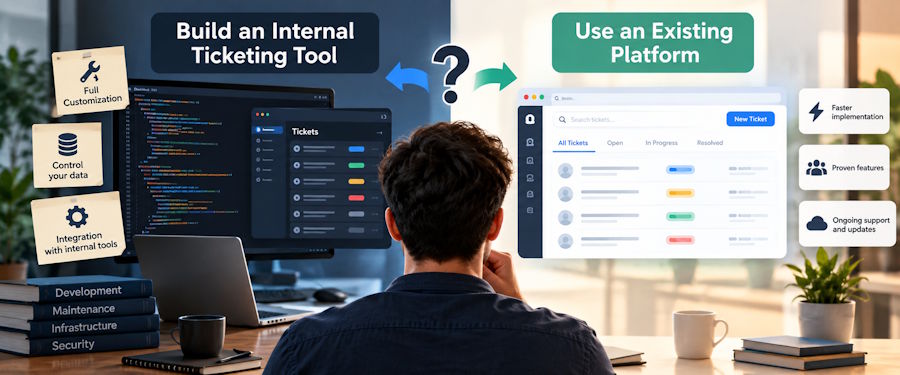
That makes the decision to build or buy less about interface design and more about where an organisation wants to own complexity. An internal system can be shaped around specific operating requirements, while an established platform offers mature infrastructure that would otherwise have to be designed, tested, secured, and maintained internally.
Start with the operating model, not the interface
The first question should be what the ticketing system needs to know and do.
A general helpdesk ticketing software platform already provides much of the underlying structure required to manage requests, users, queues, priorities, and workflows. Building internally means taking responsibility for those layers yourself, then deciding which enterprise-specific requirements justify that additional ownership.
The strongest choice therefore depends on the organisation's operating model. A company with highly unusual request lifecycles, proprietary infrastructure, or strict internal dependencies may have legitimate reasons to build. Another organisation may find that custom development adds technical debt without creating a meaningful operational advantage.
The hidden architecture of a ticket
A ticket is rarely just a record with a status field. In a mature environment, it can become a state machine connected to several other systems.
Consider a new access request. Creating the ticket may trigger identity verification, route the request according to department, check approval rules, create an account, update an asset record, and record the final action for audit purposes. Each step introduces dependencies.
An internal system gives engineers direct control over those dependencies. That can be valuable when the workflow itself is a competitive or operational differentiator. It also means the organisation owns the failure modes.
A commercial platform starts from the opposite direction. Much of the common architecture already exists, leaving engineering teams to configure integrations rather than build the complete execution layer.
Build when the workflow is genuinely unusual
Custom software becomes more defensible when the organisation's requirements sit outside the assumptions made by mainstream platforms.
That might include:
- highly specialised state transitions
- proprietary asset or configuration models
- unusual approval hierarchies
- internal protocols that cannot be exposed through standard integrations
- requirements for complete control over data structures and execution logic
However, another consideration is engineering capability.
Building a ticketing system requires more than application development. Someone has to own authentication, permissions, observability, backups, upgrades, API versioning, performance, security testing, and incident response. Those responsibilities remain after launch.
The technical question is therefore not whether the organisation can build a ticketing application. It is whether it wants to become the long-term maintainer of one.
Buy when differentiation happens somewhere else
An existing platform is often the stronger architectural choice when ticketing is infrastructure rather than differentiation.
The same principle applies to adjacent systems. Teams evaluating enterprise live chat software, for example, may gain little from recreating mature capabilities such as routing, transcripts, permissions, integrations, and reporting when those functions are not central to their competitive advantage.
Using an established platform can also reduce the number of systems an internal engineering team must support. That matters because every additional application creates another surface for security patches, monitoring, documentation, and staff knowledge. Forbes Advisor puts typical help desk software costs at roughly $20 to $200 per user per month, while custom ticketing systems can require hundreds or thousands of engineering hours to build and maintain.
Look closely at the integration boundary
The most important technical question may sit between the ticketing application and everything around it.
Before choosing an architecture, map the interfaces that need to exist:
- Identity and access management
- Endpoint and asset data
- Monitoring and alerting
- Communication systems
- Automation services
- Configuration management
- Reporting and analytics
- Internal knowledge repositories
An existing platform is only useful if its APIs, webhooks, authentication model, and data structures fit the surrounding environment. A custom system offers greater control here, but that control comes with implementation and maintenance costs. The decision should be based on the full dependency graph, not the ticket screen.
AI changes the build-versus-buy calculation
AI introduces another architectural layer. A ticketing system can now classify requests, summarise conversations, identify likely causes, recommend actions, or trigger approved workflows. That does not make custom development automatically more attractive. It may actually increase the number of components an organisation has to maintain.
Teams considering AI software factory tools are already dealing with questions around model access, orchestration, evaluation, observability, and deployment. Applying the same logic to ticketing means asking whether AI capability is something the organisation needs to engineer itself or consume through an established architecture. The answer should depend on where proprietary intelligence actually resides.
A better way to compare the two options
Rather than asking which option has more features, assess where each architecture places responsibility.
| Area | Build internally | Existing platform |
|---|---|---|
| Core workflow | Full control | Configuration and extension |
| Infrastructure | Owned internally | Provider-managed to varying degrees |
| Integrations | Fully custom | Limited by available APIs and connectors |
| Maintenance | Internal responsibility | Shared with provider |
| Customisation | Very high | Bounded by platform design |
| Time to deployment | Typically longer | Typically shorter |
| Technical debt | Entirely internal | Partly transferred to provider |
That comparison exposes the real trade-off. Building maximises control, but also maximises ownership. Buying reduces engineering burden, but introduces dependency on another architecture and its release decisions.
The decision should follow the source of complexity
There is no universal answer because the value of a custom ticketing system depends on what makes the organisation's IT operation unusual.
If the complexity sits in proprietary workflows, internal development may be justified. If the complexity comes from integrations, scale, support volume, or ordinary service-management requirements, an established platform may remove work without limiting the organisation in meaningful ways.
The most useful question is therefore not “Can we build this?” It is “Which parts of this system are worth owning?”
That framing produces a more defensible technical decision because it separates genuine architectural requirements from the understandable desire to customise software simply because customisation is possible.

