


Key Takeaways
- Usage based billing platform fit comes down to your pricing model. Flexprice suits enterprises that want open-source control and credits, Orb suits complex pricing logic, Metronome suits very high event volumes and commit-heavy contracts, and Chargebee suits subscription-first teams adding usage.
- What will it cost? Pricing comes in three shapes: flat plans by event volume (Flexprice), quote-based (Orb, and Metronome beyond its Starter plan), and a percentage of billing volume (Chargebee, at 0.65% to 0.80%).
- Is switching risky? It is manageable if you migrate historical usage, run old and new invoices side by side for a full billing cycle, and validate every line before you cut over.
- Do I need credits or hybrid pricing? Most likely. Bain & Company found that most companies adding AI pricing are layering meters on top of seats, so confirm your platform can put subscription, usage and credits on one invoice.
- When should I decide? Before launch. If you are still choosing the stack you use to build and ship AI products, pick billing at the same time so a pricing change never needs an engineering sprint.
Introduction
Flat pricing is losing its grip on AI software. A Bain & Company brief published in August 2026 found that only about one in five AI-native software companies still relies mostly on per-seat licensing, and most companies adding new pricing models are layering meters on top of seats instead of replacing them. Among companies introducing a hybrid AI meter, about 35% charge for effort, such as tokens or compute, and about 55% charge for output. Only around 10% price on outcomes. The takeaway is simple: what you meter is now a core pricing decision.
As generative AI moves into everyday business operations, costs follow consumption, not headcount. Token consumption, API requests, compute time and credits all grow with usage, and billing gets harder with every new model, feature and enterprise contract. A spreadsheet or a basic subscription tool stops working quickly.
This guide compares four options: Flexprice, Orb, Metronome and Chargebee. Each is judged on features, pricing, best fit, integrations and public ratings, so you can shortlist the right usage based billing platform for your stage. You will also see what to check before you migrate and how to match a platform to your business.
What Is Usage-Based Billing?
It is a way of charging customers for what they actually use, such as tokens processed, API calls made, GPU hours consumed or tasks an AI agent completes, instead of a flat monthly fee. You will also hear it called consumption based billing, and the pricing side of the same idea is called consumption based pricing. A usage based pricing model can be pure (customers pay only for usage), credit-based (customers buy prepaid credits and burn them down), or hybrid (a base subscription with usage or credits on top).
A usage based billing platform does the heavy lifting. It collects usage events, aggregates them into billable metrics, applies your rates, and turns the result into invoices, credit deductions and alerts. For AI companies, where agents handle prospecting and follow-ups and every task carries a real compute cost, accurate metering is what protects margins. One caution from Bain: many deals labeled usage-based are really capacity pricing with overages, so confirm which model your customers want before you buy usage based pricing software.
What to Consider Before Switching Billing Platforms
- Migration plan. Decide whether to move everyone at once or by customer cohort. Moving new customers first keeps risk low while your team learns the new system.
- Historical usage data. Export raw events and past invoices, then check whether the new platform can backfill and re-rate them and how long it keeps raw events.
- Invoice validation. Run the old and new systems in parallel for at least one billing cycle and compare every line. Settle early what counts as billable, because an API call that returns 200 but delivers a broken file is a classic dispute.
- Integrations. List your payment gateway, ERP, CRM and tax tools and confirm native support for each before you sign. A missing connector can turn into months of custom work.
- Implementation effort. Ask who will build the metering pipeline and rate cards, engineering or finance. Platforms with SQL metrics and contract tools give more control but take longer to configure than simpler ones.
Compare Best Usage-Based Billing Platforms for AI Companies
Here is a quick view of how the four platforms stack up. Pricing reflects public information in October 2026, so confirm on each vendor's site.
| Tool | Key features | Pricing | Best for |
|---|---|---|---|
| Flexprice | Open source, credits, entitlements | Free to 100K events, from $500/mo | Enterprise, AI teams |
| Orb | SQL metrics, dimensional pricing | Custom quote | Complex pricing |
| Metronome | Raw events, commits, contracts | Starter, then custom | Large AI platforms |
| Chargebee | Hybrid invoices, 40+ gateways | 0.65-0.80% of billing | Subscription-first |
List of Tools in Detail
Each tool below follows the same structure, so you can compare them side by side.
1. Flexprice: Best Usage-Based Billing Platform for Enterprises
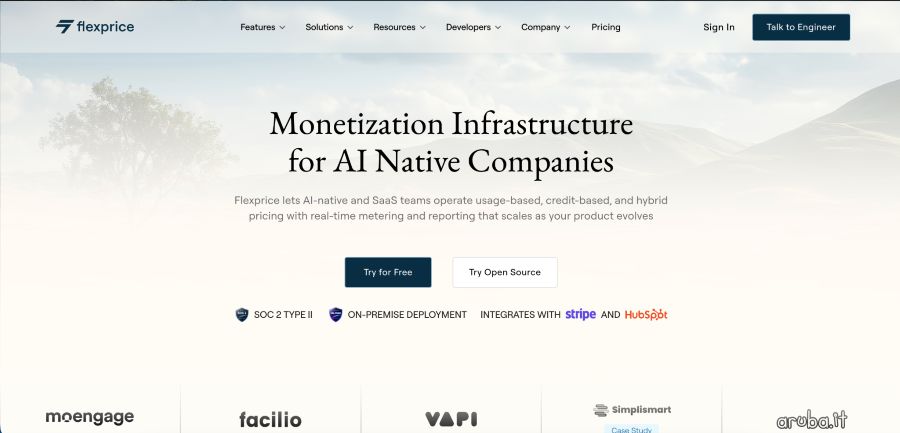
Flexprice is open-source billing and monetization infrastructure built for AI and usage-heavy products. It handles metering, pricing, credits, entitlements and invoicing in one system, so teams do not have to stitch a meter to a separate billing tool. It leads for enterprises because it pairs contract features with deployment control: run it on managed cloud, inside your own VPC or on-prem, and let your security team inspect the code.
Key Features
- Usage-based, hybrid, credit and flat pricing in one account
- Open source, with managed cloud, VPC and on-prem deployment
- Multi-account structures and custom contract terms for enterprise deals
- Credits and wallets with rollover, expiry, auto top-up and overage rules
- Entitlements and usage limits to gate features in real time
- Works with any payment gateway, so you aren’t tied to one processor
Best Suitable For
Flexprice is best suited for enterprise and fast-scaling mid-market AI companies that need credits, custom contracts and control over where billing data lives. Early-stage teams can also start on the free tier and grow into the same system.
Product Pricing
Flexprice's managed cloud is free up to 100K events a month, then starts at $500 a month for up to 1M events and $1,000 for up to 5M, with custom pricing above that. Self-hosting the open-source version is free apart from your own infrastructure, and there is no revenue share. On the managed cloud, credits and wallets start at the Scale plan.
Integrations
Flexprice is payment-agnostic and connects to Stripe, Razorpay, Moyasar and Nomod for collection, with APIs and SDKs for sending usage events from your product. Check the current integrations list for your ERP and accounting tools before you commit.
Product Ratings
Flexprice holds a 4.5/5 rating on G2
2. Orb: Query-Based Usage Billing Platform for Complex Pricing
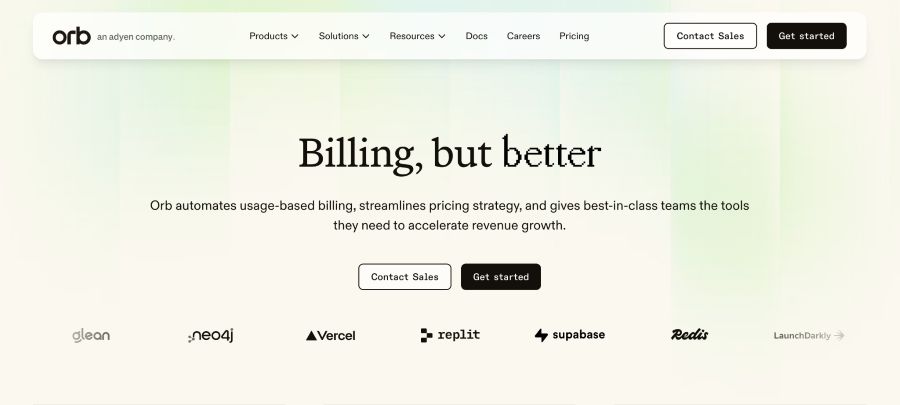
Orb is a billing platform built for usage-based and hybrid pricing, aimed at software and AI companies that bill on tokens, API calls or compute. It keeps raw usage events and calculates bills from queries over them, which makes pricing changes and corrections easier. Adyen completed its $335 million acquisition of Orb on July 1, 2026, and is running it as a standalone product that still supports multiple payment processors.
Key Features
- Raw event storage with query-based billing, backfills and backdating
- Custom SQL billable metrics
- Dimensional price groups across region, instance type or environment
- Pricing simulations against historical usage before launch
- Hybrid plans that combine fixed fees, seats and usage in one plan
- Native invoicing, dunning and threshold billing
Best Suitable For
Orb is best suited for mid-market and enterprise software and AI companies with complex, multi-dimensional pricing and an engineering team that wants control over metrics. It is less of a fit if you want published prices or a self-hosted option.
Product Pricing
Orb does not publish prices. Pricing is custom and based mainly on billings and event volume, with a platform fee on higher tiers, so expect to request a quote.
Integrations
Orb connects with Stripe, Salesforce, QuickBooks, Bill.com, tax systems and data warehouses, and keeps payment-processor choice open.
Product Ratings
Orb has a 5.0 out of 5 rating on G2, but it’s based on only 4 reviews
3. Metronome: Enterprise Usage Billing Platform Backed by Stripe
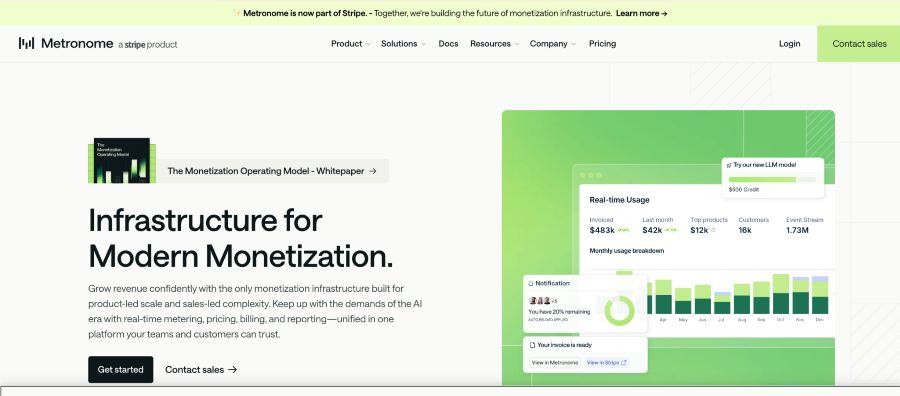
Metronome is a usage-based billing platform that handles metering, rating, contracts and invoicing at high volume. Stripe completed its acquisition on January 14, 2026, and describes Metronome as powering companies such as OpenAI, Anthropic and NVIDIA.
Key Features
- Raw usage event ingestion with SQL-based billable metrics
- Multidimensional pricing and rate cards
- Prepaid and postpaid commits with drawdowns against committed spend
- Credit wallets, soft and hard usage caps, and spend alerts
- Built for very high event volumes
- Works with Stripe: finalized invoices can be pushed to Stripe for payment
Best Suitable For
Metronome is best suited for enterprise AI platforms and large infrastructure companies with high event volumes and commit-heavy contracts, especially if they already run on Stripe. Teams that want to stay provider-neutral should note that its roadmap is now tied to Stripe.
Product Pricing
Metronome offers a Starter plan for launching usage-based billing and custom pricing above that. It is positioned as an add-on to Stripe Billing, and some Metronome-powered capabilities carry extra cost, so ask for a full quote.
Integrations
Metronome works alongside Stripe. It can run independently and push finalized invoices to Stripe for payment collection, or run next to Stripe Subscriptions, which keeps handling recurring charges while Metronome handles usage.
Product Ratings
No star rating for the billing platform on G2. The listings under the Metronome name on those sites appear to belong to unrelated tools.
4. Chargebee: Subscription Billing Platform with Usage-Based Add-Ons
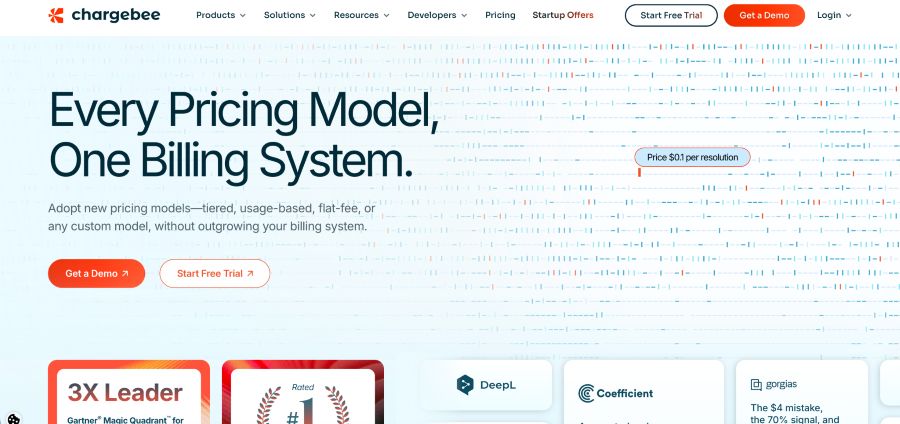
Chargebee is a subscription and revenue management platform that has added usage-based and hybrid billing on top of a plan-based core. It fits teams whose revenue is mostly recurring and who want billing, invoicing, dunning and finance workflows in one suite.
Key Features
- Full subscription lifecycle: plans, trials, proration and dunning
- Hybrid invoices that mix recurring, usage and one-time charges
- Custom SQL metering, usage thresholds and overages
- 100M usage events a month included on the Flow plan
- Entitlements to control feature access
- Account hierarchies and contract terms on Enterprise
Best Suitable For
Chargebee is best suited for mid-market subscription SaaS companies that are adding usage or AI features on top of existing plans, and for finance teams that need gateways, tax and revenue recognition in one place. It is a weaker match for pure usage products.
Product Pricing
The Flow plan costs 0.80% of monthly invoicing volume with no platform fee, or $99 a month plus 0.65%. Enterprise is custom and offers higher event limits as an add-on. Because the fee is a share of billing, cost rises as your revenue grows.
Integrations
Chargebee connects to 40+ payment gateways, including Stripe, Adyen, PayPal and Braintree, plus accounting and ERP tools such as Xero, QuickBooks and NetSuite (on Enterprise) and tax tools. Source: Chargebee pricing.
Product Ratings
Chargebee holds 4.4/5 ratings on G2 based on 950 reviews.
How to Evaluate the Best Usage Based Billing Platform
Match the platform to the stage and shape of your business.
- Early-stage AI startup with straightforward billing: choose a free or low-cost entry plan and a fast setup. Flexprice's free tier or Chargebee's Flow plan fit. If you sell something like an AI tool that turns one product photo into a set of marketing assets, credits per generation are usually enough to start.
- AI API business with high-volume usage events: test ingestion and aggregation with your real event volume. Flexprice, Orb and Metronome are built for this, and you should compare flat plans against percentage-based fees at your scale.
- AI SaaS product combining subscriptions and consumption: look for one invoice that carries subscription, usage and credits. Flexprice and Chargebee both do this, and it matters most when every action has a real cost, as with AI tools that turn product assets into video demos.
- Enterprise AI business with custom contracts and advanced billing: look for commits, ramps, parent-child accounts and deployment control. Metronome, Orb and Flexprice are the strongest here.
Whichever usage based billing platform you shortlist, price one month of real event volume and run a parallel invoice test before you sign.
Conclusion
Usage based billing platforms help companies price AI the way it is actually delivered. They turn raw events into accurate invoices, protect margins when one heavy customer drives up compute cost, and let teams change rates or launch credits without an engineering sprint. Finance gets clean, auditable numbers, and customers get transparent bills they can trust.
Among the four options, Flexprice stands out for enterprises that want open-source control, credits and contract features in one place. Orb fits complex pricing logic, Metronome fits very high-volume enterprise deals, and Chargebee fits subscription-first teams. Match the platform to your pricing model and stage, test with real data, and the move to consumption based pricing becomes a growth lever instead of a billing headache.
FAQ
1. Is Stripe Billing enough for usage based billing?
For simple metered pricing on top of subscriptions, yes. Stripe Billing is typically priced at around 0.7% of billing volume. Teams that need multi-dimensional pricing, prepaid credits, commits or very high event volumes often move to dedicated usage based pricing software, and Stripe itself now offers Metronome for those cases.
2. What is the best usage based billing platform for an AI startup?
Start with the one that handles credits, per-model rates and a subscription base on one invoice at a low entry cost. Flexprice's free tier and Chargebee's Flow plan are two low-cost starting points. Orb and Metronome suit startups that already expect complex pricing or enterprise contracts.
3. Should I use consumption based pricing, credits or hybrid pricing?
Hybrid is the most common route, since Bain found most companies adding AI pricing are layering meters on top of seats. Credits suit products with several models or features, pure consumption based pricing suits developer APIs, and hybrid suits products that need predictable base revenue.
4. How do I migrate to a new billing platform without breaking invoices?
Export raw usage events and past invoices, replay them through the new platform, and run both systems in parallel for one full billing cycle. Compare every line, fix mismatches in the metering rules, then move customers in cohorts instead of all at once.
5. Are usage based billing platforms expensive?
It depends on the pricing basis. Chargebee takes 0.65% to 0.80% of billing volume, Flexprice charges flat plans by event volume or is free to self-host, and Orb and Metronome are quote-based. One Reddit user called Metronome expensive but the only option that held up at enterprise-level volumes, so model the cost at your own volume before choosing.

