


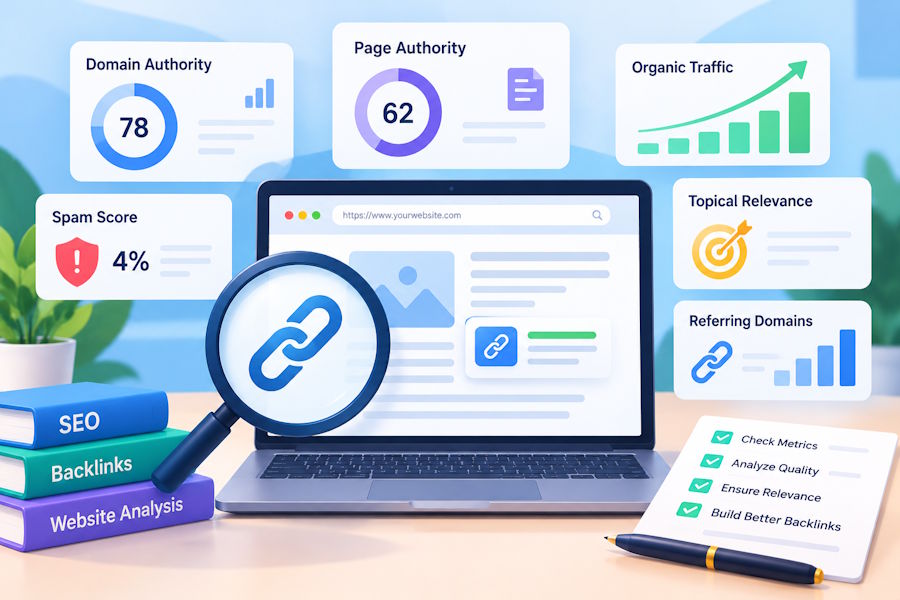
Building high-quality backlinks is an important part of search engine optimization (SEO). However, getting links from random websites without evaluating their quality can waste time, money, and effort.
Not every backlink provides the same value. Some links come from trusted, relevant websites with genuine visitors, while others originate from low-quality pages created primarily for link-building purposes.
Before starting a link-building campaign, SEO professionals should analyze potential linking websites using reliable metrics. Understanding what to check before building backlinks helps you identify better opportunities, avoid questionable websites, and develop a sustainable off-page SEO strategy.
Here are six essential metrics to evaluate before acquiring backlinks.
1. Domain Authority (DA)
Domain Authority is a third-party SEO metric developed by Moz that estimates how likely a domain is to rank in search results compared with other websites.
The score ranges from 1 to 100, with higher values generally indicating stronger ranking potential according to Moz's model.
When evaluating backlink opportunities, Domain Authority can help you compare websites within similar industries.
For example, a website with DA 55 may appear stronger than one with DA 15. However, the higher-scoring website is not automatically the better backlink source.
Consider these factors:
- Is the website relevant to your niche?
- Does it publish useful, original content?
- Does it attract genuine visitors?
- Are its articles regularly updated?
- Does it have an established backlink profile?
Important: Domain Authority is not a Google ranking factor. It is a comparative metric, not a guarantee of backlink quality or improved rankings.
Use DA alongside other indicators rather than treating a particular score as a requirement.
2. Page Authority (PA)
Page Authority is another Moz metric that estimates the relative ranking potential of an individual webpage. Unlike Domain Authority, which evaluates an entire domain, Page Authority focuses on a specific URL. This distinction matters because a website may have strong overall authority while individual pages have limited visibility or few incoming links.
Before placing a backlink, review the authority of the page where your link will appear. You can use a page authority checker to begin evaluating page-level authority when researching potential backlink opportunities.
Check Page Authority Easily with Smooli's Page Authority Checker
Before building backlinks, evaluating the strength of the specific webpage where your link will appear is an important step. Smooli's page authority checker offers a convenient way to assess page-level authority and support your backlink research. By checking Page Authority, website owners and SEO professionals can compare potential linking pages and make more informed link-building decisions. However, Page Authority is a third-party metric rather than a direct Google ranking factor, so it should be considered alongside organic traffic, topical relevance, and content quality. Combining these insights helps you identify more promising backlink opportunities and build a stronger, more sustainable SEO strategy.
3. Organic Traffic and Search Visibility
Organic traffic is one of the most useful indicators when evaluating backlink opportunities. A website receiving consistent visitors from search engines may demonstrate that its content attracts genuine interest.
However, traffic volume alone does not determine backlink quality. A website with 3,000 relevant monthly visitors may be a better prospect than one receiving 30,000 visits from unrelated topics.
Review the following:
- Estimated monthly organic traffic
- Traffic trends over recent months
- Top-performing pages
- Keywords generating visibility
- Geographic distribution of visitors
- Relevance to your target audience
Be cautious when a website shows a sudden, unexplained decline in organic visibility.
Such declines may result from content changes, technical problems, seasonal demand, competition, or search algorithm updates.
They do not automatically indicate a Google penalty.
Tools such as Google Search Console provide first-party performance data for websites you own, while third-party SEO platforms can estimate competitor traffic.
The goal is to prioritize linking websites with relevant audiences and credible search visibility.
4. Spam Score and Backlink Profile Quality
Spam Score is a third-party metric commonly associated with Moz. It estimates how many characteristics a website shares with sites that have historically been associated with spam.
A higher Spam Score can signal that further investigation is necessary, but it does not prove that a website is penalized or unsafe.
Before acquiring a backlink, examine the website's existing backlink profile.
Look for warning signs such as:
- Large numbers of irrelevant outbound links
- Repetitive keyword-rich anchor text
- Low-quality or automatically generated articles
- Unnatural patterns of linking
- Pages created primarily to sell backlinks
- Content unrelated to the website's main subject
A website that publishes helpful content and earns editorial mentions is generally a more promising prospect than one overloaded with promotional links.
Google's spam policies also prohibit link schemes intended to manipulate rankings.
Paid or sponsored placements should use appropriate link attributes, such as rel="sponsored" or rel="nofollow".
Prioritize legitimate editorial opportunities rather than attempting to manipulate search rankings through artificial linking practices.
5. Topical Relevance and Website Niche
Topical relevance is one of the most important factors to consider before building backlinks. A backlink becomes more meaningful to readers when it connects two pages discussing closely related subjects.
For example, a website offering SEO tools could reasonably earn links from articles about technical SEO, website auditing, search performance, or digital marketing.
A backlink from an unrelated entertainment website may offer less contextual value, even if that website has impressive authority scores.
Before selecting a backlink source, ask:
- Does the website cover topics related to my niche?
- Is the linking article relevant to my content?
- Would readers benefit from visiting my page?
- Does the link fit naturally into the paragraph?
- Is the website publishing genuine informational content?
Relevant editorial links can help readers discover additional resources while providing search engines with meaningful contextual information.
Website owners can also use Free SEO Tools to support different aspects of SEO research, website analysis, and optimization.
The best backlink placements should provide genuine value to the audience, rather than existing solely for ranking purposes.
6. Referring Domains and Link Quality
Referring domains represent the number of unique websites linking to a particular website or page.
This metric helps SEO professionals understand the diversity of a backlink profile. For example, 100 backlinks from one website represent only one referring domain, while 100 backlinks from different websites represent 100 referring domains.
However, having more referring domains does not automatically mean a website has a stronger backlink profile. Quality, relevance, and editorial context matter.
When evaluating referring domains, review:
- The number of unique linking websites
- Relevance of linking domains
- Quality of referring pages
- Diversity of natural anchor text
- Changes in referring domains over time
- Whether backlinks appear editorially earned
Avoid assuming that every additional referring domain provides equal SEO value. A smaller collection of relevant, trustworthy links can be more useful than a large number of questionable backlinks.
Quick Backlink Quality Checklist
Before selecting a website for a potential backlink, review these six metrics:
| Metric | What to evaluate |
|---|---|
| Domain Authority | Overall comparative domain strength |
| Page Authority | Relative authority of the linking page |
| Organic Traffic | Relevant search visibility and traffic trends |
| Spam Score | Potential warning signs and backlink quality |
| Topical Relevance | Connection between the linking content and your niche |
| Referring Domains | Diversity and quality of existing backlinks |
No single metric determines whether a backlink opportunity is worthwhile. The most reliable approach combines numerical indicators with manual website evaluation.
Frequently Asked Questions
What metrics should I check before building backlinks?
Review Domain Authority, Page Authority, organic traffic, Spam Score, topical relevance, and referring domains. Also examine the quality of the actual linking page.
Is Domain Authority important for backlinks?
Domain Authority can help compare websites, but it is not a Google ranking factor. Relevant content and genuine editorial quality should also influence backlink decisions.
What is a good Page Authority score?
There is no universal ideal Page Authority score. Compare pages within similar niches and prioritize relevant, useful content rather than chasing a fixed number.
Are backlinks from high-traffic websites always better?
No. Relevant traffic and audience alignment matter more than visitor numbers alone. A smaller niche website may provide a more useful referral opportunity.
Can low-quality backlinks hurt SEO?
Links created primarily to manipulate rankings can violate Google's spam policies. Focus on naturally earned, relevant backlinks instead of artificial link schemes.
Final Thoughts
Building backlinks successfully requires more than identifying websites with impressive authority scores. Before pursuing an opportunity, evaluate Domain Authority, Page Authority, organic traffic, Spam Score, topical relevance, and referring domains.
These six metrics provide a useful framework for assessing potential linking websites and identifying warning signs.
However, metrics should support your decisions rather than replace editorial judgment. Prioritize websites that publish valuable content, serve relevant audiences, and provide genuine reasons to reference your pages.
A sustainable backlink strategy focuses on quality, relevance, and trust rather than simply increasing the total number of links.

