

Ask a group of competitive players why they are stuck in the same rank for months and you will hear the same answers: bad teammates, unlucky queues, a broken patch. Sometimes that is true. More often the real explanation sits inside the ranking system itself, and understanding it changes how you play, how you queue and when you decide to ask for outside help.
Two numbers, not one
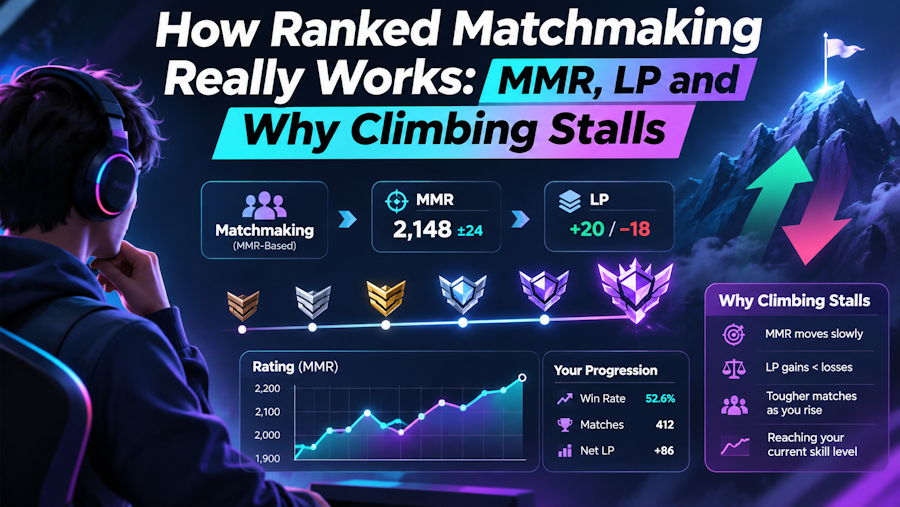
Most online games that run a ranked ladder track two separate values. The first is the number you see: the division, the points and the badge next to your name. The second is a hidden matchmaking rating, usually shortened to MMR, which the game uses to decide who you are paired with and how much a result is worth.
The visible number is a progress bar. The hidden one is the engine. When the two drift apart, you feel it immediately. If your hidden rating is higher than your visible rank, wins give you generous points and losses cost very little. If it is lower, the opposite happens: you gain a handful of points per win and lose a lot per defeat, and the ladder feels like walking up a down escalator.
Why the system pulls you toward a plateau
Ranked ladders are designed to converge. Every match nudges your hidden rating toward the level at which you win about half of your games. That is the whole point of a matchmaking system, and it is also why long stalls happen. Once your rating is accurate, you are by definition playing against opponents who are as good as you are. Improvement then has to come from your play, not from the system rewarding you for showing up.
Three patterns explain most plateaus:
- Small sample sizes. A weekend of ten games is mostly noise. Rating systems need dozens of results before a real trend separates from luck.
- Inconsistent routines. Playing tired, tilted or in the last ten minutes before bed usually produces a run of losses that erases the gains of good days.
- Narrow mechanical focus. Players practice what they enjoy, usually aim or execution, while the habits that decide close games, such as map awareness, resource timing and communication, stay untouched.
What actually moves the needle
The most reliable improvement habit is reviewing your own games. Choose three or four recent losses, watch them back and write down the first moment each one tipped. You will quickly notice that the same two or three mistakes repeat. Fix those first. Second, reduce variance: pick a small pool of characters, strategies or builds and learn them deeply instead of rotating through everything. Third, protect your streaks. Most players lose more points in a bad evening than they gain in two good ones, so stopping after two defeats in a row is a cheap and effective rule.
Finally, treat the ladder as a long game. Seasons reset, patches shift the balance and the rating system rewards steady activity more than occasional marathons. A player who plays one focused hour a day will usually pass someone who plays six unfocused hours on Saturday.
When outside help makes sense
Not everyone has the time to grind through the plateau. Work, study and sleep compete with ranked queues, and some players simply want to reach a particular rank for a season reward or to play with friends in a higher bracket. For those cases there is a whole market of services built around ranked progress, from coaching sessions to account-based rank boosting. If you are comparing options, the usual checklist applies: check how the provider protects your account, whether pricing is transparent, how long delivery takes and whether there is a clear support channel. Providers such as TopBoost publish their service pages and pricing openly, which makes comparing them far easier than guessing from a social media message.
Be realistic about the trade-offs as well. Any use of a third-party service on a game account can conflict with the publisher's terms of service, and coaching is the safer choice if your goal is to actually improve rather than just see a different badge. Decide what you want out of the ladder, then choose accordingly.
The short version
A ranked system is a feedback loop that tries to put you where you win half the time. To rise, you have to change something the loop can measure: your consistency, your decision making and your choice of practice. Understand the two-number structure, review your losses, reduce variance and stop playing when you tilt. Do that for a few weeks and the plateau stops looking like bad luck and starts looking like a problem you can solve.

