


Introduction
Modern web applications, including SaaS platforms, e-commerce websites, and APIs, require infrastructure that can handle growing traffic without compromising performance. While cloud hosting offers flexibility, developers must also consider CPU availability, memory capacity, storage speed, and long-term operating costs.
For applications with sustained workloads, dedicated physical servers provide greater control over hardware resources and system configurations. Choosing the right infrastructure is essential for building applications that remain reliable as workloads grow.
1. Understanding Infrastructure Performance Bottlenecks
Application performance depends on more than code optimization. Hardware limitations can become bottlenecks even when the application itself is well designed.
CPU capacity affects request processing, background tasks, and concurrent workloads. Insufficient RAM can force applications and databases to rely more heavily on disk operations, increasing latency. Storage performance also matters, particularly for database-driven applications that perform frequent read and write operations.
Developers should monitor CPU utilization, memory consumption, disk I/O, and network traffic to identify resource constraints before increasing server capacity.
2. Choosing Dedicated Server for Demanding Workloads
Cloud hosting offers flexibility for applications with changing resource requirements. However, workloads that demand consistent hardware capacity and greater system control may benefit from dedicated physical servers.
Dedicated bare-metal servers provide exclusive access to physical hardware without a virtualization layer. Key advantages include:
- Dedicated CPU and RAM: Resources are allocated to a single customer, providing greater control over application workloads.
- Flexible Configuration: Developers can customize operating systems, software environments, and server settings.
- High Storage Performance: NVMe and SSD options support demanding database operations and frequent data access.
- Predictable Resource Availability: Dedicated hardware helps reduce resource contention associated with shared environments.
Server Mart offers Intel Xeon-powered dedicated servers with configurations of up to 48 CPU cores and 256GB RAM. These configurations are suitable for demanding workloads such as database hosting, SaaS platforms, virtualization, and high-traffic applications.
3. Optimizing Storage and Application Architecture
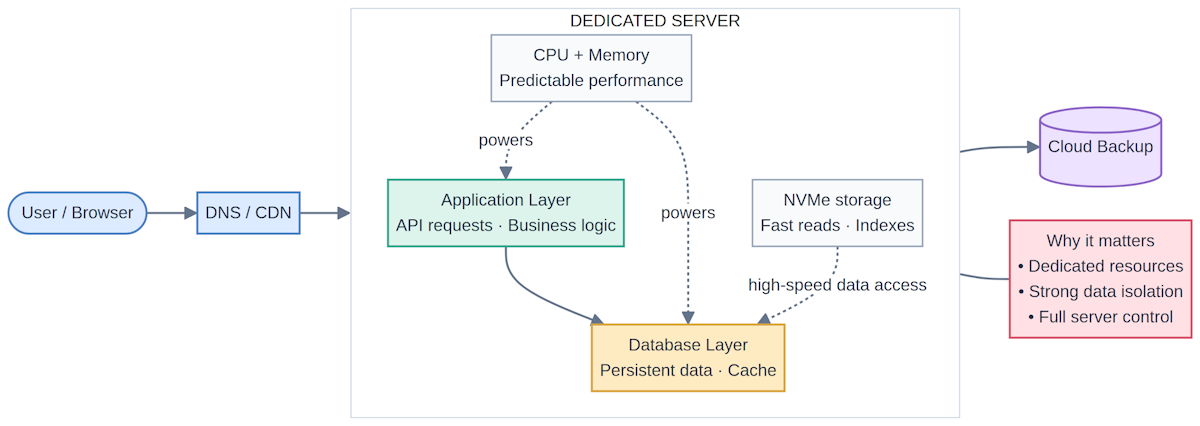
Storage selection directly affects database performance and application responsiveness. NVMe SSDs offer high throughput and low latency, making them suitable for workloads involving frequent database queries, transaction processing, and large volumes of application data. SATA SSDs provide another option for general-purpose workloads, while RAID configurations can improve data redundancy or storage performance depending on the selected RAID level.
Consider a SaaS application with separate application and database workloads. The application layer processes user requests, while the database handles queries and persistent data. Allocating sufficient CPU and RAM to these workloads, together with fast NVMe storage, can help reduce resource contention and improve response times.
Server Mart provides dedicated server configurations with NVMe, SSD, SATA, and RAID storage options, allowing developers to match hardware to their application requirements.
4. Building Reliable and Scalable Infrastructure
Performance alone does not guarantee production reliability. Developers should also implement regular backups, security updates, firewall rules, and resource monitoring.
Network connectivity and data center infrastructure are equally important. Server Mart operates its U.S. infrastructure in Dallas, Texas, and Kansas City, Missouri. Its Dallas facility holds SOC 2 Type II and ISO 27001 certifications. Available bandwidth configurations range from 100Mbps to 1Gbps, with unmetered options on supported plans.
As workloads increase, developers can use vertical scaling by upgrading CPU, RAM, or storage on an existing server. Horizontal scaling distributes workloads across multiple servers and can support larger applications requiring additional capacity and availability.
Conclusion
Building scalable web applications requires balancing application architecture, hardware performance, reliability, and operating costs. With configurable Intel Xeon hardware, multiple storage options, U.S. data center infrastructure, and 24/7 technical support, Server Mart provides a practical foundation for demanding production workloads.
Not every project requires dedicated physical hardware, however. For lightweight development, testing, and everyday application environments, RDP-Servers offers a more cost-effective Windows remote desktop solution.

