

I still remember the conversation that changed how I think about test automation. It was 2019, and a QA lead at a Fortune 500 company told me her team had spent six months building a Selenium framework for their customer portal. It was beautiful, Page Object Models, custom reporters, parallel execution on Docker containers. Then the frontend team migrated from Angular to React, and 70% of her selectors broke overnight. She spent the next three months fixing tests instead of finding bugs.
That story isn't unique. It's the norm.
For decades, test automation has been a coding discipline. If you wanted reliable automated tests, you hired engineers who understood DOM structures, XPath syntax, and Appium's desired capabilities. The result was powerful but fragile, brilliant frameworks that collapsed under the weight of UI changes, platform updates, and the simple reality that most QA professionals aren't programmers.
Today, that's finally changing. And it's changing fastest in the places where traditional automation has struggled most.
The No-Code Tipping Point
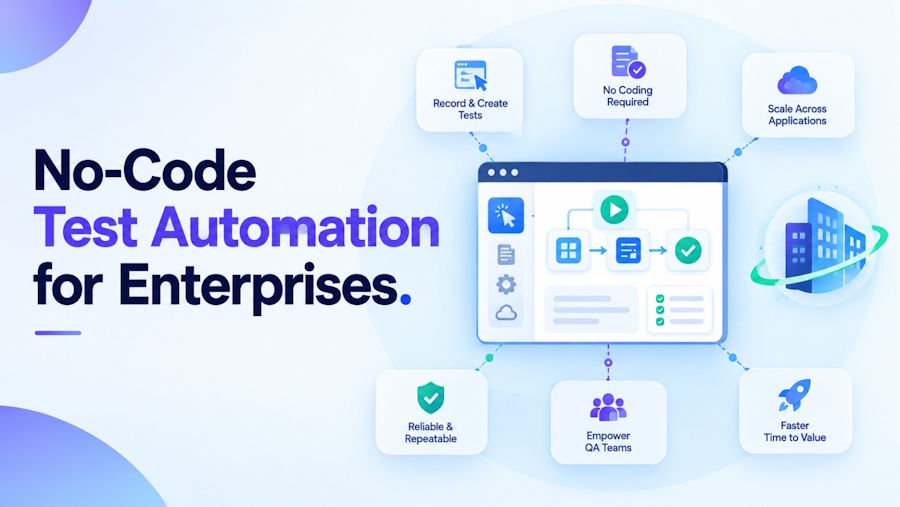
No-code test automation isn't new. Tools have promised "record and playback" since the early 2000s. What is new is that the technology has finally caught up to the marketing.
Modern no-code web testing platforms use AI-powered visual recognition, natural language processing, and self-healing algorithms to interact with applications the way humans do, by understanding what they see, not by scraping underlying code. When a button moves from the header to a sidebar, these tools don't break. They adapt. When a form's CSS classes change, they don't fail. They recognize the functional element and continue.
This shift matters because it fundamentally changes who can build and maintain automated tests. You no longer need a Java engineer to validate a checkout flow. A business analyst who understands the user journey can create the same test in minutes, maintain it without filing a Jira ticket to the automation team, and update it when requirements change.
But web testing was just the beginning. The real disruption is happening where complexity has historically made automation prohibitively expensive.
Mobile Testing Without the Device Lab Nightmare
If web automation is hard, mobile automation is brutal. The fragmentation alone is enough to break most teams: iOS and Android, phones and tablets, emulators and real devices, OS versions that range from current to three years old, and hardware variations that affect everything from touch responsiveness to camera behavior.
Traditional mobile automation requires specialized expertise. You need engineers who understand Xcode, Android Studio, Appium's arcane configuration, and the subtle differences between testing on an emulator versus a physical Samsung Galaxy. Most teams either outsource this work to expensive contractors or skip comprehensive mobile automation entirely, relying on manual testing and hoping for the best.
No-code mobile testing changes the economics completely. Instead of writing platform-specific scripts, teams describe what they want to test, "a new user downloads the app, creates an account, and completes onboarding", and AI agents execute those flows across real devices and OS combinations. The agents handle gestures, permissions, network transitions, and OS-level dialogs without human scripting.
The impact on coverage is dramatic. Teams that previously tested on three or four device configurations can now validate against twenty or thirty. Tests that took days to script take minutes to describe. And because the AI adapts to UI changes, maintenance drops from a constant firefight to a occasional review.
For consumer apps where mobile is the primary revenue channel, this isn't a nice-to-have. It's the difference between shipping with confidence and shipping with prayers.
The Enterprise Frontier: SAP and Legacy Systems
If mobile automation is complex, SAP automation has historically been considered nearly impossible for no-code platforms. SAP systems, whether S/4HANA, ECC, or Business One, don't behave like modern web applications. They rely on proprietary GUI technologies, deeply customized business logic, and transaction codes that vary from one implementation to the next. A script that works in one SAP environment is almost guaranteed to fail in another.
This is why SAP test automation has remained stubbornly expensive. Organizations either rely on manual regression testing (slow, inconsistent, and impossible to scale) or invest in specialized SAP scripting tools that require ABAP knowledge, deep platform expertise, and months of implementation time.
But the same AI advances that made no-code web and mobile testing viable are now cracking the SAP problem. Modern agentic testing platforms don't rely on brittle object repositories or recorded scripts. They understand business processes, "create a purchase order," "run a payment run," "generate a financial report", and execute them by interpreting the SAP interface dynamically.
This matters because SAP changes constantly. Patches, notes, customizations, and upgrades alter screen layouts and transaction flows. Traditional automation breaks with every change. AI-driven SAP test automation adapts, recognizing that the "Save" button moved or that a new mandatory field appeared, and adjusting execution without human intervention.
For enterprises running SAP as their operational backbone, this is transformative. Regression cycles that took weeks can run overnight. Business users who understand the processes can create tests without involving ABAP developers. And CFOs finally see ROI on automation investments that previously consumed budgets without delivering reliability.
Building a Unified No-Code Strategy
If you're evaluating no-code automation for your organization, resist the temptation to solve one problem at a time. The teams that get the most value take a unified approach across their entire application portfolio.
Here's what that looks like in practice:
- Start with your riskiest user journeys, not your easiest. The temptation is to automate simple smoke tests first because they're low-risk. But simple tests are also the least valuable, they catch the fewest bugs and provide the least confidence. Identify the three to five business-critical flows that would cause the most damage if they failed, and automate those across web, mobile, and SAP simultaneously.
- Demand cross-platform consistency. Your users don't experience your product as "web" or "mobile" or "SAP." They experience it as your brand. Choose a no-code platform that can validate end-to-end journeys across all three surfaces, not just one.
- Invest in data, not just tooling. The best automation in the world fails if the test data is thin, unrealistic, or stale. Ensure your no-code platform handles test data generation and lifecycle management automatically. This is especially critical for SAP, where transactional data complexity can make or break an automation initiative.
- Measure escaped defects, not test counts. A thousand automated tests that never catch anything meaningful are worth less than fifty that consistently find real problems before production. Track whether your no-code suite is actually improving quality, not just checking boxes.
- Plan for human oversight. No-code doesn't mean no humans. The most effective implementations use AI agents for execution and exploration, but keep human experts in the loop for strategic validation, edge-case identification, and continuous improvement. The goal is augmentation, not replacement.
Why Developers Should Care
If you're a developer reading this on Our Code World, you might be skeptical. No-code platforms have earned a reputation for generating messy, unmaintainable outputs that engineers eventually have to rewrite. That's a fair concern, and it's why the new generation of no-code testing tools is different.
These aren't drag-and-drop script generators that output spaghetti code. They're AI agents that execute tests autonomously, using the same browsers, devices, and applications that your users do. They don't generate code for you to maintain. They eliminate the need for that code entirely.
For developers, this is liberating. Instead of spending hours debugging flaky XPath selectors or updating Appium configurations, you can focus on building features. The QA team stops filing "automation is broken" tickets. The release pipeline moves faster because testing isn't the bottleneck. And when something does break, the AI provides diagnostic context, screenshots, network logs, reproduction steps, which makes fixing the actual bug faster.
The Bottom Line
The debate about whether no-code testing is "real" automation is over. The question now is whether your organization will adopt it strategically or be forced into it reactively when your competitors ship faster with fewer defects.
No-code web testing has matured. No-code mobile testing has proven itself at scale. And SAP test automation, long considered the final fortress of script-based testing, is finally accessible without ABAP expertise and six-figure consulting engagements.
The teams that win in the next five years won't be the ones with the biggest automation engineering teams. They'll be the ones that democratized testing across their organizations, empowered business users to validate quality, and let AI handle the execution complexity that used to consume half their engineering capacity.
Your users don't care how your tests were built. They care that your product works. It's time to stop letting testing infrastructure get in the way of that goal.
SOFY.AI helps enterprises automate testing across web, mobile, and SAP applications with AI-powered agents that require zero scripting. Explore no-code mobile testing, SAP test automation, and no-code web testing at sofy.ai.

